IMES

IMES

Friday, February 14, 2020

Holly-(UR) Feeling Kind of Crabby!

Last week I had mentioned my interest in testing salinity, temperature, and dissolved oxygen in the blog titled 'Just Testing the Waters'. The main goal of the research was to see if those 3 factors had any correlation with marine life an their sizing. I had no specific marine life in mind, but within the beginning of this week my professor sent a message about crabbing. With further discussion we have agreed to narrow down my research to crabs specifically. Now with my pervious testing examples listed above I am also testing to see if there is any correlation between invasive crabs as well as non- invasive crabs. An invasive species can be defined as "an introduced species that takes over habitat and poses a threat to native ecosystems. Invasive species can harm the local economy or human health" (2008, Science Dictionary). I am having some difficultly identifying native and non-native crab species to the central Florida region. I still need to do further research of both native and non- native crab species.

Native Florida crab species include:
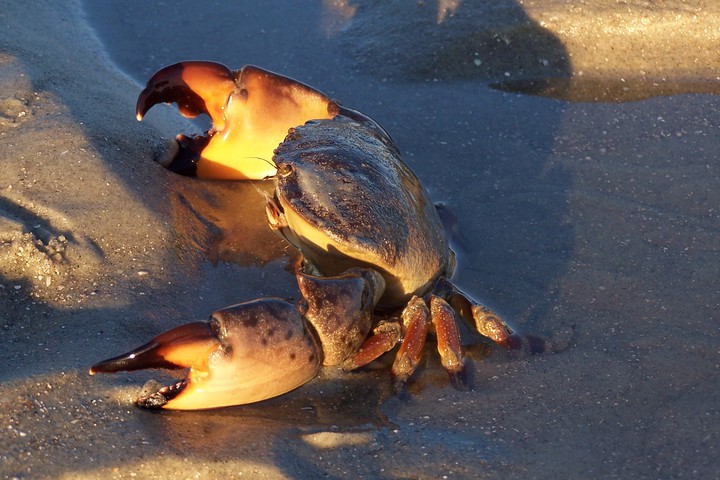
1) Menippidae Menippe mercenaria, Also known as, Florida Stone Crab, (Florida Fish and Wildlife conservation commission).
2) A second species of Stone Crab can also be found in Florida, but I need to further research this species (Florida Fish and Wildlife conservation commission).
3) Portunidea Callinectes sapidus, Also known as, Blue Crab, (2020, FAO Fisheries and Aquaculture- Aquatic Species)

Menippidae Menippe mercenaria
Portunidea Callinectes sapidus

Aside from identification, I have found some information regarding the crab traps. For a Portunidea Callinectes sapidus in particular the maximum trap size can be 2 feet (ft) by 2ft and the mesh (outer layer of the trap) size must be 11.5 inches (inch) or larger. Additionally a total of 3, 2 3/8inch escape rings must be on the trap and a 3inch by 6inch degradable panel (Florida Fish and Wildlife conservation commission).

Example of a standard commercial blue crab trap
Portunidea Callinectes sapidus Crab Trap

Additionally, I do plan on going to the Dunlawton Bridge in Port Orange I had previously mentioned in my last post 'Just Testing the Waters'. I will also be placing a trap in the Spruce Creek Estuary, that way I can have varining sailinity results to compare. An estuary can be defined as a large river that contains both salt and fresh water that meets sea tide (Dictionary.com). I hypothesis that the Dunlawton Bridge will have a higher salinity concentration due to it being located so close to the ocean verus the Estuary becuase of the mixture of freshwater.

Things to take into consideration include:
1) Noise/ Dunlawton Bridge vibrations.
2) The near by Dunlawton Bridge restaurants.
3) Other fishers near by (both locations).
4) If the trap is removed from either location.
5) Tides.
6) Weather.

Sources:
(2008). Science Dictionary. http://www.webquest.hawaii.edu/kahihi/sciencedictionary/I/invasivespecies.php

Florida Fish and Wildlife conservation commission. https://myfwc.com/research/saltwater/crustaceans/stone-crabs/

(2020). FAO Fisheries and Aquaculture- Aquatic Species. http://www.fao.org/fishery/species/2632/en 
http://www.fao.org/fishery/species/2632/en

Florida Fish and Wildlife conservation commission. https://myfwc.com/fishing/saltwater/commercial/blue-crab/

Dictionary.comhttps://www.dictionary.com/browse/estuary

(Menippidae Menippe mercenaria). https://animaldiversity.org/collections/contributors/jo_okeefe/stone_crab_100_5137/medium.jpg

(Portunidea Callinectes sapidus). https://upload.wikimedia.org/wikipedia/commons/9/99/The_Childrens_Museum_of_Indianapolis_-_Atlantic_blue_crab.jpg 


Jenna Fairchild (UR) - Who Needs a Photo-synthesizer Anyway!


Climate change. The leading cause of coral bleaching. A warming planet means a warming ocean, resulting in a change in water temperature. Similar to the way that human's bodies need to stay between the temperatures 91.8-100.8°F in order to function properly, corals also need to maintain the proper temperature to function properly. With an increase of as little as 2 degrees Fahrenheit, coral will drive out their photo-synthesizer algae, bleach, and eventually die. Coral and their zooxanthellae algae component have a symbiotic (mutually beneficial relationship), and one cannot survive without the other. Or can they...?
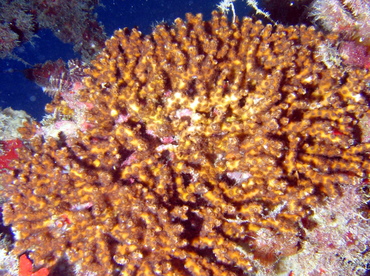
The coral reef ecosystem Oculina is known only off the coast of East Central Florida. This coral exists nowhere else in the world and it is unique among all other corals! Oculina can survive with or without its algae symbiont, identifying it as an azooxanthellae (it lacks symbiotic algae) coral. Additionally, this coral has exceedingly high biodiversity, similar to that of tropical reefs. Not much is known about this coral species since it is only found off the coast of Florida, and because large ivory bushes of this species live at depths that are too deep for recreational divers to visit.

Image result for oculina coral florida
You can tell that zooxanthellae are present here because the algae give the coral this orange color
Oculina are known to live in shallow waters, or up to 350 feet deep! Interestingly enough, the deepwater coral without zooxanthellae grow at a faster rate than the shallow water corals with zooxanthellae (Reed, 2002). Because these deep coral are impossible to visit unless you're a speciality diver, not many people know they exist - making them vulnerable to destruction from trawling and dredging. On the other hand, the shallow water Oculina are at risk of bleaching as a result from climate change because they're dependent on their symbiont algae.
Image result for deepwater oculina coral flordia
The photosynthetic zooxanthellae cannot survive at this deep depth, but the coral and its polyps can! This is an example of azooxanthellae, you can tell by its white color.
This uniqueness, productivity, and vulnerability of Oculina has inspired me to study its nature and presence on the Ponce Inlet jetty in the Indian River Lagoon. My research will focus on the growth, biodiversity, and symbiotic relationship that Oculina has with zooxanthellae. I would like to compare this data with known data about deep water Oculina, Oculina living on artificial reef systems, and also natural reef systems.

My prospective scientific question is two fold: What is the *level of resilience in shallow water Oculina in regards to growth, biodiversity, and symbiosis. How does this compare to Oculina that are growing in deep waters, natural reefs, and artificial reefs?

*This means i'll have to establish a point system for coral that portrays their level of resistance to factors that affect their health, then rate each location of coral residence.


References

Avent, et al. “Deep-Water Oculina Coral Reefs of Florida: Biology, Impacts, and Management.” Hydrobiologia, Kluwer Academic Publishers, 1 Jan. 1977, link.springer.com/article/10.1023/A:1016588901551.

Thursday, February 13, 2020

Ivy Gentry (UR)- The longing question!


My current question is “How much of the temperature of the sand affects the sex of the hatchlings?” as I was doing some more research, I found out some interesting information. “Rainfall is a common environmental variable that may impact development and sex determination.” (Jena, 2017). I knew that the sex was mainly determined by the temperature of the sand, but I did not think about the other factors that are in place. I did not know that the rainfall is one of the other big factors.

Also, with this question, it can lead to even bigger questions like if the temperatures get too cold, we will have an overabundance of male sea turtles. Meaning how much does climate change affect the future of sea turtles? If the temperature increases any more than it already has the populations of sea turtles will be more biased to the female turtle. We are roughly about 1˚ C higher the rate of them being bias would be significantly more.

I also found out a rough estimate of the temperature for female and male turtles. However, with my research project, I want to test and find the best temperature for both male and female hatchlings. I am extremely excited to do this research project!

Some Chelonia mydas (Green Sea Turtle) hatchlings from back in 2018. 
The one lonesome hatchling. 


S., Kristen. “Temperature Effects on Sea Turtle Sex Ratios and the Potential Impact of Climate Change.” National Marine Life Center, 23 Sept. 2011, nmlc.org/2011/09/temperature-effects-on-sea-turtle-sex-ratios-and-the-potential-impact-of-climate-change/.

J, L. (2020). Experimental assessment of the effects of moisture on loggerhead sea turtle hatchling sex ratios. - PubMed - NCBI. [online] Ncbi.nlm.nih.gov. Available at: https://www.ncbi.nlm.nih.gov/pubmed/28764866 [Accessed 14 Feb. 2020].

Alex Mercer (UR) What Is In the Shallows

As we all know, sharks are the apex predators of our oceans. They can be found all over the world in many different environments. However, Ponce Inlet seems to be special. Being labeled the shark attack capital of the world, one in fifty shark attacks in the world occur in our inlet here. Im seeking the answer to what makes this single location so much different than any other inlet, any other coast line, or any environment throughout all of the oceans. What is drawing them to this specific spot, and what species are involved? Shark tagging and conservation is becoming more popular by the day because we are finally realizing how crucial they are to our oceans and ecosystems. The resources and research going into these studies each day is remarkable. I would like to do my own research on Ponce Inlet and attempt to monitor what species are traveling in and out. By constructing a piece of equipment that houses a camera and some type of chum box, it will allow me to place it at any given position and monitor what is lurking in the depths. There will be many limiting factors, but especially the bottom time and length of film that can be utilized. Yes my goal is to monitor the shark species but any other type of fish caught on camera will give insight to the ecosystem and prey that is also in these waters. There are many websites and blogs out there that can help further my research. By using https://www.sharks.org/species and https://www.ocearch.org/tracker/?list I will not only be able to identify the species but also track previously tagged sharks entering the area. 

Lily Lehr (UR) Wrack on the Beach

Blog post options: 1) online search of reputable website(s) useful to your research topic. What is your IRP and scientific question? (be sure to review and correctly cite it).

At this point my question is, "How is the Wrack on the Beach Affected by Micro-Plastics?" To gain future and fundamental information I researched how this wrack affects our environment. "Biologists found that about 40% of the invertebrate species living on sandy beaches depend on wrack." () With it being a connection between the ocean and the shore many animals depend on for food and shelter. As the fish and birds eat the wrack on the beach plastic gets put in the food chain. Micro-Plastics get ate by humans, whales, sharks, etc,. With all of these creature eating plastic and getting it into their bloodline how is it affecting our health. (Sarah Gibbens, National Geographic). It is important to question how this will affect the future of human immune systems as well as a Floridian's natural surroundings of oceans and gulfs.

I found multiple sites when researching this topic, when individually looking into beach wrack I found the site for the Palm Beach County Board of County Commissioners Environmental Resources Management that raises awareness about beach wrack. They made the point of stating that taking the wrack can create an imbalance in the beach/dune ecosystem and that taking it harms all the animals that use it for food, shelter, and overall protection. Another site was called "Explore Beaches" they are a research team in California. Through them I found "Loss of Coastal Strand Habitat in Southern California: The Role of Beach Grooming." Which is where I learned more about native plant abundance depending on these wracks. 


Hale, B. (2017, March 15). Sarah Gibbens. Retrieved February 12, 2020, from https://www.nationalgeographic.com/contributors/g/sarah-gibbens/

Dugan, J.E. & Hubbard, D.M. Estuaries and Coasts (2010) 33: 67. https://doi.org/10.1007/s12237-009-9239-8
https://discover.pbcgov.org/erm/Publications/BeachFactSheet.pdf

University of California, Santa Barbara
Santa Barbara, CA 93106University of California, Santa Barbara
Santa Barbara, CA 93106University of California, SantaUniversity of California, Santa Barbara
Santa Barbara, CA 93106University of California, Santa Barbara
Santa Barbara, CA 9310Santa Barbara, CA 93106

Friday, February 7, 2020

Ame Teaderman (UR) - Extra Tidbits and Research Topics

I've said a fair bit in my previous post about myself, but I feel that more needs to be said before I dive into the research aspect of things. Despite my scientific drive, I actually wound up on the Environmental Science and Technology (EST) program by spur of the moment decisions and perhaps a bit of luck. I'm inspired by many things both in science and art, and while that lends me the ability to be more creative and varied in my knowledge pool, it also makes it exceedingly hard to make decisions on life-changing career choices, especially in college majors and degrees, which often at first glance lend themselves to specialization, rather than branching out. So while sitting in front of the advisor anxiously, not having a single clue what degree or major to even consider pursuing, I made a best guess at what I would like, and picked the EST program. It was probably one of the most nerve-wracking moments of my life! Thankfully since then I've found more grounding in what I would like to learn and do with my time here, which leads to the potential research topics.

As I've mentioned in my previous blog post, I'm most fond of seabirds and particular flora, though that fondness certainly extends to other wildlife as well. While the upcoming research project I'll be doing needs to involve water quality in some form, rather than just testing the water by itself in different locations, I've been given a pretty cool opportunity to study something else.
Crabs! (Photo by Jules Thomas)
That's right. Crabs. I haven't had a chance to do too much reading into them yet, but from what I have looked into, blue crabs and stone crabs are likely what we're going to see a lot of down here in Florida, and so far it looks like the research project will be tuned to catching and releasing them after collecting data. Which is rather exciting! I'm going to go get some shut eye however, but expect more research soon, and see you next week!

Source: Thomas, J. (2019, Nov. 13). [Photo of many Blue Crabs]. Unsplash. https://unsplash.com/photos/vM1Lz1ftMU8.

Thursday, February 6, 2020

Ivy Gentry (UR)- Following my dreams!


I was roughly seven years old when I decided I wanted to do something in the science field. I knew it was going to take a lot of schooling to do, but I was completely prepared for that. My family and I had always come down to Daytona Beach every year for vacation, due to that my love for the ocean just kept growing and growing. I have always loved the ocean and the animals in the ocean. My favorite animal has always been sea turtles. As a kid, I was always in the water trying to see what laid beneath the ocean surface.

When we moved, I knew I wanted to volunteer at the Marine Science Center; however, you must be sixteen in order to volunteer. I was only twelve at the time we moved but that didn’t stop me from turning to volunteer, I went to the Marine Science Center every weekend in order to learn more about animals. Once I turned sixteen, I was already down to volunteer. This helped me really find the area I would love to work with. Even though you can not volunteer in the turtle deportment until you are eighteen, I still got a lot of insight on what all happens and what they do to help the turtles to release them.

The Marine Science Center along with all my science teachers in school really inspired me to become a Marine Scientist. I honestly do not think I would be following through with this dream if it wasn’t from my amazing teachers in high school, and the educators at the Marine Science Center.

I am excited about my independent research project! I am looking at studying to see how much the temperature of the sand affects the sex of sea turtle hatchings. I have been curious about this topic for a few years now, so I am extremely excited to be able to do this research and be able to come out with an answer!


This was my first day of volunteering! 


This was taken on Turtle Days at the Marine Science Center. I was helping with Turtle Triage in 2017. 


My friend and sister and I having fun in the waves on vacation in 2009. 

Lily Lehr (UR): See the line where the sky meets the sea? It calls me.


     Ok, no that line does not call me, at least physically. When I am with my family at the beach I much rather go back to the pool. My dad always says the ocean is cleaner than the pool. When I was younger we went to the ocean in Hawaii, and I got stuck on a sandbar, it was in the middle of a stingray migration (probably not so close to shore, but there were about five of them) and multiple swam right by me. I was about four, but I remember them being close so I froze in fear. My dad ran to me and carried me back to shore, as exciting as the experience would be now at the time it was petrifying, and mentally scarred me.
     My connection to the environment is strong. I treat it as something that is its own very powerful force that needs my effort and attention, but not something I need to spend every second in it for me to be connected. I tell my cousins when they come down to Florida that, "Some people are worth dying for," in the ocean. Yes, Olaf said that too, but we learn from these new movies important lessons.
    I know how to and participate in many ocean and water activities. My favorite books are underwater science fiction and movies deal with creatures under the sea. It's a weird love, but if the hearts are connected no distance will stop it. I chose Environmental Sciences, might change to Oceanography, but I'm still figuring that out because how indirectly it does the ocean calls me. The ocean inspires me because its depths are uncharted, but it shows welcoming features. It shows you its dangers as you walk into it, yet it holds the hearts and homes of an extensive variety of species.
    My IRP was always going to be about protecting the Earth based on either plastics or a new way of getting paper and benefits from other plants versus trees. I am seriously debating micro-plastics. Micro-Plastics are in the water we drink, the animals we eat, the dirt and ocean we play in. The creatures of the ocean do not deserve the effects humans have thrown at them. Recently, I watched this video about whales, in this video they did a project on deceased beach whales. Obviously the ones they could save they did, but some of these whales had thousands of plastic bags in their stomachs. I remember them saying about fifty pounds!!! Pounds, with a plastic bag being a couple ounces this is an intense discovery. I understand that the plastic bags are macro-plastics, but if we have a numerous amount of whales, turtles, birds, dolphins dying because of the larger versions how drastic will the measures be when we truly understand what the micro plastics are doing to us.

1) why did you choose your
field? What about it motivates or inspires you?
What do you care about? What do you think
your IRP might be abo

Alex Mercer (UR): Hands On

The first time I went to the beach I was 16 days old. Unknowingly then, it would become the place I fell in love with. On that 4th of July when I was only two weeks old, I saw my first shark (no I don't remember), but it was the start of a passion that I would carry with me for the rest of my life. For as long as I can remember the ocean has called to me and I knew that it would be a forever passion of mine. I knew that I not only had to live around it but I needed to work around it.

For over half my life I have worked with my hands, every job I've ever had, they were my tools. I was good at it, I had a natural ability to build and fix things. Growing up it was my dream job to build boats, I was obsessed with it. So after I got out of the military I decided to pursue that dream job and I landed it. I started building sport fishing yachts for Jarrett Bay Boatworks. I loved every second of it but it just wasn't enough. Thats when I decided I needed to take it a step further. I had built the boats, but now I wanted to design them. So I started to seek out degrees that would allow me to do that and I came across Ocean Engineering. I realized the vast number of opportunities that this degree path could open up for me. It will fulfill my dream to design boat hulls like I had originally planned or open up other opportunities such as working along sing scientists to design equipment they could use for shark research.

For my research project I would like to investigate the shark population and species of the shark bite capital of the world, which happens to be right in our back yard at Ponce Inlet. I want to know the "whys" of this location, what is drawing them here? What makes this tiny segment of the ocean so much more dangerous than anywhere in the world? With an ocean engineering degree I'll be able to combine my passions of the ocean, and working with my hands together. They say if you love what you do you'll never work a day in your life and thats what I'm after.

A rendering of a flats skiff I designed on the computer. 
Planking on the side of Jarrett Bay Hull #64.
This was the boat I helped build and is still under construction.


Monday, February 3, 2020

Jenna Fairchild (UR) - From Midwest Girl to Surfer Girl

Going right at Ponce Inlet
Here it comes. The peak of the wave is heading in my direction. I paddle in and I paddle right at the same time to line up with the part of the wave that has the most energy. I paddle once, paddle twice, then I push up on the rails of my hand shaped board to stand as the wave pushes me forward. I lean back to keep my balance and glide down the face of the glassy blue wave. I use my back foot to snake my board back and forth with the energy of the whitewash. There is nothing like dancing with a wave right before it crashes and ceases to exist. It is an intimate experience to be part of the last moment of that wave's life.

I grew up surrounded by corn fields and woods, persevering through long, dark, and cold winters. When I moved to Florida at 15 years old, I was fascinated by anything to do with the ocean. I picked up hobbies that immediately helped me understand the nature of its character even more. Surfing taught me that the ocean can be peaceful and calm, inviting and therapeutic. On other days, surfing forced me to recognize the oceans strength, unpredictability, unforgiving nature and more than anything - its mystery. I am intrigued by the contradiction of the ocean, the mystery behind its character, and also its ability to humbly control everything on land. With humility, and hidden beneath the salty water, the ocean controls climate, plant life on land, and also temperature and storms. Fascinating! And everything in life depends on this reservoir of mystery. I chose Oceanography/marine science as my field because there is a lifetime of research, learning, and protecting to do with the ocean. I am eager to learn for the rest of life and use that knowledge to protect the ocean, which gives me life - literally.
Welcoming the ocean's strength and mystery on the Ponce Jetty

More specifically, I am inspired by the perfect activities that innately happen under water for life to happen on Earth. For example, the balance of the chemistry in the water, the photosynthetic organisms zooxanthellae in coral, and the symbiotic relationship between coral and that algal component zooxanthellae. The ocean is 71% of our Earth! Don't you want to know what is going on down there? I do. With this being said, I think my research topic will be the local coral, Oculina varicosa. This coral is special because it can live with or without zooxanthellae. I want to focus my research on that interesting characteristic of this coral, and possibly use in vitro fertilization to experiment with the genes of less resistant coral from climate change. Ultimately, I would be helping the coral to adapt at a faster rate by forcing it to.

Sincerely,
Jenna Fairchild

Friday, January 31, 2020

Ivey (UR)--Just a little get to know me!


Hello Everyone!

I would love to start out by introducing myself my name is Ivy Gentry and I am 19 years old. I am currently going for a major in Marine Science or Marine Biology. I love the ocean more than most things in the world. My favorite animal are sea turtles, I even have a watercolored sea turtle tattoo. I care greatly about the environment. I have done many volunteer hours at the Marine Science Center in Ponce Inlet. I have worked with sea turtles, string rays, many invertebrates, sharks and even with two different types of snakes one pine snake and a corn snake. My favorite animal to work with would have to be the stingrays. I got to help the guest feed and pet the sting rays correctly. As a volunteer, I have also been able to help with some of the turtle releases over the years.

In high school, I was also part of the AEMS academy which stands for Agriculture, Environmental, and Marine Science. With being a part of this academy, I was able to be in a marine science class where I got to take care of a shark, an eel, and a blue triggerfish. I was also able to participate in an aquaculture class during my senior year, in this class, I had to pick a species of fish to try and breed by the end of the year; however, with getting out of school earlier I was not able to see if they did breed. I also got to participate in many different field trips, like the ShORE event, Marine Science Center, etc. Ever since I was roughly seven-year-old I have wanted to be a marine biologist but just recently I have decided to move over into Marine Science to be able to do more with the environment and be able to work more in the ocean not just the biology of the sea animals.

Other than just school and science I really enjoy spending time with my family and friends. There many different things I enjoy doing with family and the main one would have to be going to Disney World. I am a huge Disney fan and have been to Disney World many times. I love taking pictures of different things from plants to pictures of my friends and family. I also enjoy going to the beach with friends, while on the beach I tend to walk and pick up any trash that I see.

This was my first tattoo! 

This is a picture that I took on my phone during the firework show.

Meeting Stitch at Magic Kingdom!


Whitney M. (UR) : This is just the beginning!

Hey! My name is Whitney. I am currently enrolled in the Marine Science Track. With a split goal of majoring in Oceanography (Biological) and Ocean Engineering. Originally from Ohio, raised barefoot, climbing trees and exploring forests in different states across the U.S.. From influences working on farms, in Veterinary offices and Automotive Shops I chose a path working as a Diesel Mechanic for a construction company. Throughout my time I spent most of my days in my bay working on loaders, semis and dump trucks. Being around this environment conflicted with my values as I have always had a passion for the nourishment and love of nature. I wanted to change the way I impacted the world an steer others in the right direction as well. Exploring my options in finding a balance I found inspiration in books, podcasts and educational talks. This decision did not come easy as I have only just met the ocean a few years ago and my understanding of its ways is still unfamiliar. I think in finding a path we love and can thrive in we need to find something that challenges us and combining my love for organisms and my fear of anything unpredictable. I look forward to the journey this semester, and the challenges I will face. This is only the beginning!
Bike Week Daytona Beach, FL

Shelling in Marineland, FL

Studying local birds in Ponce Inlet, FL


Thursday, January 30, 2020

Alex Mercer (UR): Getting My Feet Wet

Hey everyone! 


My name is Alex Mercer. I’m a new member of the Oceanography Lab at Daytona State College. Originally from North Carolina and now here in Florida, I have always been around the water. I’m a Navy veteran who is now pursuing my degree in Ocean Engineering. Since I was a child, I've been fascinated by the ocean and all it has to offer and explore. I got certified as a rescue diver in Guantanamo Bay, Cuba. However, I prefer to free dive and spearfish. On the weekends you can always find me at the beach surfing, fishing, or painting marine life with acrylicsSharks have always been a huge interest of mine and I love diving with them and spending time in their environment, so shark conservation and tracking is something I’m very passionate about. I look forward to all the research and information I will be learning throughout this semester and I know I have a great team behind me to help me out and get my feet wet!


Free diving through a cave in Cuba.
Catching a wave at Ponce Inlet.


Swimming with sharks in Belize.


One of my favorite pieces I did in acrylic.


Holly-Noel (UR)- Just Testing the Water

I have always enjoyed going fishing with my family when I was younger, especially if it was salt water fishing. There would be some nights we would catch a variety of marine life, while others we would be lucky if we got a single bite. Now that I am older, I have begun to wonder why this maybe. For the research project I have brainstormed various ideas on how to incorporate this question.

Hammer Head Shark
Dunlawton Ave
Stingray
Dunlawton Ave
2016 Fishing Trip
Dunlawton Ave
 A question I have formed while brainstorming is, does the salinity, temperature, and dissolved oxygen levels of the water effect the abundance of marine life or their sizing?
In order to gather more information I could go to two locations; the Daytona Beach pier and of a bridge on 93 Dunlawton Ave, Port Orange. I would travel to these locations for the same amount of time during various mornings, nights, and afternoons to test the water salinity, temperature, and dissolved oxygen levels. I would like to also go out right after it rains for further testing. With this information I would begin to fish for a set amount of time while noting the various marine life I catch as well as there sizes. 
View of Dunlawton Ave Bridge
Underside of the Daytona Beach Pier
I hypothesis that the pier will have a higher salinity concentration and possibly cooler temperature due to being off the coast versus the more inland and possibly less salinity based and warmer location of the Dunlawton bridge. Also I will be able to collect data from the same types of marine life at both locations. At the Daytona Beach Pier I do have to take in account for noise as well as the guest possibly dropping food from the restaurants near by. At the Dunlawton bridge I will also have to keep in mind noise/ road vibrations from traffic as well as guest possible dropping food from the near by restaurants.

Ame Teaderman (UR) - A New Player has Entered the Match!

Greetings!

My name is Ame Teaderman, and I am a trans guy who is eagerly working towards finishing my Associative Science degree for Environmental Science and Technology in Daytona State College. Coming from a background immersed in science and the arts, I'm always interested in seeing the two connect in my everyday life, especially now that I have a growing fondness for the environment. When I'm not out and about observing nature, studying, or socializing on the rare occasion, I'm playing video games, hence the title. But more importantly, I'm also taking part in recreational writing and art, while using research to fuel my interests further and add weight to my words.
Enjoying the attractions at Disney's Animal Kingdom Theme Park.
Originating in Ohio, I moved down to Florida just before high school, and have travelled to various locations near and far, from the various state parks right here in Florida, to other places like Pennsylvania, Virginia, New York, Washington DC, and Niagra Falls. I've even travelled out of the country a handful of times to visit family for a month out in Ukraine, and the rural, quiet scenery there really seeded my love and curiosity for the life around me. Since then, all of my experiences thus far have only served to fuel my love and various interests in nature, which currently include seabirds and various flora, but also encompass a wide variety of other wildlife, and the conditions they need to survive. It is my hope that this blog, and all of the opportunities I've had here in Daytona State College, will give me the start I need to find my place in the scientific community, and make a difference in whatever way I can. Until then, see you next week!

Saturday, January 25, 2020

Jenna Fairchild (UR) - Translating My Love for the Ocean

Hello everyone!

My name is Jenna Jay Fairchild and I would like to introduce myself as a new member of the Oceanography lab at Daytona State College. After completing a year long conservation marketing internship with Costa Del Mar in the last year of my undergraduate degree, I fell in love with conservation and wanted to pursue a marine science graduate degree. In order to apply to a graduate program, I am gaining course credentials and research experience at DSC. 2020 will be a BIG year for me!

Most everything I love to do is centered around the ocean. I am an open-water diver who loves to adventure around Florida springs and caverns (see image below). I am a local surfer at Ponce Inlet who sees surfing as a way to be one with the ocean while riding along with the energy of a wave. I enjoy learning classic rock songs on my guitar and harmonica. And lastly, I find solitude by translating my love for the ocean through artwork of all sorts (see below).

As of right now, I am leaning in the direction of studying artificial reefs alongside Volusia County's Reef Research Dive Team for the Oceanography Lab. I can't wait to learn alongside everyone!

Groovy surfer piece I wood burned and enhanced with acrylics

Diving in The Ballroom at Ginnie Springs
Sincerely,
Jenna Fairchild
Jenna_fairchild@daytonastate.edu

Thursday, January 23, 2020

Holly-Noel (UR)--the Beginning of a Tree Huggers Dream!

Hello reader, my name is Holly-Noel Monroe and I am currently enrolled in the Daytona State College Environmental Science and Technology program, while also working towards my Associates and Arts degree in Wild Life and Ecology Conservation. I have always lived in Florida, but I have traveled and experienced many wonderful environmental sites. Like these top two photos for example were taken in New York state parks. As you can see I also really love photographing trees and also taking photos hugging them as an ongoing family joke.
Hugging a tree in New York State Park


Do you remember being a graduating high school student and being asked "What do you want to do career wise?" countless times? You may have had an answer or maybe you did not, like me. I honestly was unsure of what path would suit me, but then one day I realized. Luckily, through volunteer service on a local horse farm I was given the inspiration to persue a higher education in environmental sciences. It has always been a childhood dream of mine to make a difference in the science community and work for a zoo. This research blog here will be that stepping stone to an excellent future career. I look forward to blogging my research further soon!

Thursday, October 31, 2019

Andrew Hardwick- (CUR)


Alrighty then, boys and girls. buckle up cause I have two more devises that we can observe for Blue Energy:

First up is the Rotating Mass WEC (Wave Energy Converter): the basic principle is fairly simple. you have a hollow mass with a rounded bottom that has a heavier mass inside it that is attached to a vertical axle. The device is tipped over to and fro by the waves that causes the mass inside to rotate the axle, this rotation is then converted into usable energy. easy peasy. The difficult part is trying to find any amount of useful information about it other than basic concepts. Luckily the Finnish have me somewhat covered on this. Back in 2013, the Finnish company Wello Ltd. deployed such a device in Orkney, Scotland. This device had a maximum output of  300-700Kw and was able to take on waves up to 12 meters (when converted from the European's strange metric ways, that would work out to 39 feet, 4 inches). In the test, it was able to operate in waters as deep as 60 meters. keep in mind that the average water depth around the Florida Peninsula is around 50 meters. As seen on the map below.
With this being a primary model, there is much room for improvement in the second model, which is currently rated for a full Megawatt!

Image result for topographic map of florida peninsula


Now the second one is a bit trickier to wrap your head around: the Submerged Pressure Differential WEC. The concept behind this device is that as waves pass by, there is a change in pressure under the water's surface. this change in pressure can be used to drive a submerged mass or two up and down. This mechanical energy can then be converted to usable energy. think of it as a submerged point absorber. But the leading model for this method would be the mWave device developed by Bombora, a company founded in Australia. With this design (which resemble more of an attenuater design), it has the potential to be the most powerful WEC in the world at 1.5Mw. It is also the most well-funded, and the most well developed. Bombora is supposed to deploy their first full-scale model sometime early next year in 2020. It consists of a frame-like structure that is sealed with industrial rubber membranes around an air pocket. As waves pass over it, the pressure from those waves compress the rubber membranes which forces air through a unidirectional  pipe. this air turns a turbine which is directly converted to energy.

---------------------------------------------------------------------------------------------------------------------

Why did the Witch's baseball team lose?

their bats flew away.