
Climate change. The leading cause of coral bleaching. A warming planet means a warming ocean, resulting in a change in water temperature. Similar to the way that human's bodies need to stay between the temperatures 91.8-100.8°F in order to function properly, corals also need to maintain the proper temperature to function properly. With an increase of as little as 2 degrees Fahrenheit, coral will drive out their photo-synthesizer algae, bleach, and eventually die. Coral and their zooxanthellae algae component have a symbiotic (mutually beneficial relationship), and one cannot survive without the other. Or can they...?
The coral reef ecosystem Oculina is known only off the coast of East Central Florida. This coral exists nowhere else in the world and it is unique among all other corals! Oculina can survive with or without its algae symbiont, identifying it as an azooxanthellae (it lacks symbiotic algae) coral. Additionally, this coral has exceedingly high biodiversity, similar to that of tropical reefs. Not much is known about this coral species since it is only found off the coast of Florida, and because large ivory bushes of this species live at depths that are too deep for recreational divers to visit.
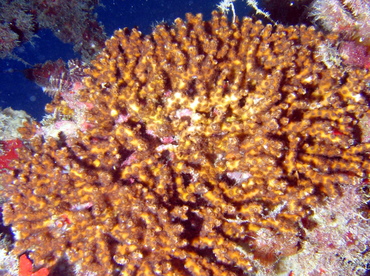 |
| You can tell that zooxanthellae are present here because the algae give the coral this orange color |
 |
| The photosynthetic zooxanthellae cannot survive at this deep depth, but the coral and its polyps can! This is an example of azooxanthellae, you can tell by its white color. |
My prospective scientific question is two fold: What is the *level of resilience in shallow water Oculina in regards to growth, biodiversity, and symbiosis. How does this compare to Oculina that are growing in deep waters, natural reefs, and artificial reefs?
*This means i'll have to establish a point system for coral that portrays their level of resistance to factors that affect their health, then rate each location of coral residence.
References
Avent, et al. “Deep-Water Oculina Coral Reefs of Florida: Biology, Impacts, and Management.” Hydrobiologia, Kluwer Academic Publishers, 1 Jan. 1977, link.springer.com/article/10.1023/A:1016588901551.

Jenna--first, excellent post! About your scientific question--how do you propose to answer the question about their level of resistance?--what materials/methods are used to do this?
ReplyDelete
ReplyDeleteI think I need to form a new scientific question based off the data I’m interested in collecting over a period of time as shown below.
I will test the resilience of coral growth on Jetties by: 3D photogrammetry. This is a software that turns photos and videos into 3D models of the subject. The volume and surface area can also be given from the model. An example of a 3D photogrammetry software is Agisoft. I’ve already contacted three companies, and I’m waiting to hear back about a discount for students/educational programs. Is this something that DSC would fund for one year?
*I will photograph the coral once a month from April-September 2020 in order to obtain the volume and surface area. Since not much is known about this species, this could be awesome data to collect specific to growth on a jetty!
I will test the biodiversity of the coral by documenting fish identification (I can make a video on my GoPro!)
I will test the symbiotic relationship of the coral by – I was thinking that I could do this by testing the density of the coral but I’m afraid that may be too advanced for me, and it might be best that I focus more on the 3D modeling that will determine growth of this unique coral on the jetty! So monitoring the symbiotic relationship is out of my Scientific question.
Additional monthly measurements that I’ll gather:
Skeletal growth - The skeletal growth of corals consists of two distinct processes: extension (upward growth) and densification (lateral thickening). I THINK I can measure this by hand with a ruler for upward growth, and for lateral thickening I am not sure yet.
Water salinity – Using the refractometer
Sea level - I remember you saying that Volusia County has an instrument off our coast right now measuring the water level. In regards to coral, sea level rise may lead to increases in sedimentation for reefs located near land-based sources of sediment, so sea level would be cool to include.
Turbidity – Using the HACH instrument 2100 N turbidimeter This measurement has been included in some academic articles I’ve read about coral, this number will give readers a visual of the environment the coral is in – especially since a tool I’m using is SCUBA.
PH - A pH range between 8.4 and 7.7 is experienced daily in thriving coral reefs, that range appears to be an optimal balance that supports both photosynthesis and calcification. I can take a pH measurement with pH paper.
SCUBA – This is a tool I’ll be using to gather my data on the Pone Inlet jetty.
Jenna--I'm looking into your software question; I'm simply not sure. I would suggest that for your first research experience and scientific question, keep it concise. This will give you more time to accommodate for the many unexpected challenges that always accompany scientific research, and you don't have a whole lot of time! You can add to your research with time...
Delete