IMES

IMES

Friday, February 28, 2020

Ivy Gentry (UR)- The Hatchling


Hi Everyone!

I am furthering my research on how much of the temperature of the sand affects the sex of the hatchlings as my scientific question. However, I am working with a previous student to further this study. I have not been able to meet up with her to discuss the methods and materials needed; however, I have been able to look at the poster that she had made. I want to complete her project and possibly adding in some ideas she has not thought about. I am excited to be able to further this interest between both of us and see if we can come to a result.

Kemps Ridley Sea Turtle 
However, while I was looking over Allie’s poster, I noticed she was doing Loggerhead Turtles. Whereas I was looking at doing mine over Green Turtles or Kemps Ridley’s only because Greens genuinely tend to nest on the beaches of Daytona Beach, and for Kemps Ridley’s because they are the smallest type of Sea Turtles. Although we are going to be going off the NSB, it might just be easier to go off their most common sea turtle to their beaches.

Materials:
Green Sea Turtle 
  •         Sand Collector
  •       Temperature Sensor

This are the ones I know for sure considering that my project it mainly over the temperature of the sand.

Methods, I am not completely sure about how to go forward since I have not been able to meet with Allie to see and learn how she is going about checking the temperature of the sand. I should know within this upcoming week.

I am truly excited to be working with Allie and to test the Scientific Question “How much of the temperature of the sand affects the sex of the hatchlings?”


Sources:


Limbo, Gumbo. “Green Sea Turtle.” Gumbo Limbo Nature Center, 2019, www.gumbolimbo.org/Green-Sea-Turtle.

“Temperature Effects on Sea Turtle Sex Ratios and the Potential Impact of Climate Change.” National Marine Life Center, 2015, nmlc.org/2011/09/temperature-effects-on-sea-turtle-sex-ratios-and-the-potential-impact-of-climate-change/.

Thursday, February 27, 2020

Holly Monroe (UR) -Testing Water Samples!

Last week I mentioned the different key components of what a crab trap must have, but this week I am going to speak upon how to take water samples and what they could mean. The kit I am going to use for testing is the LaMotte Green Low- Cost Estuary Monitoring Kit (1). This kit is a nonhazardous way to test the salinity of brackish waters found in an estuary. Brackish waters consist of waters that have a high salinity, but not as high as the ocean. Brackish water may also cause salt water and fresh waters to mix, forming an estuary. The oceans salinity level is usually around 35ppt (parts per thousand).
Spruce Creek Brackish Water

Testing Kit

Included in the kit:
1) Manual with diagrammed instructions.
2) Laminated color chart.
3) Apparatus.
4) TesTab reagents.

Tests Included in the Kit:
1) Coliform bacteria (2 test samples).
2) Salinity.
3) Dissolved Oxygen.
4) Nitrate.
5) pH.
6) Phosphate.
7) Temperature.
8) Turbidity.

As mentioned in previous posts I have mentioned testing the salinity the most. The importance to testing the salinity between my two locations could have a strong impact of the crabs preferred locations. Through research I have found that adult male blue crabs prefer low-salinity waters up-stream versus their female counter part that likes higher-salinity closer to an estuary mouth (2).  The dissolved Oxygen test will provide me with how much Oxygen is in my two locations. As for Nitrate it is composed of Oxygen and Nitrogen. Nitrogen is an important component of plant life, but to much Nitrogen can cause issues. The pH test will indicate if the water is Acidic, Alkaline, or neutral on a scale of 0-14, as seen below.
pH scale (3)
For Phosphate, much like Nitrate it is important for plant life but to much can cause issues. Temperature is another important test because certain crabs may like certain temperatures.
Turbidity tests how cloudy the water maybe. Recently in lab I had taken a sample from Spruce Creek to test the turbidity and salinity, both came out with surprising results. I had made an error previously when testing turbidity which could have caused my end result. As for salinity my result came out to 11ppt. This was shockingly low for it to be estuary water, but it could have rained previously before i collected my sample, skewing my result. Which both of these will be taken into consideration when testing in the field.

Sources:
(Fisher Scientific).Retrieved from https://www.fishersci.com/shop/products/green-low-cost-estuary-monitoring-kit/s65403#?keyword=591120 

(2020). Adaptions of Blue Crabs. Retrieved from https://oceanservice.noaa.gov/education/kits/estuaries/media/supp_estuar07b_crab.html

Tara, L. [TaraLee]. (2019, January 2). How to raise and lower pH level of cosmetics l I TaraLee [Video file]. Retrieved from https://www.youtube.com/watch?v=jMVg4n4u7uU


Tuesday, February 25, 2020

Jenna Fairchild (UR) - These Coral Enthusiasts Ventured 300 ft Under Water!

Oculina varicosa, a native species to eastern Florida, is important to the biodiversity and functioning of the underwater world - but there is still much to learn about this unique species. Oculina (varicosa) form natural structures in deep water (70-100 m) and they also inhabit shallow-water limestone ledges.

Deepwater Oculina consist of many pinnacles and ridges, 3-35 m in height, with average growth rates of 16.1 mm yr^-1 and rich biodiversity similar to that of tropical reefs (Reed, 2002). Extensive areas of Oculina rubble may be caused by humans from fishing, dredging, anchoring, and bottom longlines. The combination of human induced destruction and natural causes like bioerosion have made a clear distinction between what was once an environment teeming with life, to evidence of a decline in reef fish such as grouper and snapper.
Follow this link to watch these two researchers go down 300 ft to document deep water Oculina!
https://vosslab.weebly.com/news/baseline-explorer-sub-dives
Much less is known about shallow-water Oculina, this is likely due to the fact that deepwater Oculina are azooxanthellae, meaning that they lack symbiotic algae. This makes deep water Oculina an intriguing coral to study - but what about shallow water Oculina? Can they survive in shallow water without zooxanthellae, making them resistant to coral bleaching from climate change? Can these coral resist coral diseases because of their high tolerance of turbidity, sedimentation, temperatures, and salinity? In order to find out the answer to these scientific questions about a very important, but rare species, we must first have a scope of where shallow water Oculina like to live, where they thrive most, and how they grow in different shallow water environments.

This spring I will be laying the foundation of what will be a long-term study of Oculina varicosa. By collecting background data and identifying gaps in knowledge of shallow water Oculina, I will be teaching people why Oculina is a species to keep an eye out for. The rational of my study will be to gather information about a species we know little about in order to protect a local species that has a high tolerance to environmental and human induced factors that otherwise cause coral to die off. In order to do this, we must first understand the habits of these coral.

I will be using my GoPro to take photos of coral colonies on the Ponce Inlet jetty and compare these photos to coral colonies living in the estuary (I have reached out to Mike McCue, coral expert at the MSC for coordinates to locate Oculina). I will use the PVC half meter square pipe as a tool to show scale of the colonies - this should be big enough since shallow water Oculina grow in small colonies. The PVC square pipe will also have tick marks representing centimeters in order to scale colony size. With this information, we will be able to have an idea of where Oculina prefer to live in Ponce Inlet and their growing habits at each site.

My scientific question is: What are the growing habits and formations of shallow water Oculina coral in Ponce Inlet, Florida? 

My objectives for this research are to locate and document Oculina in Ponce Inlet, Florida because they're an important species to monitor and understand in order to protect our local reefs. 


References

John K. Reed. Deep-water Oculina coral reefs of Florida: biology, impacts, and management. 2002

Sandra Brooke, Craig M. Young. Reproductive ecology of a deep-water scleractinian coral, Oculina      varicosa, from the southeast Florida shelf. January 7, 2003.

Monday, February 24, 2020

Ame Teaderman (UR) - Crab-tastic News!

Hello readers!

Diving right into the details, I'll be collaborating with Holly-Noel, another researcher who runs a blog here for this class. Since our topics align with crab capturing and invasive species, we'll be working together to create a project with a larger pool of data, which means we'll have more locations and more information to work with!
Party Crab!
In addition to this, I'd also like to give a huge shout out to Dr. Crowley! She has sent an incredible amount of information about blue crabs my way, from field data sheets and lab manual diagrams for reference, to a whopping three hundred and thirteen page document about blue crabs in the Gulf of Mexico! Needless to say, this has immensely helped me with my crab research by giving me a better idea of what data I should collect while catching crabs, how to identify the anatomy and health of blue crabs, how to identify and estimate when blue crabs are molting, and what environments I can expect to find these crabs. All in all, I'd like to thank her for the huge help, and I plan to use this data with other research to put together methods and materials next week!

References:
heytvm. (n.d.). Party Crab GIF. Tenor. https://tenor.com/view/party-crab-happy-crab-crab-dancing-hey-tvm-gif-13915961.

Thursday, February 20, 2020

Jenna Fairchild (UR) - It Looks Like I'll be Diving This Semester!

The ivory bush coral, Oculina varicosa, is often found in interesting habitats. This coral has a high tolerance to high sedimentation, marginal temperatures, salinity, and turbidity. This characteristic allows Oculina to survive in coastal inlets and lagoons. Interestingly enough, though, this coral can only be found off the coast of East Central Florida. Ponce Inlet, Florida is just south of Daytona Beach, Florida and it is known to be a habitat for shallow water Oculina. I am researching this shallow water coral for a few reasons:

  • Oculina is known to have high biodiversity, similar to that of tropical reefs
  • Not much information is known about Oculina since it is only found in East Central Florida, and they can live up to depths of 1000 meters, which is deeper than the recreational diver's limit
  • Oculina are extremely resistant to climate change because of their ability to survive without zooxanthellae and their high tolerance to sedimentation, turbidity, temperatures, and salinity
I will be researching the levels of tolerance of Oculina on inlets in order to understand how resilient this species is while living on coastal inlets. I hope that this research will add to the knowledge of this unique and highly resilient coral, and ultimately help us to conserve this stony coral while learning about it. 
Image may contain: outdoor
I will use the SCUBA system to collect my data before bringing it in to the lab 
My scientific question is: How resilient are Oculina coral that live on coastal inlets in shallow water? (shallow water Oculina is considered 6-120ft).

The materials and methods that I will be using are as follows:

Water salinity: Refractometer
Sea Level: The Volusia County instrument that was placed offshore a couple years ago? One of a kind. Sea level influences sedimentation.
I will test TSS and turbidity with a HACH Turbidimeter 
Skeletal growth: Extension and lateral thickening with a ruler. 
PH: A pH range between 8.4 and 7.7 is experienced in thriving coral reefs, that range appears to be the best balance that supports photosynthesis and calcification. I will test pH with pH paper.
SCUBA: I will use the SCUBA system to collect my data.

Tuesday, February 18, 2020

Holly Monroe (UR) Baiting the Trap!

As you can see from my previous blog posts I have fished a good amount in the past, but I have never gone crabbing. I began researching to learn the basics and I found one article in particular "Crabbing for Beginners: How to Use a Crab Trap" by the website Brave Hunters (1). This article explains that a crab trap is a mesh cage designed to catch adult crabs with a labeled diagram, as shown below.
Labeled Crab Trap

Scientific terms to know:
  • Cull ring: Allows under legal sized crabs to escape the trap. These rings also minimize potential injury to the under sized crabs (2).
  • Escape panel: A degradable panel that is roughly the size of the traps entry. This panel is important for allowing crabs to escape incase the trap gets lost (3).
  • Terrapin excluder: A 2 by 6inch. rectangle or diamond shape opening fastened to the funnel entrance. The importance of this is to allow other marine animals to escape the crab traps (4).
  • Terrapin: (Malaclemys terrapin)A species of turtle that likes to feed on the bait located within the crab trap. Without the terrapin excluder in place these turtles would drown in the crab traps (5). 
  • Bait Pot: Area to place bait.
  • Pot: Another name for crab trap.
    Terrapin Excluder
    Malaclemys terrapin

This site also explained how to use a crab trap, such as baiting the trap, attaching a buoy, location, and observation.
  1. Baiting the Trap: Secure the bait to the bottom of the crab trap in case of strong currents. For box traps specifically attach smaller pieces of bait to the sides of the trap.
  2. Attaching a Buoy: Orange, green and red colored buoy is prefered so that it easily seen in the water. The line attached to the buoy and the crab trap should be weighted down so that the line does not float.
  3. Location: Place the trap in a desired location. This site suggests placing the trap in a low tide area.
  4. Observations: Check the trap every 20-30 minutes to make sure crabs are present.
Additionally the sight suggests different types of baits to use. For blue crabs specifically chicken and clams. Also, in general fish, which should be cut into half or one thirds. This allows the smell to travel the water easier. The suggested fish types listed included: Cod, Salmon, and Mackerel.
Prepared Fish Bait

Sources:
Crabbing for Beginners: How to Use a Crab Trap. Retrieved from 
https://bravehunters.com/how-to-use-a-crab-trap/ 

Location, Location, Location: The Importance of Cull Ring Placement in Blue Crab Traps. Retrieved from
https://afspubs.onlinelibrary.wiley.com/doi/abs/10.1577/T08-168.1


How To Catch Your Own Stone Crab. Retrieved from
http://www.stonecrabflorida.com/how-to-catch-your-own-stone-crab.html

Diamondback Terrain Malaclemys terrapin. Retrieved from
https://aqua.org/Experience/Animal-Index/diamondback-terrapin

(1998).Change in Commercial Style Crab Pot Regulations. Retrieved from
https://www.nj.gov/dep/fgw/news/crabregs.htm

Excluder Devies on Crab Traps. Retrieved from
https://wetlandsinstitute.org/conservation/terrapin-conservation/excluder-devices-on-commercial-crab-traps/

Terrapin Picture:
https://www.bing.com/images/search?view=detailV2&ccid=GYESHymW&id=989AD5C3BDB2908D96AA7F45CF2BE225EE8D79C7&thid=OIP.GYESHymWKPdqUn-8Z8mBOQHaE8&mediaurl=https%3a%2f%2fupload.wikimedia.org%2fwikipedia%2fcommons%2fthumb%2fa%2faf%2fDiamond_terrapin_turtle_reptile_malaclemys_terrapin.jpg%2f1200px-Diamond_terrapin_turtle_reptile_malaclemys_terrapin.jpg&exph=800&expw=1200&q=terrapin&simid=608022520849368893&selectedIndex=0&ajaxhist=0

Sunday, February 16, 2020

Ame Teaderman (UR) - Water Testing and Crabby Pursuits!

Hi again! This week was rather busy, but that means there's plenty to cover for this blog post! Starting out, I gathered a water sample from Long Creek Nature Preserve a couple days back and learned how to test it for salinity (salt levels), turbidity (cloudiness of the water), and suspended solids. I was rather surprised to find out that the salinity levels for the marsh was at 33ppt, which is rather close to the average salinity levels of ocean water! I was honestly expecting more freshwater considering that the area is not so close to the ocean. It's possible that the high salinity levels may be due to weather patterns, though I'm also curious about the possibility for the refractometer's (a device that uses the refraction of light in water to measure salinity) measurements to be off due to the turbidity of the water sample.
A photo taken a year back of the marsh the water sample came from.
Another view of the marsh.
In other news, I've also been looking into more research about crabs, mainly working towards finding information about the native species in Florida as well as invasive species to look out for. It actually took a good while to find what I was looking for, as some sites came to dead ends. However, aside from the two species of stone crabs and the blue crabs, all of which are native to Florida (Florida Fish and Wildlife Conservation Commission, n.d.), I got lucky when one of the websites about the Everglades mentioned that some of the invasive crabs that pose issues for Florida are the Bocourt swimming crab, Indo-Pacific swimming crab, and green porcelain crab (Center for Invasive Species and Ecosystem Health, n.d.)! There may be others, though I feel more research would be required to confirm that at a later date.

Lastly, I've been thinking about what I should focus my research on that includes crabs and water quality, and what sites would work to place the crab traps at. So far, answering the question, "What environments are most vulnerable to negative impacts from invasive crab species?" seems like a good start towards the right direction. As far as locations are concerned, there are several ideas ranging from the marsh that was mentioned earlier, to the underside of the Hammock Dunes Bridge, or even Flagler Beach or Flagler Pier, though I would need to double-check regulations to learn more about what locations are safe, and what should be ruled out. Regardless, I look forward to posting soon, and acquiring a fishing license in the near future!

References:
Florida Fish and Wildlife Conservation Commission. (n.d.). Crustaceans - Marine Arthropods. Florida Fish and Wildlife Conservation Commission. https://myfwc.com/research/saltwater/crustaceans/.

 Center for Invasive Species and Ecosystem Health. (n.d.). Everglades Invasive Crustaceans. Everglades Cooperative Invasive Species Management Area. https://www.evergladescisma.org/species/crustaceans/.

Friday, February 14, 2020

Holly-(UR) Feeling Kind of Crabby!

Last week I had mentioned my interest in testing salinity, temperature, and dissolved oxygen in the blog titled 'Just Testing the Waters'. The main goal of the research was to see if those 3 factors had any correlation with marine life an their sizing. I had no specific marine life in mind, but within the beginning of this week my professor sent a message about crabbing. With further discussion we have agreed to narrow down my research to crabs specifically. Now with my pervious testing examples listed above I am also testing to see if there is any correlation between invasive crabs as well as non- invasive crabs. An invasive species can be defined as "an introduced species that takes over habitat and poses a threat to native ecosystems. Invasive species can harm the local economy or human health" (2008, Science Dictionary). I am having some difficultly identifying native and non-native crab species to the central Florida region. I still need to do further research of both native and non- native crab species.

Native Florida crab species include:
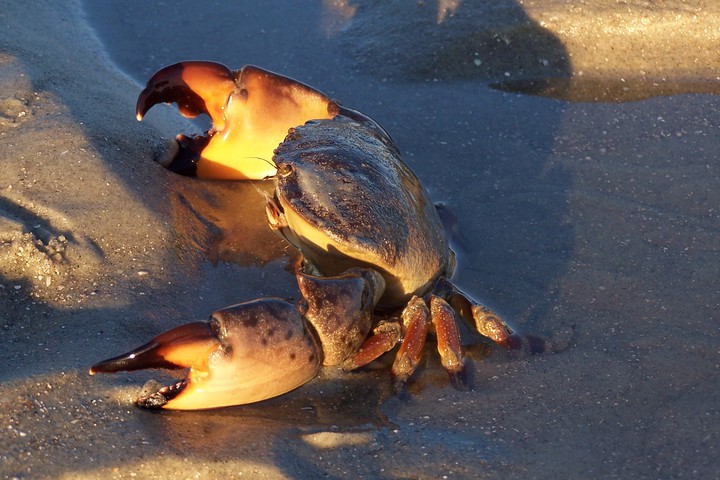
1) Menippidae Menippe mercenaria, Also known as, Florida Stone Crab, (Florida Fish and Wildlife conservation commission).
2) A second species of Stone Crab can also be found in Florida, but I need to further research this species (Florida Fish and Wildlife conservation commission).
3) Portunidea Callinectes sapidus, Also known as, Blue Crab, (2020, FAO Fisheries and Aquaculture- Aquatic Species)

Menippidae Menippe mercenaria
Portunidea Callinectes sapidus

Aside from identification, I have found some information regarding the crab traps. For a Portunidea Callinectes sapidus in particular the maximum trap size can be 2 feet (ft) by 2ft and the mesh (outer layer of the trap) size must be 11.5 inches (inch) or larger. Additionally a total of 3, 2 3/8inch escape rings must be on the trap and a 3inch by 6inch degradable panel (Florida Fish and Wildlife conservation commission).

Example of a standard commercial blue crab trap
Portunidea Callinectes sapidus Crab Trap

Additionally, I do plan on going to the Dunlawton Bridge in Port Orange I had previously mentioned in my last post 'Just Testing the Waters'. I will also be placing a trap in the Spruce Creek Estuary, that way I can have varining sailinity results to compare. An estuary can be defined as a large river that contains both salt and fresh water that meets sea tide (Dictionary.com). I hypothesis that the Dunlawton Bridge will have a higher salinity concentration due to it being located so close to the ocean verus the Estuary becuase of the mixture of freshwater.

Things to take into consideration include:
1) Noise/ Dunlawton Bridge vibrations.
2) The near by Dunlawton Bridge restaurants.
3) Other fishers near by (both locations).
4) If the trap is removed from either location.
5) Tides.
6) Weather.

Sources:
(2008). Science Dictionary. http://www.webquest.hawaii.edu/kahihi/sciencedictionary/I/invasivespecies.php

Florida Fish and Wildlife conservation commission. https://myfwc.com/research/saltwater/crustaceans/stone-crabs/

(2020). FAO Fisheries and Aquaculture- Aquatic Species. http://www.fao.org/fishery/species/2632/en 
http://www.fao.org/fishery/species/2632/en

Florida Fish and Wildlife conservation commission. https://myfwc.com/fishing/saltwater/commercial/blue-crab/

Dictionary.comhttps://www.dictionary.com/browse/estuary

(Menippidae Menippe mercenaria). https://animaldiversity.org/collections/contributors/jo_okeefe/stone_crab_100_5137/medium.jpg

(Portunidea Callinectes sapidus). https://upload.wikimedia.org/wikipedia/commons/9/99/The_Childrens_Museum_of_Indianapolis_-_Atlantic_blue_crab.jpg 


Jenna Fairchild (UR) - Who Needs a Photo-synthesizer Anyway!


Climate change. The leading cause of coral bleaching. A warming planet means a warming ocean, resulting in a change in water temperature. Similar to the way that human's bodies need to stay between the temperatures 91.8-100.8°F in order to function properly, corals also need to maintain the proper temperature to function properly. With an increase of as little as 2 degrees Fahrenheit, coral will drive out their photo-synthesizer algae, bleach, and eventually die. Coral and their zooxanthellae algae component have a symbiotic (mutually beneficial relationship), and one cannot survive without the other. Or can they...?
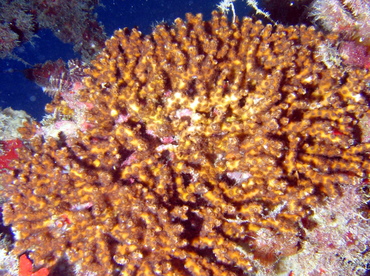
The coral reef ecosystem Oculina is known only off the coast of East Central Florida. This coral exists nowhere else in the world and it is unique among all other corals! Oculina can survive with or without its algae symbiont, identifying it as an azooxanthellae (it lacks symbiotic algae) coral. Additionally, this coral has exceedingly high biodiversity, similar to that of tropical reefs. Not much is known about this coral species since it is only found off the coast of Florida, and because large ivory bushes of this species live at depths that are too deep for recreational divers to visit.

Image result for oculina coral florida
You can tell that zooxanthellae are present here because the algae give the coral this orange color
Oculina are known to live in shallow waters, or up to 350 feet deep! Interestingly enough, the deepwater coral without zooxanthellae grow at a faster rate than the shallow water corals with zooxanthellae (Reed, 2002). Because these deep coral are impossible to visit unless you're a speciality diver, not many people know they exist - making them vulnerable to destruction from trawling and dredging. On the other hand, the shallow water Oculina are at risk of bleaching as a result from climate change because they're dependent on their symbiont algae.
Image result for deepwater oculina coral flordia
The photosynthetic zooxanthellae cannot survive at this deep depth, but the coral and its polyps can! This is an example of azooxanthellae, you can tell by its white color.
This uniqueness, productivity, and vulnerability of Oculina has inspired me to study its nature and presence on the Ponce Inlet jetty in the Indian River Lagoon. My research will focus on the growth, biodiversity, and symbiotic relationship that Oculina has with zooxanthellae. I would like to compare this data with known data about deep water Oculina, Oculina living on artificial reef systems, and also natural reef systems.

My prospective scientific question is two fold: What is the *level of resilience in shallow water Oculina in regards to growth, biodiversity, and symbiosis. How does this compare to Oculina that are growing in deep waters, natural reefs, and artificial reefs?

*This means i'll have to establish a point system for coral that portrays their level of resistance to factors that affect their health, then rate each location of coral residence.


References

Avent, et al. “Deep-Water Oculina Coral Reefs of Florida: Biology, Impacts, and Management.” Hydrobiologia, Kluwer Academic Publishers, 1 Jan. 1977, link.springer.com/article/10.1023/A:1016588901551.

Thursday, February 13, 2020

Ivy Gentry (UR)- The longing question!


My current question is “How much of the temperature of the sand affects the sex of the hatchlings?” as I was doing some more research, I found out some interesting information. “Rainfall is a common environmental variable that may impact development and sex determination.” (Jena, 2017). I knew that the sex was mainly determined by the temperature of the sand, but I did not think about the other factors that are in place. I did not know that the rainfall is one of the other big factors.

Also, with this question, it can lead to even bigger questions like if the temperatures get too cold, we will have an overabundance of male sea turtles. Meaning how much does climate change affect the future of sea turtles? If the temperature increases any more than it already has the populations of sea turtles will be more biased to the female turtle. We are roughly about 1˚ C higher the rate of them being bias would be significantly more.

I also found out a rough estimate of the temperature for female and male turtles. However, with my research project, I want to test and find the best temperature for both male and female hatchlings. I am extremely excited to do this research project!

Some Chelonia mydas (Green Sea Turtle) hatchlings from back in 2018. 
The one lonesome hatchling. 


S., Kristen. “Temperature Effects on Sea Turtle Sex Ratios and the Potential Impact of Climate Change.” National Marine Life Center, 23 Sept. 2011, nmlc.org/2011/09/temperature-effects-on-sea-turtle-sex-ratios-and-the-potential-impact-of-climate-change/.

J, L. (2020). Experimental assessment of the effects of moisture on loggerhead sea turtle hatchling sex ratios. - PubMed - NCBI. [online] Ncbi.nlm.nih.gov. Available at: https://www.ncbi.nlm.nih.gov/pubmed/28764866 [Accessed 14 Feb. 2020].

Alex Mercer (UR) What Is In the Shallows

As we all know, sharks are the apex predators of our oceans. They can be found all over the world in many different environments. However, Ponce Inlet seems to be special. Being labeled the shark attack capital of the world, one in fifty shark attacks in the world occur in our inlet here. Im seeking the answer to what makes this single location so much different than any other inlet, any other coast line, or any environment throughout all of the oceans. What is drawing them to this specific spot, and what species are involved? Shark tagging and conservation is becoming more popular by the day because we are finally realizing how crucial they are to our oceans and ecosystems. The resources and research going into these studies each day is remarkable. I would like to do my own research on Ponce Inlet and attempt to monitor what species are traveling in and out. By constructing a piece of equipment that houses a camera and some type of chum box, it will allow me to place it at any given position and monitor what is lurking in the depths. There will be many limiting factors, but especially the bottom time and length of film that can be utilized. Yes my goal is to monitor the shark species but any other type of fish caught on camera will give insight to the ecosystem and prey that is also in these waters. There are many websites and blogs out there that can help further my research. By using https://www.sharks.org/species and https://www.ocearch.org/tracker/?list I will not only be able to identify the species but also track previously tagged sharks entering the area. 

Lily Lehr (UR) Wrack on the Beach

Blog post options: 1) online search of reputable website(s) useful to your research topic. What is your IRP and scientific question? (be sure to review and correctly cite it).

At this point my question is, "How is the Wrack on the Beach Affected by Micro-Plastics?" To gain future and fundamental information I researched how this wrack affects our environment. "Biologists found that about 40% of the invertebrate species living on sandy beaches depend on wrack." () With it being a connection between the ocean and the shore many animals depend on for food and shelter. As the fish and birds eat the wrack on the beach plastic gets put in the food chain. Micro-Plastics get ate by humans, whales, sharks, etc,. With all of these creature eating plastic and getting it into their bloodline how is it affecting our health. (Sarah Gibbens, National Geographic). It is important to question how this will affect the future of human immune systems as well as a Floridian's natural surroundings of oceans and gulfs.

I found multiple sites when researching this topic, when individually looking into beach wrack I found the site for the Palm Beach County Board of County Commissioners Environmental Resources Management that raises awareness about beach wrack. They made the point of stating that taking the wrack can create an imbalance in the beach/dune ecosystem and that taking it harms all the animals that use it for food, shelter, and overall protection. Another site was called "Explore Beaches" they are a research team in California. Through them I found "Loss of Coastal Strand Habitat in Southern California: The Role of Beach Grooming." Which is where I learned more about native plant abundance depending on these wracks. 


Hale, B. (2017, March 15). Sarah Gibbens. Retrieved February 12, 2020, from https://www.nationalgeographic.com/contributors/g/sarah-gibbens/

Dugan, J.E. & Hubbard, D.M. Estuaries and Coasts (2010) 33: 67. https://doi.org/10.1007/s12237-009-9239-8
https://discover.pbcgov.org/erm/Publications/BeachFactSheet.pdf

University of California, Santa Barbara
Santa Barbara, CA 93106University of California, Santa Barbara
Santa Barbara, CA 93106University of California, SantaUniversity of California, Santa Barbara
Santa Barbara, CA 93106University of California, Santa Barbara
Santa Barbara, CA 9310Santa Barbara, CA 93106

Friday, February 7, 2020

Ame Teaderman (UR) - Extra Tidbits and Research Topics

I've said a fair bit in my previous post about myself, but I feel that more needs to be said before I dive into the research aspect of things. Despite my scientific drive, I actually wound up on the Environmental Science and Technology (EST) program by spur of the moment decisions and perhaps a bit of luck. I'm inspired by many things both in science and art, and while that lends me the ability to be more creative and varied in my knowledge pool, it also makes it exceedingly hard to make decisions on life-changing career choices, especially in college majors and degrees, which often at first glance lend themselves to specialization, rather than branching out. So while sitting in front of the advisor anxiously, not having a single clue what degree or major to even consider pursuing, I made a best guess at what I would like, and picked the EST program. It was probably one of the most nerve-wracking moments of my life! Thankfully since then I've found more grounding in what I would like to learn and do with my time here, which leads to the potential research topics.

As I've mentioned in my previous blog post, I'm most fond of seabirds and particular flora, though that fondness certainly extends to other wildlife as well. While the upcoming research project I'll be doing needs to involve water quality in some form, rather than just testing the water by itself in different locations, I've been given a pretty cool opportunity to study something else.
Crabs! (Photo by Jules Thomas)
That's right. Crabs. I haven't had a chance to do too much reading into them yet, but from what I have looked into, blue crabs and stone crabs are likely what we're going to see a lot of down here in Florida, and so far it looks like the research project will be tuned to catching and releasing them after collecting data. Which is rather exciting! I'm going to go get some shut eye however, but expect more research soon, and see you next week!

Source: Thomas, J. (2019, Nov. 13). [Photo of many Blue Crabs]. Unsplash. https://unsplash.com/photos/vM1Lz1ftMU8.