IMES

IMES

Thursday, April 28, 2016

Chris Browne, UR - IRP Wrap Up

E. coli (A fecal coliform)
     Alright, I have done nearly all the research I’m going to do, and here is a wrap up of the fecal coliforms found in our local waters. I will save just a few specifics and formal graphing for the presentation. I have been clarifying the differences between safe water and safe seafood. This data ranges a bit, and the biggest difference is that the FDA will classify the fecal coliforms as CFU’s per grams of food specimen. So it’s different then the water quality which is in CFU’s per m/L.
New Smyrna Site
    
      I found it interesting that this was the case, but in research and the amount of samples typically took, I have found that water samples can range significantly. In fact they can range so much so, that mostly all the studies that I found in water quality were based on monthly averages. However, there are desired levels of fecal coliform info that I have discovered.
Control-Tuscawilla-New Smyrna
     
      As stated last week, 800 CFU’s per 100m/L is considered to be unsafe for recreation use. Well ideal environment conditions (on monthly average) is considered to be <200 CFU’s per sample. Daily given samples should be no more than 400 CFU Studies indicate that individual tests can range greatly, so the main difference that I would improve on for a possible future experiment would be to test maybe every few days and take a monthly average. The individual test would be strongly effected by rain, tide, and current or normal conditions of any given natural environment.

Conclusions:     This IRP has given me some insight into the methods and water sampling that the EPA and local government partake in to determine water safety. I have found that this water near city point source outlets is not suitable for fishing, or recreational use. There could have been abnormal readings for these samples, but even cutting the number in half would have produced less then desired fecal coliform levels. The E. coli that was not found does indicate that the sewerage in these areas is being managed efficiently. However these waterways are not very clean, and should not be fished (or shell fished) around, which they sometimes are. That is also another indication to properly clean and                                                       cook any food harvested from these waters.

                                                                                                                                                         ~CB


Friday, April 22, 2016

Samantha, CUR- Polluted Perception

Happy Earth Day !

             This afternoon I revisited Canal Street Canal to take some various water quality measurements at an outgoing (Ebb) tide.  The Canal's oxygen levels were life sustainable measuring, 3.31mg/L.  In fact I even noticed a few different species of fish swimming around within the Canal.  Yet, visually, the water within the canal was unpleasant. My initial walk up to the Canal was shocking noting anthropogenic pollution instantly, with plastic bottles, snack wrappers, and an aluminum beer can which settled at the bottom.
One of 3 plastic bottles observed in canal
In my opinion, the most significant material observed today was various amounts of chemical agents floating within the Canal. I have been monitoring this Canal for some time now, with a total of 8 data points.  I do not recall ever noticing visual perception of chemical pollution.  As I mentioned, I currently have 8 data points of various WQ parameters within this basin, my goal is to have 10, half of the information taken during ebb tides and the other half with flood tides.  Tracking the tides is essential to my research, A flood tide "floods" the canal allowing water from the IRL to reach into the culvert system and mix with any fresh stormwater that may be within.  Thus, an outgoing/ebb tide allows the mixing of the fresh and brackish(slightly salty waters;typically <30parts per thousand(ppt) as opposed to normal seawater being 35ppt) waters, leading the fresh stormwater into the canal drainage basin and most likely into the IRL.   I will be out in the field all weekend (Sat. & Sun.) monitoring the water quality at Flood Tides.  I'm hoping to achieve significant data allowing me to determine this culvert system is contaminated and therefore contaminating the water body of this Canal which leads into the IRL. Have a great weekend everyone !


Chemical agents in Canal 


Emily UR - Crunching numbers

Happy Earth day fellow Earthlings! What an excited sort of progress my project has made. I created a graph that merged my results from nutrients found in my stormwater management ponds before a rain and the more recent results from nutrients found in my SMPs after a rain as well as data from rainwater that was collected during the storm! Now, at each pond I decided to take samples from three different areas in the pond to see if one area of the pond was more susceptible to nutrient pollution than another so at both the Halifax Plantation pond (HPSMP) and the Tuscawilla Park pond (TPSMP) the water analyzed before the storm are samples 1, 2 & 3 for three locations in one pond and these translate into 4, 5 & 6 after the storm but were taken from the same locations respectively. In the center of the graph dividing the two events is the nutrient readings I found in rainwater.
As you can see, there are some variances in the results, some sites experience a loss in nutrient concentrations while others experience results that require me to break the bar graph. Noting the nutrient criterion line for total phosphorus and identifying total phosphorus as the orange bars, we can see that all the readings for phosphate are either just at or above the nutrient criterion line. Now there are some plants in each pond so decreased nutrient readings could have something to do with the uptake of nutrients through plants following this storm. Let's look at the rainwater for a minute though. The nutrient concentrations found in rainwater were greater than every site with the exception of HPSMP-5 which I'll talk about in a minute. According to my chemical spreadsheet, there are many possible sources of nitrate and phosphates in our atmosphere, including the burning of fossil fuels for nitrate and soil dust or seawater for phosphate. I'll definitely have to examine the rainwater results more closely in the coming week as I see another storm is coming over the Gulf so I hope to be able to get more data for comparison.
Now, I want my audience to better understand the view of the lake that supports my hypothesis of one site being more susceptible to nutrient pollution than another. Below are pictures of the Halifax Plantation pond.
A view of the entire pond at Halifax Plantation
View of Site 1 & 4

View of Site 2 & 5

   
View of Site 3 & 6
If you compare the data found with pictures of the quality of water at each site, you can see that the results found at site 2/5 are likely not an error. Further investigation is required as I look to determine the source of this as well as collect more rain and water from a coming storm to expand my data library.

Thursday, April 21, 2016

Chris Browne, UR - Unfit for Recreation

Unfit for Recreation - Canal Street
Q:  Janice sec. 50: Hi Chris. Yucky stuff here! I took Dr. Horikami's class a while back and I thought I remembered that fecal chloroform was identified by the presence of E. Coli on the plates (neon green color) while chloroform (all animal gut content which includes fecal/e. coli) was the way we identified all gut contents on the plate and not just those associated with fecal (poop). Please correct me if I'm wrong.

A:  My results showed no specific E. coli, yet, I have confirmed that the bacteria counted was fecal coliforms, that are specifically from gut tracks, lactose or animal protein break downers. 

Q:  Phaleisa
Section01
I have seen people fishing on Reed canal and Tuscawilla, my question is that are their any signs poster to let the public know that the canal/pond is contaminated, and is the fish safe for human consumption?

A:  Tuscawilla may end up being within a decent range of acceptable bacteria, I am getting more specific data on that soon. However, there seems to be an abundance of nutrients, which can be a sign of pending problems to come. Look to Emily Reyes for more info on Tuscawilla Park as well. Check back next week for more info on wildlife/bacteria levels.

The Lab at IMES, DSC
     Formulas have been doubled checked, numbers have been run. Field notebook is in use. This week I can give some numerical values. I will attempt to explain them, but will be adding some info as I refine it, or get more reserch specific.


     Technically I had TNTC results. So, as directed by Dr. Horikami, I broke down the filter into quarters and attempted to get specific readings. All results will post as a greater then number for that reason. Plus this is the way the EPA delivers results. Samples were based on 100mL, the same volume of sample that computed evenly into the formula, supplying us with the actual number of CFUs(Colony Forming Units).

     The Environmental Protection Agency (EPA) states that anything over >800 CFUs, is considered to be unsuitable for recreational use. These are my findings, while next week I'll focus on what they mean for the fishing and shell fishing of the area. A reminder that fecal coliforms are a present and natural occurrence in the environment.
UNFIT:                  >800 CFUs, per 100mL
Canal Street:          >1,125 CFUs , per 100mL
Tuscawilla Park:    >260 CFUs, per 100mL.

Renee; UR: What you've all been waiting for!

MATH! ...Yay?

So who is ready for some statistics?
Results of pH T-test. In a nutshell this decimal means that there
is a 95% chance that both samples came from the same place.
Thanks to Dr. Woodall’s excitement my data got put into a lovely paired T-test ( a paired T-test compares two sets of possibly related data Such as before-and-after data, two different forms of measurement or two different treatments). Similar to finding the R value in a scatter plot the paired T-test was used to see if there was a correlation between the root zone and contrast samples pH values and redox potentials.


Unfortunately, if I understood the T-test correctly, both the pH and the redox T-tests showed that the two groups in question (the root zone and contrast samples) were not significantly different from one another.
Results of redox T-test. In a nutshell this decimal means that there
is a 88% chance that both samples came from the same place.

Hopefully there will be more significant differences in one of the tests UF will be performing. We have at least finally gotten the samples shipped off. Once again thanks to Dr. Woodall who is the best, most amazing professor ever!

Q: Michael Blevins, former geology student
 I'm surprised to see that according to your map, much of Florida has acidic soils. I know when in the geology class, we learned that much of Florida's soils were a sort of sandy soil with a lot of calcium carbonate in them--which you would think would be more alkaline. Can you explain these differences? Thanks!

A: The University of Florida IFAS Extension a great explanation in one of their documents concerning "soil pH and the home landscape":  "The median soil pH for Florida soils is 6.1, which is characterized as slightly acidic. However, Florida soils can vary widely in pH, depending on the parent material(Source from which the Soil came, ie. eroded granite, shell deposits, organic litter, ect...) from which the soil formed or on the management of the soil. For example, soils formed under pine flatwoods can be quiet acidic. In contrast, soils formed from calcium carbonate-bearing materials like limestone, marl, or seashells are alkaline. Alkaline conditions are common in coastal soils and the mineral soils of south Florida. It is also common to encounter alkaline soils in the home landscape as a result of calcium carbonate-rich building materials (i.e., concrete, stucco, etc.) that may be left in the soil following construction." 
The full document can be found HERE.

In the specific case of my Sarracenia minor(pitcher plants) they live in a bog full of sphagnum moss and other organic material right in the middle of pine flatwoods. It is this large amount of decaying organic matter that makes the soil more acidic for the pitchers who love the acid. 

Wednesday, April 20, 2016

Samantha, CUR- Industrial Stormwater Monitoring

        Greetings, since my last blog, I have been looking deeper into Aleeica's question, Have you ever thought about taking some water samples somewhere within the watershed, to see what's in it before it gets to the canal?  Fortunately, I recently stumbled upon an article from Washington State's, Department of Ecology, focusing on monitoring the water quality (WQ) from a pipe (or culvert system) discharging stormwater offsite, as well as monitoring WQ within ditches and man holes, carrying stormwater.  Environmental Protection Agency (EPA) suggests; "when taking a sample within a storm drain or man hole, to use a pole with a sampling container attatched at the end to collet the sample."
Attach a bottle for sampling
in manholes or storm drains. A
boathook is used in this example with
a bottle attached using a filament string
from Washington's Ecology Dept.
This concoction can easily be made in the field !   It is not always possible to sample stormwater runoff in locations such as ditches or pipes where the flow is concentrated, thus sampling a sheet flow allows you to gather stormwater runoff before being concentrated.  A sheet flow sample must be taken during or immediately after a storm, choosing significant, downhill areas where urban stormwater runoff is collecting, allowing an accumulation of runoff.   Monitoring the WQ specifically within storm drains, if possible, will allow quantitive data to determine pollutant concentrations associated with runoff before the stormwater reaches the receiving water.  Canal Street Canal (CSC) consists of an array of interconnected swales and ditches as well as direct piping that feed into the Canal.
Field Scientist performing sheet flow sampling.


When going out in the field this upcoming weekend, not only will I be monitoring the water quality, I will take initiative in setting up methods for collecting this storm water from a site other than the Canal Street Canal drainage basin, the only thought/problem that comes to mind is, "Will my Nalgene bottles be able to fit through the small opening within the storm drains?"  Stay tuned !


Bibliography:

  • Jenkins, D., C. Cairns, and N. Barber. "How Do Ward Pharmacists Spend Their Time?: An Activity Sampling Study." International Journal of Pharmacy Practice 1.3 (1992): 148-51. How to Do Stormwater Sampling. Department of Ecology, Mar. 2010. Web. 20 Apr. 2016. <https://fortress.wa.gov/ecy/publications/publications/0210071.pdf>.
  • Us Epa, Ow, Owm, Water Permits Division, Municipal Branch. Industrial Stormwater Monitoring and Sampling Guide (n.d.): n. pag. Industrial Stormwater Monitoring. Environmental Protection Agency, Apr. 2009. Web. 20 Apr. 2016. <https://www3.epa.gov/npdes/pubs/msgp_monitoring_guide.pdf>.

Monday, April 18, 2016

Emily UR - Phases Two & Three are Underway!

Rain over Florida, 4/14/2016 8pm
My rain dance has taken effect just in time! I returned from my wonderful internship at the Smithsonian this past Friday, April 15th only to find that a heavy rain storm had passed the day before! My lovely bearded assistant/boyfriend took it upon himself to grab my buckets and leave them out for me so as to collect rainwater from the passing storm. He did this a little late into the storm but thankfully, we collected just enough water to fill one mason jar. Upon my return, I went to my ponds and collected the post-rain water in mason jars. All the jars of water are currently being kept on ice in a cooler until they can be analyzed in the lab. Because I was all caught up working with my internship, I wasn't able to catch the passing rain on my NOAA radar app, so I archived a past radar map from NOAA's website. The colorful blue, green and yellow over and heading towards Florida, shows the rain from which water was collected.

I'd like to revisit Aleecia's Question from last week which may have been answered inappropriately. 
The Question:"Why are your total phosphate concentrations so different for the one pond?"
Refer to my blog from last week for the graph she is referring to. I answered this question assuming Aleecia was referring to the different levels between the two ponds instead of what she actually meant, which is why the levels of phosphate are so varying in the one Tuscawilla Park pond. The answer to this has to do with where in the pond I collected the water. Throughout each pond the water quality varies slightly either because of vegetation or interaction with a lower quality water body. In Tuscawilla Park, I collected water from three different areas of the pond; the first was collected at a culvert connecting the pond I'm studying to a neighboring pond that is experiencing a severe algae bloom. The second sample was collected next to a concrete bridge that leads to a small island in the center of the pond and the third sample was collected at another culvert that connects my pond to a drainage basin. As pictured, you can see there are slight differences in the turbidity of the water. Collecting water from various locations along the pond allows me to possibly narrow down a source of nutrients. Hopefully, I've better answered your question this week!

Sunday, April 17, 2016

Rachel UR - Time For An Egg Hunt!


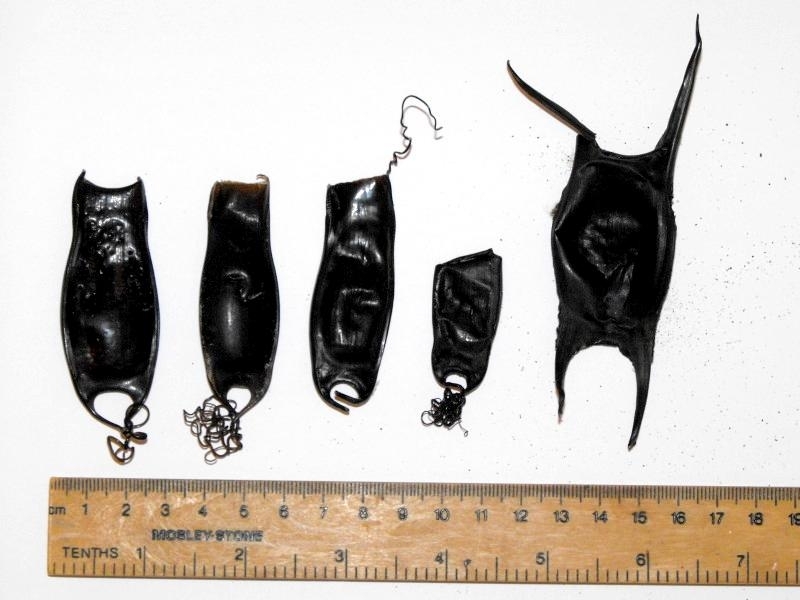
Examples of egg cases. The case to farthest
on the right is from the Common skate
       Hello everyone! I know it's been a while sense I've posted on the blog but i'm back and ready to do some hunting. Before we go egg hunting we need to know what we are looking for and where to find it.The picture to the right shows some common egg cases that I might run across. The only one belonging to a skate is the case on the right. This egg case is very similar to the cases that we will be finding out in the field. Speaking of the field, your going to need some basic materials to collect your eggs.


Materials:

  1. A stranded ruler
  2.  Waterproof Container with freshwater (I will be using a 5 gallon bucket)
  3.  1 gallon plastic zip lock bag
  4. Field notebook and Pencil
  5. Camera
Method:
  1.    Before leaving for your search site, fill your waterproof container with freshwater. This container can either be carried with you or left in your car.
  2. Once you find an egg case record your environmental conditions and location
  3.  Take a picture of the case before collecting it either into your waterproof container or zip lock bag.
  4. Put the egg case into the waterproof container with freshwater and let soak for 1-2 hours so they can regain their full shape. (Some larger cases may need to soak for up to 24 hours)
  5. Take the egg case out of the bucket and record length of the body, length from horn to horn, and width of the body
  6.  Identify the species belonging to the egg and record
  7. Set the egg out in the sun for preservation

In my research I ran a cross a website called sharktrust.org and planned to use the ID key that hey had to identify my egg cases. Upon looking further I found that they ID key was for the skate of Great Britain which isn't very useful for me. I am currently looking for another ID key that I can use but I might have to make my own. Happy hunting everyone!

Friday, April 15, 2016

Deanna DeLong UR- Perseverance and patience!

The transition from the Matanzas River to the Halifax River
Q & A: Jacob sec. 65. Are there any differences in the Volusia and Flagler water environments that might impact the number of fish you catch. For example, does one area have more mangroves than the other?

Thank you, Jacob, for your question. I have been fishing the North end of Volusia (specifically in and near the Tomoka Basin), and in different areas of Flagler County. Both areas are pretty similar environments, so I don't think the water environments alone are enough to effect the number of fish I catch. I have been fishing in salt marshes, which are visibly very similar in both counties. In fact, the water bodies that I fish for red drum in Flagler county are connected to or in the Matanzas River which then turns into the Halifax River. Great question!


Red Drum
Unfortunately, so far I have not had much luck on my seek for red drum. I had went fishing with my uncle and two cousins last weekend. We caught nothing but some craps, and my uncle catching rocks or oyster beds (he swore a fish was biting his line). We were fishing from the banks at a very popular spot in Flagler county under the toll bridge. This spot has pretty much been overfished for years. So catching any fish there is very difficult for anyone. No one around us in the surrounding area had any luck either. It was a bad choice of spot- but that's what I get for listening to my uncle and going where he wanted. I learned my lesson. Listening to someone who doesn't even know how to set up a fishing pole- about anything to do with fishing- is a bad idea. Plus taking a twelve and a seven year old fishing, is difficult because they have no patience, especially when they aren't catching anything. Better luck next time.


Victoria Czupta UR- Let's go fishing

So a day has been set to get some shark fishing accomplished. The fishers are at their marks, ready to catch what's out there and win with the biggest catch! And the bell starts the tournament! There are people everywhere trying to catch the biggest shark and prove they are the best fisher!

A thresher shark caught in a New Jersey Shark Fishing Tournament


There are many tournaments that are set up to actually catch and kill sharks, with the winner getting a grand prize at the end. Many people fish in these tournaments to just kill the animals that scare them, while some fish them just for the sport of it. But why kill these animals if they aren't even going to be eaten like a regular fish. We know all animals are important, but why is it allowed to just kill something that many people don't like? This is a big reason that many people today are working on shark research.

I personally will be catching these sharks and releasing them to get an idea at to how many sharks live in the local waters and find the characteristics that define them. Learning this can help determine how important a certain fish species can be or a particular environment can be, especially when it comes to mating and nursing.

It was been determined that catching sharks first thing in the morning will be best, along with an ebb tide, as it is going out instead of coming in. This is the same idea as fishing for any other fish, where they don't like the heat during mid-day, and with the tide going out, many fish will be leaving the inlet and going out to the ocean for deeper water, where the sharks will be waiting.

I am still determining a few details as the exact type of leaders, which I have been given tips on. But most everything else is now set up to head out. My identification sheet is still being worked on, since it right now is 40 pages, but it is easily understood when trying to figure out what kind of shark was caught. This leads me into a question that was asked:

Jacob sec. 65 asked    It looks like there are some stingrays on that key of yours. Why is that? What do they have to do with sharks?

Eagle ray, with Ampullae of Lorenzini under it's nose.
Ampullae of Lorenzini on the underside of a Tiger sharks nose
Well, sharks are called cartilaginous fish which are in a taxonomic class called Condrichthyes. Rays are also in this class, since neither have actually bones aside from their teeth. Their bodies are made of cartilage, just like the ears and nose of humans. After the class is a sub-class, which seperates animals called chimeras (Holocephali) from the sharks and rays known as Elasmobranchii. From there, sharks and rays and skates are seperated. But they do have a lot of similar features aside from having no bones. In most of the Elasmobranchii, they have an organ called Ampullae of Lorenzini, which are the pores on the underside of the nose which have a gel inside. Just like with an ultrasound, this gel absorbs electrical waves that are given off by all living organisms, and the pores send the waves to the brain. This is what allows most sharks, rays, and skates to hunt for their food and avoid anything that may cause them harm. This is also the reason that for a long time people said to punch a shark in the nose and it will flee, because it disrupts their ability to sense their environment.

To Angela Boney: The shark researcher is working at the Kennedy Space Center for the KSC Ecological Program & Integrated Mission Support Services

Renee; UR: Lets talk acid! ...Soil acidity that is...

I know that last week I mentioned such things as graphs being blogged about this week; however, I thought that the wonderful question that I received concerning soil pH deserved a thorough answer.
... it was also a very busy week and I hate to admit but sieving my samples to send to UF was all I was able to get done So far as project based work is concerned.

Q. Jacob sec. 65. 
why are you soils so acidic? That seems really low to me like nothing should be able to live there. Are Florida soils typically this acidic?

A: I love this question! The diversity of kingdom Plantae is one of the things that has captivated me about plants and is well illustrated in how plants have adapted to live in pretty much every sort of soil on earth.

Please be aware that this map was created in 1998. It is a
beautiful map and I included it because I did not find
anything recent that was significantly different.
(click for bigger image, it's totally worth it!)
First, most soil in the southern US is indeed acidic. Perhaps not always as acidic as we see in my samples but still under 7.0pH.

A huge contributor to the acidic soil in the south is the decay of organic material which produces hydrogen ions which in turn lower soil pH. This is very true at my site which has been thick with pine trees which continually shed and renew their needles for over a century. The sphagnum moss which grows thickly in the wetland soil also contributes to the high amount of decaying organic mater at my site location.
For a more in depth but easily understood explanation of acidic soil causes check out Jeff Ball's article on The Samuel Roberts Noble Foundation website. The article is about both soil acidity and "correcting" it with lime. If the acidity explanation was not so good I wouldn't recommend it... Please note that I do NOT condone liming(the practice of adding lime to soil to raise the pH for the purpose of growing plants that do not tolerate acidic soils particularly grass and food) 

Here in Florida where a lot of our native flora (plants) prefer our naturally acidic soil the habits of various farmers and home owners working hard to change the soil to fit their needs have put added stress on our native friends. Which is totally not cool.

Moving on, Sarracenia minor(hooded pitcher plant) is recommended to be potted in a sphagnum moss and perlite mix of between 5.0pH and 3.0pH by Plant Delights nursery who have some of the best exotic plant overviews I've ever seen on the web. As we saw last week in my blog the acidity hovered in the 3pH block dropping as low as 2.87 making this rather acidic.

Keep in mind that the 5-3pH recommended by the nursery is for potted plants. Natural soils are effected by a wider range of pH changing factors so such as leeching. Also projected preference zones are subjective to some degree. Plants like all life are often surprising and will persevere in conditions outside preference parameters.

Now for a fun, fascinating and thought provoking cluster of facts:
The hooded pitcher plant is not the only plant whole likes acidic soils. The long leaf pines for which the preserve where my site is located was named also love the acidic conditions.

The magical hydrangea! The colors are NOT
different varieties but different pHs! 
Other plants get complicated with their soil pH. The hydrangea is a fantastic example! Their preferences are broad: any pH between 4 and 7 makes for very happy hydrangeas; however, the owner may prefer hydrangeas in acidic soil which produce blue flowers while the neighbors may prefer pretty pink flowers grown in basic soil. 

I personally prefer the lovely shades of purple in the 5/6pH area.

Before I head to bed I'd like to issue a thought challenge:

All of you clever Oceanography and Aquatics students out there who have grass google the pH preference of your grass variety. Write that down. Now considering the soil map above and the pH guidelines from Plant Delights for pitcher plants think about two questions:
How natural might the soil beneath your grass be? Why do you think this?
And based on the pH criteria alone could pitcher plant grow successfully in your yard? Again, why?


Thursday, April 14, 2016

Chris Browne, UR - Fecal Growth

Canal Street in the Field
Samples: Control, Tuscawilla Park, Canal Street
     How's that for a title. Well, I am still going over the numbers, stats, and computations for the formula desired. However, I'll share some of the growth results here. More to come next week, as I refine my details.

     No need to show the close up of the negative control, there was close up no bacteria what so ever, which was mostly expected. The first two pictures are for fluff, and show that I used the desired methods for sample retrieval, as well as show my assistance from Dr.                                                       Horikami.

Tuscawilla Park Fecal Coliforms
Science Department Head, Dr. Horikami


Canal Street Fecal Coliforms
     These pictures show the Tuscawilla Park sample, as well as the Canal Street sample. I could literally not see the grid guidelines, so my canal street numbers are a +/- situation, yet I was able to get the average number counts. The Tuscawilla park also had bacteria, but showed about 20% of what was discovered to be in the Canal Street outlet.

~CB


Saturday, April 9, 2016

Emily UR - About a week of intermission..

I need to work on my rain dance if I want to start seeing some progress in my study. Phase One is complete but waiting on a rainstorm is taking much longer than I had originally anticipated. Comically, even if there is a perfect storm for sample collecting in the coming week, I will be in Fort Pierce completing my internship with the Smithsonian Marine Research Station (so excited!) and will therefore be unable to further my study until I return on Friday evening. Hopefully my classmate Chris will have some results from his sampling of the same Tuscawilla Park stormwater management pond (SMP)!

Questions from Aleecia Sec. 65: "Why are your total phosphate concentrations so different for the one pond?"


Thank you for the question Aleecia! The question refers to the graph to the right for those who may have missed my blog from last week. I wish I could give you a more thorough answer as to specifically why there are higher concentrations of phosphorus in the Tuscawilla Park SMP compared to the Halifax Plantation SMP but for now, all I have are hypothetical sources. Phosphorus has many natural and anthropogenic, or human-caused, sources as a pollutant. A likely natural source for phosphorus pollution in this case would be atmospheric deposition as soil dust that gets blown into the upper atmosphere acts as a condensation nuclei for rainwater to condense on and will enter a water body via precipitation. Anthropogenic sources are more likely the cause here and some of those sources include fertilizers and domestic and industrial wastes. Fertilizers aren't used at Tuscawilla Park so that leaves domestic waste as a likely cause for the levels of phosphorus at the one park. Considering Tuscawilla has also been experiencing sewage management issues, domestic waste is not an unlikely source. I hope this answered your question!

Thursday, April 7, 2016

Victoria Czupta- UR "There's plenty of fish in the sea"

      Have you ever wanted to meet someone who you idolize and want to be like? I haven't made it quite that far, but since my last post, I have had the opportunity to talk with a shark researcher who works in Cape Canaveral for the environmental group. He emailed me some of the information they collected on black tips, which are one of the most common shark species in the area. He also sent me a few papers he wrote and co wrote about sharks in the area. Once I have the chance to review the papers, I'll have more information to post about it.

      In order to identify the species of shark being caught out in the field, I found a website that had links for a dichotomous key. I took the information and pictures and spread it out in a Microsoft Word Document. This will be used for identifying the species caught as well as general information about that species to help understand it better.


Pictured dichotomous key
I am also making a spreadsheet of the information that will be recorded for this project, including the lengths, species, gender, and umbilical scar.                                                                                                                                                      The umbilical scar is basically like a belly button, but on the sharks underside. It can show how healthy the shark was growing up and whether it grew up in a high oxygen or low oxygen environment. The umbilical scar is located on the belly either near the pectoral fins or closer to the anal fins, depending on the species. Also, if the shark is still a "newborn" the umbilical scar will still be slightly open and more pink in color, just like a fresh wound on a human.
Q&A: Aleecia Sec. 65 You say the information you recieve will reduce our fears. How is that possible? I say the more sharks you catch the more fearful I'll be! (LOL) But really what value is your information? What will you be doing with it?
Well, the idea is that knowledge is power. That is how we as humans have worked our way up to the top of the food chain is by knowledge, which allows us to create things to help our survival. But we aren't just animals that go around killing things we fear. The more we understand these animals, the better it will be for us and them, as well as keeping the food chain going. Once a species dies off, the whole web gets altered and can cause a giant disruption to the ecosystem. Once we understand what species come through our waters though, we can get an idea as to what fish are their food, which makes it important to know how much of a species should be fished and during what season. Some of these species just pass through, while others live here year round. With information like this, we can get a better understanding of when it might be a good time to stay out of the water, instead of splashing around in their home. Plus, it would prevent a lot of needless slaughter of the sharks, and injuries to surfers and swimmers.

Renee; UR: Finally making some head way!

Remember RZ stands for Root Zone (6 inches from the plant base)
and C for Contrast (3 feet from the plant base)
Good news everyone! I finally finished my redox and pH tests! Isn't the table lovely? >>>>>>>>

Sadly there are no smoking guns apparent from the table about why the hooded pitcher plants are so sporadic at my site.
At first glance everything appears to be within pH and redox parameters that these plants find acceptable. They love acidic soil that is not heavily compacted. If you remember my last post and the lovely redox chart the higher milli-Volts means more available oxygen and thus less compacted, more aerobic soil.

Now looking at the data in the paired fashion I collected it (RZ-1 compared to C-1 and so on down the number line) the redox potential in the Contrast samples are mostly higher in milli-Volts than the Root Zone samples.  In practical terms this also implies that the soil is looser and probably contains more organic material. Knowing that the site is home to lots of pine trees the organic material is probably pine needles which would help explain why the pH is lower in high redox samples. Really all this table does is confirm what I already suspected and knew. I will have to do some thinking outside of the box to see what other info I can tease out of the data.

Anyway, I got carried away there. A preview of next week: I will have some correlation data and probably some graphs for y'all to see statistically how these numbers relate to one another and what it implies about the soil

Q&A

Q: Joseph Sec1
Thanks for your answer. So what are the favorable weather conditions for this plant? and do they die off when conditions become unfavorable?

A: Sarracenia minor prefers warm, sunny weather with regular afternoon rain storms to keep the soil wet but not flood out the area. So our late spring and summers are the pitcher plant's favorite time of year. These plants are perennials.(plants which go dormant and die back when it starts getting cold then come back when it gets warm like oak trees) They are well adapted to Florida's mild winters and have been shown to benefit like all perennials from the 'rest period' that winter brings. Unfortunately unusually cold winters like we experienced a few years ago can result in damage and even death of the plant. The International Carnivorous Plant Society website has tons of great information about S. minor and other carnivorous plants found in Florida and abroad.

Chris Browne, UR - Expectations

The Outgoing Tides Path from Canal Street
     Bacteria is naturally found everywhere. Fecal coliforms are no exception. E. coli is more commonly found in warm blooded animals, and can live for smaller periods of time outside the gut track. A recent link to the Tomoka River's median expected water levels stated that 46.00 colonies of bacteria were found in the average water sample taken from the river.
Hypothetical Graph
http://www.sjrwmd.com/watershedfacts/factPages/27010024.html
   

Hypothetical Graph 
     My research will tell us what is found after a 24 hour incubation, in the Canal Street outlet, and the Tuscawilla park retention pond, which surrounds the Nova Road area. The map presented shows the an outgoing tide and path of tested water. Notice that there are several square miles of mangroves right where this area flows to. I'll be compiling data next week, and sharing info with E.Reyes as to Tuscawilla Park. It seems I will definitely be counting and identifying E. coli. Here are a couple examples of graphs that I may use, these numbers are just hypothetical, actual data should be sorted                                                      through next week.
~CMB

Monday, April 4, 2016

Dave, UR - No news is good news, but good news is better!

Update time!

I would like to say that for all of the screaming that we hear about "evil corporations," we should consider that the actions of some do not represent a whole. Sparton Navigation and Exploration, who manufactured the two hydrophones that I borrowed from Embry-Riddle, is based in DeLeon Springs, Florida. We called them, hoping to see if they might have some nature of program for educational institutions.  They not only offered an exceptional deal on future procurement, but they donated the first hydrophone!

Daytona State College's Institute of Marine and Environmental Studies now has its own PHOD-1, for this project and many to come! Also in good news, the Television Production folks at the college will be facilitating the analog-digital signal conversion, so more budget got saved!

There is still a bit of technical housekeeping to be done before we dive, but we are finally "over the hill" on the major technical hurdles that had to be crossed in order to bring this project to fruition.

 That is all for project updates, so let's answer some recent questions.

Aleecia, from DSC's OCE1001 class, writes:
 "...what are the different shapes you are going to look at and why these shapes?"

I'm glad you asked. First, let's think about what we know about sound. It's a wavelength, transmitted from one source, and received by one or more sources in one or more locations. The basic components of a sound wave are frequency, wavelength, and amplitude. The wavelength is the period of one cycle, the amplitude is the strength or pressure of the wave, and the frequency is how many times the wave cycles in one second. We measure those cycles in units called Hertz (Hz), which obviously give way to kilohertz (kHz) and megahertz (MHz). 

Everything we know about capturing specific wavelengths, usually revolves around shallow conical shapes like dishes. For the sake of this experiment, we will have 0° flat plates to act as a control, followed by 15° and 25° dishes, and finally a 90° "can" shape. If the dishes work as we believe they should, then we will be able to see the difference between them in the readout data, and that will give us a direction to go. The 90° "can" shape is inspired by collector shapes of certain unidirectional radio antennas already in use, so since we will already be diving, we will try this shape as well to get data from our "extreme" limit. No one has yet mastered unidirectional sound collection underwater, but hopefully the variance we've built into this experiment will give us some direction.

 Aleecia also asks:
"Do you plan on using it to study dolphins in the wild or in captivity?... Do you think your prototype will be able to move as needed to study the dolphins? And while it's moving, will you have sound interference from the water's movement?"

I am lumping all three questions together, for one finite answer. I am developing this system so that everyone who studies underwater organisms will be able to collect a wealth of specific sounds, without much movement themselves. There have not yet been discussions of ROV-mounted variants, though I would love to see that be a future possibility. I am starting simple, with considerations towards a diver-carried unit. Dolphins, like us, breathe atmosphere in order to conduct cellular respiration. This means the majority of their communication occurs in congregated social groups in limited spaces. Why not communicate while swimming across the ocean at high speeds? Well, they have the same problem that the runners of our species do: they're too busy breathing.

Our intention with this device is to allow a diver from the outside of a biological family group to listen in on specific sounds from within the group, without getting close. This way, the diver doesn't risk disturbing an otherwise natural interaction.  So, a bit of water movement can be filtered out with software, but there is little risk of high-speed movement becoming an issue.

As the technology continues to develop, it will be important to study both captive and wild family groups, so as to better compare data.  Through this, we can group what sounds can constitute common "language" for the species, versus sounds that are attributed to one group or the other.

Thanks for the questions Aleecia, and I look forward to more from everyone else!

Samantha, CUR- Determining the health of an overall body of water

Aleecia sec 65.  Have you ever thought about taking some water samples somewhere within the watershed to see what's in it before it gets to the canal? 
Thank you Aleecia, A great question, I have never thought about taking water samples somewhere within Canal street Canals contributing watershed to see what exactly may be polluting this Canal (flowing through the culvert system to discharge).  I am concerned that something like this would not be an option.  The culvert system is underground (although I am not certain on how far down) and therefore it may not be feasible.   The watershed is also compromised of streets, houses, yards making it an urban area, I am not sure monitoring water quality anywhere else would help determine the total and overall amount of pollution associated with the watershed. The discharge point is associated with the storm drain, collecting untreated street runoff from the entire watershed (170.6 acres), and is possibly the most efficient way of determining what anthropogenic (not natural or originating in human activity) pollution is being released into this basin or body of water, discharging into the Indian River Lagoon (IRL).  The discharge point of Canal Street Canal is known as a point source discharge, collecting non-point source untreated pollution which can originate from many different places within communities along with the help of some rain, "runoff" is collected and and sent down the storm drains, into the storm drain system, or in my case the 5x8 box culvert running on the south side of canal street and out at discharge point.  Also, I am specifically focusing on the nutrients within the canal such as nitrogen and phosphorus.  When measuring nutrients from collected water samples, I use methods and instruments (in the lab) which are focusing on Total Inorganic Phosphate and Total Inorganic Nitrogen, which allows a better understanding that the measurement readings are relating to nutrients that are more than likely being discharged into the following body of water (basin shaped canal).   I am excited that you were interested in water quality monitoring points associated with the canal storm drain system.  I have been interested in monitoring further points as well although focusing in the water basin.  I would like to initiate a transect within this canal basin.  When talking about water quality parameters I have been specifically focusing on the discharge point, which I have discussed is an imperative point in determining the effects of the storm drains on the contributing water environment/habitat.  The Canal Street Canal extends from the East end of Canal Street where the street ends and the discharge point of the storm drain lies.  The canal is  ~81.5 meters wide and ~129 meters long flowing East into the Indian River Lagoon (IRL) North.  
Canal Street Canal basin discharge point
on the left where road cuts off IRL on the right
at the end of the Canal basin.


So, I have a adequate amount of data and information on the water quality at discharge point.  The basin however is extensive and therefore due to tidal flow as well as biovolume within the canal I am not certain of the overall health of this body of water.  Biovolume is the term to define cells within a unit amount of water, specifically here being phytoplankton and other photosynthetic organisms, especially algae that thrive on nutrients such as nitrogen.  Which leads me back to the purpose and definition of a transect.  A transect is something like a line from discharge point of the canal to the East or the end of the basin partner of the IRL.  For example, the Canal basin is ~129 meters long and therefore if I wanted to monitor six points within the canal, I would want to stop and collect water samples as well as measure other factors such as oxygen,salinity and pH at every ~21.5 meters.  (Note: this is just an example of a possible transect within the canal and not my actual plan).  Transect research has just begun, Questions or suggestions are significantly appreciated!

Emily UR - Phase One complete

April is looking like the busiest month of this year so far! To refresh, my project is studying nutrient pollution due to runoff and atmospheric deposition before and after a rain. There are essentially three phases for this project, phase one being the collection of "before rain" data from each of my sites, phase two being the collection and analysis of rainwater and phase three being the collection of "after rain" data from each of my sites. I've finally collected samples from both my sites completing phase one!
HPSMP = Halifax Plantation Stormwater Management Pond
TPSMP = Tuscawilla Park Stormwater Management Pond
3 different samples taken per site
I used the nutrient criteria limits of the halifax river because I couldn't find a more specific nutrient limit outside of the powerpoints for this class. In this graph, which shows the amounts of total nitrates (grey) and total phosphates (blue) in mg/L before a rain, I only added the nutrient criterion line for total phosphates because the limit for total nitrates (0.72mg/L) is much higher than any of my recorded values.
Now, onto phase two. I will continue to eagerly track the weather to collect my next set of data.

Last week I was asked a question from former geology student Michael Blevins who asked:
"Are your ponds lined with anything, like clay?" & "You said these ponds are built in the flatlands to prevent flooding; does this mean these areas used to be wetlands and and humans are controlling the water flow to regain land for development purposes?"

Thank you Michael! These questions were actually pretty tough but nothing that can't be answered with some research and a phone call or two. First, the two stormwater management ponds (SMPs) I'm studying do not have an impermeable layer, such as one of clay, lining the ponds. The goal of the ponds are to guide rainwater into them for collection and filtration before replenishing the groundwater. This does make the water susceptible to contamination though and there may be a source of contamination at Tuscawilla Park where levels of Total Phosphates have been recorded above the nutrient criterion levels.
To answer your second question, yes and no, but yes. It is known that when you destroy one environment, you're creating another and that is the case with both of my sites but they differ slightly. Tuscawilla Park was once a bald cypress dome way back before aerial photography had captured it as one. It was drained into these ponds and the once swampy terrain became a sort of upland habitat. The Halifax Plantation differs in that it went from a natural environment to a humans environment over the 50 years between the two aerials below. I was told that as Daytona Beach got more popular, the city thought a nice park you could walk through and play at would be more appealing to tourists than a swamp in the middle of the city. So regardless, yes, land was developed and these ponds are used to manage the water.
Halifax Plantation Pre-Development 2/6/1995

Halifax Plantation Post-Development 1/15/2014