 |
| Shark project being presented |
IMES

Friday, March 31, 2017
Christian Vinciquerra, UR: Project reviews

Monica, UR- Catching Solar Rays
I am doing my IRP on solar energy. In my introduction I will be talking a little bit about the history of solar and how it is environmentally friendly. Then I will go into what is known about the performance vs the angle of the solar panel. I will state my scientific question: What angle performs best at my location (latitude 29 degrees). I also changed one of my angles again due to new information I found. I will be talking more about why I choose the angles that I did.
MATERIALS
My data collection will be getting the volts and amps of each solar panel, multiplying them to get the Watts or power produced. I picked the cluster bar graph because It will overall show my data for each day. Each day I will collect my data at the same time for consistency. I also will be writing the date/outside temperature and weather data.
WHAT WAS ADDED/FIXED:
MATERIALS
- (3) ECO-WORTHY 20W 12V Solar Panel
- (3) Unlimited Solar U-MO-0112 mounting kit
- (3) Metal Fencing Post
- Protractor
- Southwire TECHNITIONPRO TRUE RMS IV MULTIMETER
 |
| My backyard set up of solar panels |
METHODS
- Assemble solar panels (will get in more detail during final presentation)
- NO SHADOWS/ Panels Facing South
- Collect data using multimeter (will do demo on how to measure volts and amps)
- Collect data at 12pm each day
 |
| Projected Graph |
WHAT WAS ADDED/FIXED:
I just copied and pasted my last Blog because I didn't have to change much. I added the direction that my panels are facing and added that I will be taking my measurements at 12 pm each day in my methods. I also fixed my citation of a website: Landauhttp, C. (2015)
Optimum Tilt of Solar Panel. Retrieved from www.solarpaneltilt.com.
Stephanie Guyotte, UR- Where do you want to live?
Hello everyone,
This is my proposal for my research project if you have any questions please feel free to leave them in the comments section.
What is known and unknown about clearnose skates-
The clearnose skate or Raja eglanteria are found on the eastern coast of the United States from Massachusetts to the northern end of gulf of Mexico. The skate can withstand water temperatures between 5-27℃, salinity of 12-35ppt, are benthic, and can be found in estuaries and inshore at depths around 100m but have been found up to 330m. The clearnose skate is identifiable by some of the following characteristics; translucent patch of sink around the nose, a single row of thrones along the mid-ridge on dorsal side from shoulders to end of tail, vary in color but will have darker spots and bars on dorsal side and plain white on ventricle side. Males have a pair of claspers and females are oviparous (lay eggs). The skate is often caught as bycatch by commercial fishermen during otter trawling. The clearnose skate is studied widely in captivity, but currently natural habitat and population is not well known.
Scientific Question-
What type of habitat holds the highest concentration of Raja eglanteria (clearnose skate)?
Methods and materials-
Interpretation-
My main focus is to look at the clearnose skate population at different location. However with all the information I am gathering, I might find other interesting connections like the different in coloration of skates from an inlet population Vs the onshore skates.

This is a possible graph that could be used to represent the data collected (this is NOT real data).
References
Miller, M. 2013. "Raja eglanteria" (On-line), Animal Diversity Web. Accessed March 30, 2017 at http://animaldiversity.org/accounts/Raja_eglanteria/
This is my proposal for my research project if you have any questions please feel free to leave them in the comments section.
What is known and unknown about clearnose skates-
 |
| Clearnose Skate |
Scientific Question-
What type of habitat holds the highest concentration of Raja eglanteria (clearnose skate)?
Methods and materials-
 |
| Inshore Habitat (google) |
 |
| Mangrove Habitat (google) |
 |
| Estuary Habitat (google) |
Using fishing gear, I will be fish at three different habitats; inshore, estuary, and mangrove to look for clearnose skates. The following measurements will be taken; salinity and temperature of the deep water (because this is where the skates are found), weather conditions, time, sex, body dimensions (wing to wing and tip of nose to tip of tail), overall appearance, and location. Whatever bycatch I catch will be noted as well. I will catching and releasing everything. To find salinity, a sample will be collected with a brown Nalgene bottle from as close to the bottom as possible by lowering the bottle with the lid on into the water column then open the lid letting the deep water flow in. Then the sample will be brought back to the lab (stored in the refrigerator) and tested using the refractometer. Temperature will be found using a waterproof thermometer attached to a fishing pole and casted out to reach the deep water. Location and weather can be found using a cell phone. Sex can be determined by the presents or lack of claspers. Body dimensions will be measured with a sewing tape measure.
My main focus is to look at the clearnose skate population at different location. However with all the information I am gathering, I might find other interesting connections like the different in coloration of skates from an inlet population Vs the onshore skates.

This is a possible graph that could be used to represent the data collected (this is NOT real data).
References
Miller, M. 2013. "Raja eglanteria" (On-line), Animal Diversity Web. Accessed March 30, 2017 at http://animaldiversity.org/accounts/Raja_eglanteria/
| Ha, D., Luer, C. & Sulikowski, J. 2009. Raja eglanteria. The IUCN Red List of Threatened Species 2009: e.T161658A5474334. http://dx.doi.org/10.2305/IUCN.UK.2009-2.RLTS.T161658A5474334.en. |
Thursday, March 30, 2017
Steve Cofone, UR - Nothing makes a fish bigger than almost being caught.
Micro Plastics
What I will need and how I will preform my project:

It’s in the water, but is it in our food supply?
What we know is that it is in our water supply, both fresh
and salt
water. Maia Mcguire, UF Extension agent for this area has done extensive research and data collection. Here is a link to
her Awareness Map .
She has concentrated mostly on sampling the water in and
around Florida.She is a wealth of information on the subject.
We know it's in
shellfish, and there was a study in England that documents
microplastics in 10 species of fish from the English
Channel. 504
Fish were examined and plastics found in the
gastrointestinal
tracts of 36.5%. (Lusher, 2017)
Scientific Question: Are
Microplastics found in the digestive tract
of bottom feeding fish?
Map of my fishing spots for this Independent Research
Project
Randomly chosen fishing spots 1-4 (right click open in new
tab)
Materials
•Fishing equipment
•Sample Preservation material/Ice, cooler
•GPS Unit/phone/Field Book(550f)
•Analysis Laboratory (microscope)
Methods
-Fish each spot at best times to catch fish, log pertinent
information with gps coordinates.
-catch fish, preserve intestinal tract,
-bring to the lab at school and
examine/measure/count microplastics, I will then graph and evaluate
Questions....Comments....Suggestions??

References:
•Lusher,
A. (2017). Occurrence of microplastics in the
gastrointestinal tract of
pelagic and demersal fish from the English
Channel.
Sciencedirect.com.
Retrieved 30 March 2017, from
http://www.sciencedirect.com/science/article/pii/S0025326X1200
5668
Casie UR- IRP
 |
| ST. Johns River |
The Water Hyacinth is an invasive plant native to South America, they were brought over to the U.S in the 1880's where they were used as an ornamental plant. No one could have guessed the negative impacts that the Water Hyacinth would have on our local environment.
Over the last several months I have been investigating the impacts that the Water Hyacinth has on the environment. I found that they out compete indigenous plants in Florida by reproduce rapidly in a body of fresh water. They choke out water ways by producing daughter plants that literately clog up the body of water, limiting aquatic life and reducing recreation . They also cause oxygen depletion, when they decompose they release a high level of nutrients back into the water causing the oxygen levels to decrease in the area where the Water Hyacinth is present.
After all this research I stumbled across some amazing uses for this invasive weed. Some of which include creating bio-ethanol, sewage purification and heavy metal accumulation. This lead me to form my scientific question "What is the reduction rate of Copper when the Water Hyacinth is present?"
The method to my madness-
I will gather 6 fish tanks, 3 will have the Water Hyacinth and 3 will not (these will be my control) and fill them with distilled water. I will then add the appropriate amount of nutrients that the Water Hyacinth needs to thrive. After doing this I will add copper sulfate to all of the fish tanks and put them in a light box. I will monitor the change in copper sulfate over a weeks time.
The Materials-
Water Hyacinths
Fish tanks
Copper Sulfate
Distilled water
Light Box
Nutrients
 |
| Known locations of Water Hyacinths in Florida |
I hypothesis that there will be a decrease in the amount of copper in the tanks over time.
If you have any questions please feel free to leave a comment and I will be happy to respond in my next post!
Pam, UR - Micro flora and fauna of brackish and saltwater marsh

The organisms to be tested for will be more than 80 um size, with anticipation of collecting phytoplankton and zooplankton. The sample areas are the Tomoka River basin and northern Indian River Lagoon.

My scientific question: What is the diversity between brackish and saline marsh micro organisms in the water column?
Materials Used:
- 80 um Plankton net
- rope used to attach net to boat, length yet to be determined
- microscope, type yet to be determined
Method:
- take samples as described below from brackish water Tomoka River basin and Indian River Lagoon estuary
- from boat determine start point, lat/long waypoint, take water sample for salinity, temperature, dissolved oxygen and any other factors available
- drag plankton net along top of water column for specified distance
- at end point take lat/long waypoint, water sample as above
- bring plankton net to boat and elevate so sample drains to lower end of cup.
- empty cup into collection receptacle
- put on ice, store in refrigerator until available lab time
Carly, UR - Shark Life
Sharks have taken over my life in the past year, but especially in the past couple months while researching and refining my independent research project (IRP). It's pretty cheesy, but sharks inspire me. They're these strong, but relatively simple creatures. They work smarter, not harder.
But sharks also have a lot to tell us about our world, primarily the ecosystems they inhabit. If they're not doing well, then that system is struggling as well. What happens then when we effect their ecosystem? With our earth rapidly changing because of human impact on things like climate, is that currently having an effect on sharks? We know most sharks are ectotherms and how biothermal regulation works, so with sea surface temperatures(SST) rising is there a correlation between sharks and those SSTs?
The University of Miami is focusing on an aspect of that, climate change and sharks. They have tagged a few sharks, primarily Tiger and Great Hammerheads. The satellite tags have sensors for temperature, depth, and acceleration to study the optimal range for the species. The map to the right here shows the pings of a female Tiger shark the University has tracked over a year with temperature ranges. This is something I would like to do with the online data available to me through OCEARCH and WindyTV.
I plan to use these resources to compared multiple individuals among 4 different species of sharks: White, Blue, Tiger, and Mako. I've chosen these species because 3 of them are ectotherms, while the White is an Endotherm. Using multiple individuals will allow me to guarantee that I will get regular data, because sharks aren't always going to be at the surface to get a ping. I'll record their data a couple times a week, using current and monthly average SST from WindyTV since ping coordinates aren't readily available on OCEARCH I'm estimating the average temperature will relay more information.
There's a lot of work to do, but from this I hope to learn more about the creatures that inspire me and whether the positive or negative correlation of sharks and sea surface temperatures can help us predict what's to come.
Fins and Grins,
Carly
 |
| Lydia, one of OCEARCH's icon Great White Sharks |
 |
| Female Tiger shark tracked over one year by University of Miami |
I plan to use these resources to compared multiple individuals among 4 different species of sharks: White, Blue, Tiger, and Mako. I've chosen these species because 3 of them are ectotherms, while the White is an Endotherm. Using multiple individuals will allow me to guarantee that I will get regular data, because sharks aren't always going to be at the surface to get a ping. I'll record their data a couple times a week, using current and monthly average SST from WindyTV since ping coordinates aren't readily available on OCEARCH I'm estimating the average temperature will relay more information.
There's a lot of work to do, but from this I hope to learn more about the creatures that inspire me and whether the positive or negative correlation of sharks and sea surface temperatures can help us predict what's to come.
Fins and Grins,
Carly
Dylan Radford, UR My evaluations!
 |
| Presentation!(not a picture I took when I was leaving) |
Thursday, March 23, 2017
Kelly-Ann UR - What Do You Ask Yourself Before You Swim?

Before you get into a freshwater source here in Florida, have you ever considered if it is safe? Those of us living in Florida become accustomed to looking out for alligators, snakes, and other dangerous wildlife, however there are dangers we cannot see as well. Nitrate, a nutrient naturally found in freshwater systems, can reach toxic levels due to anthropogenic enrichment.
 |
| Algae Bloom in 2005, St. Johns River |
The St. Johns river is the largest freshwater body in our area. It has been classified as a class 3 water source, which means it is supposed to be safe for recreational use. People do often fish, swim, and participate in other activities that put them within direct contact with the water of the river. However, regular toxic algae blooms indicate that there may be elevated levels of nitrate in the river, since algae blooms are caused by high levels of nitrate and phosphorus. Although the photo shown to the right is from 2005, there have been reports of toxic algae blooms as recently as last summer. Naturally, nitrate levels tend to be less than 1 mg/L in freshwater sources. Certain species of fish are sensitive to nitrate levels above 0.06 mg/L. Levels above 10 mg/L are toxic to humans. We know that excess nitrate is making its way into the St. Johns river due to the use of fertilizers, storm runoff, industrial waste, failing septic systems, and other human based sources.
 |
| St. Johns River Map |

Based on what is already known about the nitrate in the St. Johns river, I am investigating if the nitrate levels in the St. Johns river is safe for fish and human recreation. In order to answer my scientific question, I am going to be preforming a transect of the river, taking surface samples at five locations along the river: in Jacksonville, Green Cove Springs, Lake George, Lake Monroe, and the St. Johns Marsh. I will be preforming the transect in the previously listed order, which follows the river from in the opposite direction of its flow. I will be preforming the complete transect in one day. The samples will be analyzed using method 1002l with a HACH DR/890 colorimeter to quantitatively measure total nitrate concentration. I will visually present my data in a line graph, which shows changes in concentration of nitrate over distance.
Sources:
Behar, S. (1997). Testing the waters: chemical and physical vital signs of a river. Retrieved February 9, 2017, from https://fosc.org/WQData/WQParameters.htm
Issues. (n.d.). Retrieved February 09, 2017, from http://www.stjohnsriverkeeper.org/issues#nutrients
Maher, J. R., P.E. (n.d.). Water quality and the st. johns river [PDF]. Department of Environmental Protection.
Behar, S. (1997). Testing the waters: chemical and physical vital signs of a river. Retrieved February 9, 2017, from https://fosc.org/WQData/WQParameters.htm
Issues. (n.d.). Retrieved February 09, 2017, from http://www.stjohnsriverkeeper.org/issues#nutrients
Maher, J. R., P.E. (n.d.). Water quality and the st. johns river [PDF]. Department of Environmental Protection.


Monica, UR- Solar Energy
As you all know I am doing my IRP on solar energy. In my introduction I will be talking a little bit about the history of solar and how it is environmentally friendly. Then I will go into what is known about the performance vs the angle of the solar panel. I will state my scientific question: What angle performs best at my location (latitude 29 degrees). I also changed one of my angles again due to new information I found. I will be talking more about why I choose the angles that I did.
MATERIALS
MATERIALS
- (3) ECO-WORTHY 20W 12V Solar Panel
- (3) Unlimited Solar U-MO-0112 mounting kit
- (3) Metal Fencing Post
- Protractor
- Southwire TECHNITIONPRO TRUE RMS IV MULTIMETER
|
| My backyard set up of solar panels |
METHODS
- Assemble solar panels (will get in more detail during final presentation)
- NO SHADOWS
- Collect data using multimeter (will do demo on how to measure volts and amps)
|
| Projected Graph |
My data collection will be getting the volts and amps of each solar panel, multiplying them to get the Watts or power produced. I picked the cluster bar graph because It will overall show my data for each day. Each day I will collect my data at the same time for consistency. I also will be writing the date/outside temperature and weather data.
Wednesday, March 22, 2017
Chelsey, UR, Saltwater Tanks and More Saltwater Tanks
Another late post I apologize sincerely,
While I cant find anything on my exact topic because it seems as if no one has done this project before, there is of course a million things on saltwater tanks and the proper way to keep them (salinity levels, how long you should leave a light on for fish, etc.) so I thought it best to put some of my findings on the subject of aquarium tank setup and upkeep on here.
When starting a saltwater fish tank, the first thing you need is to have the proper water, because if not, your fish or other creatures will die. Purified or distilled water is your best bet at starting your tank out right, although now a days they make all sorts of filters and purifiers to make dirty water safe and clean. Next step is to pick the right salt for your tank and mix it properly (Instant Ocean is the typical choice). Now unless your tank creatures are from brackish waters or a place with higher salinity levels, 35ppt saltwater will be perfect for your tank. Let your tank sit for 12-24 hours before adding any live beings, and measure your salinity levels using a refractometer. Make sure temperature and salinity is adequate and your ready to go!
 Upkeep on saltwater tanks is very important and vital to your tank survival. Make sure to always have some extra salt for when you need to clean your tank and change your water. When changing the water, make sure to measure and record salinity and temperature of your tank, and always use clean water. Too much deviation from original water levels can cause your animals to die or go into shock. Also, when water is evaporated, replace with only fresh water not salt prepared water, because salt remains behind when water is evaporated from a tank.
This finding about replacing with fresh water is very important to my experiment because now I know to only replace with fresh water, so I do not disrupt the balance of salt when conducting my experiment. Threw my research on the topic I also discovered the right levels of salt I need to start my experiment, 35ppt. I also found out how long to let the saltwater sit first before I start my experiment, 12-24 hours to get accustomed to the water. I hope to find out more throughout the class and while conducting my research!
Great source on the topic
http://successfulreefkeeping.com/learn/reef-tank-101/salinity-mixing-saltwater/
While I cant find anything on my exact topic because it seems as if no one has done this project before, there is of course a million things on saltwater tanks and the proper way to keep them (salinity levels, how long you should leave a light on for fish, etc.) so I thought it best to put some of my findings on the subject of aquarium tank setup and upkeep on here.
When starting a saltwater fish tank, the first thing you need is to have the proper water, because if not, your fish or other creatures will die. Purified or distilled water is your best bet at starting your tank out right, although now a days they make all sorts of filters and purifiers to make dirty water safe and clean. Next step is to pick the right salt for your tank and mix it properly (Instant Ocean is the typical choice). Now unless your tank creatures are from brackish waters or a place with higher salinity levels, 35ppt saltwater will be perfect for your tank. Let your tank sit for 12-24 hours before adding any live beings, and measure your salinity levels using a refractometer. Make sure temperature and salinity is adequate and your ready to go!
 Upkeep on saltwater tanks is very important and vital to your tank survival. Make sure to always have some extra salt for when you need to clean your tank and change your water. When changing the water, make sure to measure and record salinity and temperature of your tank, and always use clean water. Too much deviation from original water levels can cause your animals to die or go into shock. Also, when water is evaporated, replace with only fresh water not salt prepared water, because salt remains behind when water is evaporated from a tank.
This finding about replacing with fresh water is very important to my experiment because now I know to only replace with fresh water, so I do not disrupt the balance of salt when conducting my experiment. Threw my research on the topic I also discovered the right levels of salt I need to start my experiment, 35ppt. I also found out how long to let the saltwater sit first before I start my experiment, 12-24 hours to get accustomed to the water. I hope to find out more throughout the class and while conducting my research!
Great source on the topic
http://successfulreefkeeping.com/learn/reef-tank-101/salinity-mixing-saltwater/
Chelsey, UR, Methods and Other Fun Stuff
I know this is very over due I won't lie I totally forgot about it and slipped up. So I'm here now to get my blog up to date.
IRP:
The impact UVB light and a fan system have on the stability of salinity and temperature in a controlled laboratory tank study.
Materials
This entire project will be done in the lab of Dr Woodall at Daytona State College.
I hope at the end of my project I will have figured out the perfect settings to keep a saltwater tank at while experimenting or just keeping an aquarium of your own.
IRP:
The impact UVB light and a fan system have on the stability of salinity and temperature in a controlled laboratory tank study.
Materials
- 1 Lightbx
- 1 Fan
- 2 400-700 nano meter range, 40 watt, 48 inch plant and aquarium lights
- 7 2.5 gallon aquarium tanks
- Instant Ocean
- Distilled water
- 3 pieces of live coral
- 1 Refractometer
- 1 thermometer
- 1 ruler
- 7 water filters
- Fill tanks to designated water level
- Let sit overnight
- Mix instant ocean into water until 35ppt salinity in 6 of the tanks
- Leave one tank with just distilled water
- Anchor a piece of coral into three of the saltwater tanks
- Designate a time frame for lights and fan to be on
- Measure salinity, temperature, and water levels daily for two weeks then every two days for remainder of experiment
- Record results
This entire project will be done in the lab of Dr Woodall at Daytona State College.
I hope at the end of my project I will have figured out the perfect settings to keep a saltwater tank at while experimenting or just keeping an aquarium of your own.
Friday, March 10, 2017
Lyle UR I Got a barrel full of Plastic
 Hey there again! I was back in the l was back in the lab again this week and got some more great results. This oyster was from my third site that i got samples from. This oyster was smaller than the last one at 2 grams but the results weren't to shabby. Last weeks oyster weighing 4 grams produced 12 micro fibers and this week an oyster weighing 2 grams had 9 micro fibers
in it. That is a 4.5 micro fibers per gram. I still used the same methods that I have been doing since I started. The cool thing about this oyster is that most of the micro fibers that I found were red in color unlike most of the others had a blue or green micro fiber inside of them.
I am finding most of the micro fibers within the gills of the oyster. With that being said I don't know if the fibers are being processed and going through the digestion track. Next week being spring break I will either be out on the water doing more research or enjoying bike week, either way im going to enjoy my time away from school and relax a little bit.
Amber Hanick, UR- Here Sharky Sharky Sharky
Hello all,
Last Friday 3/3/17 was our second day in the field at Ponce Inlet. Our mission for the day was to shark fish off the shoreline of the Inlet and reel in as many sharks as possible to get an A in the class according to Dr. Woodall haha. As we arrived on the shoreline and began scoping out our field site conditions and area, we concluded first that the pier was no longer going to be the site of our fishing as the whipping wind gusts were crashing waves against the jetty and making the pier unsafe for fishing. We then moved along to site 2, the high energy habitat we seined on our last day in the field. This area was a lot more passive as far as waves and wind was concerned and the only issue now was sand being carried by the wind ending up in places sand should not be. We rigged all the rods up, baited them and began casting our lines out into the inlet. Everyone waited anxiously for one of the rods to show that something was biting and had gotten caught on the circle hooks. Unfortunately, this was not the case and the next 2 and a half hours were spent with lines casted out, close eyes on the rods, but also was bonding time with our classmates and time spent having fun no matter what our field day results turned out to be, and that's what I call optimism in unfortunate circumstances. I believe that our catch was unsuccessful due to the whipping wind gusts at time exceeding 25 mph and the currents being high energy and strong at our site which caused difficulty in luring in the sharks. Since the wind played such a huge factor in our activity and caused changes in our original plans, I decided to create a line graph for my "fun graph" that showed speeds over our study time at the inlet. Even if our day in the field didn't go as desired or as we planned, it was undeniably an adventure, learning experience, and a great day with lots of laughs and fun!
Over and Out,
Amber
 |
| Rigging the rods |
Over and Out,
Amber
 |
| Enjoying our fun in the sun! |
Stephanie Guyotte, UR- Skate break
 |
| Raja eglanteria (clearnose skate) (from google) |
 |
| Formation of blastodisc (b), cleavage(c-e), start of head formation (f) (source2) |
 |
| Last stages of formation (source2) |
References:
1. http://www.flmnh.ufl.edu/index.php?cID=2110
2. https://link-springer-com.db06.linccweb.org/article/10.1007/s10641-007-9219-4
Thursday, March 9, 2017
Monica Barrick, UR- Getting closer!
 |
| One of three solar panels. |
I recently got my solar panels I ordered on Amazon and now I'm just waiting for the adjustable solar panel brackets. They should be here by the end of the week, then I will set up my panels at my three different angles. I'm happy I got the adjustable brackets because it will keep my solar panels from moving from strong winds. These solar panels have very good reviews on Amazon but I read one review saying that the wires actually take up a lot of the energy so if its a huge loss of power I may need to get better wires.
 |
| This Information is on all solar panels. |
I have learned a lot just by looking at the information on the back of my solar panel.
Here's what they mean:
Pmax- Maximum Power
Vpm- Maximun Power Voltage
Ipm- Maximun Power Current (AMPS)
Voc- Open Circuit Voltage
Isc- Short Circuit Current
Now to find Pmax you simply multiply Vpm to Ipm. In other words Volts X Amps = Watts. This solar panel has the maximum power of 25 Watts. Open circuit voltage is the maximum possible voltage when the current is zero. Short circuit current is the maximum current when resistance (voltage) is zero. So far so good, can't wait to test these bad boys out.
BIBLIOGRAPHY: http://nature-log.blogspot.com/2010/01/definitions-of-solar-power-terms.html
Christian Vinciquerra UR, Shark fishing wasn't so bad
Last class we met at Ponce Inlet again. I was beyond excited for this one because we were shark fishing. Shark fishing is something I do often but i usually do it from boats not shoreline, so I was a little out of my element. Unfortunately we had to improvise and move locations because of foul weather. There was a reed flag on the lifeguard tower and winds were howling.
 |
| Line in the water |
 |
| Jetty was all whitecaps |
We tried to walk onto the jetty and people were losing their hats. We moved to site 2 from the seining lab in hopes to catch some sharks. Unfortunately we did not catch anything. We were all a tad disappointed, however, it wasn't the worst class I've attended. We literally were fishing for a class and it was relaxing. Just siting in a beach chair on the beach and with a line in the water. I chose to sit on the end of the our class so I didn't talk to Chad or Dr. Woodall too much. I did have the chance to connect with some of the other students and talk. So due to no sharks being caught there is no data I can report this week.
Pam, UR - A girl and her plankton net.
 |
| plankton net 80um |
What I really want are those beautiful little diatoms. (Not something from a nightmare) When the real search begins in my two research areas the plankton net will be conical, about 5' with a container at the end. The mesh is 80um and the cup at the end with mesh of same size
The microscope I used for the test is also pictured. It had good lighting and focus, but not as close up as I would have wished. But I'm sure the college has some special high power microscope hidden away somewhere.


Carly, UR - Behavioral thermoregulation? behavioral thermoregulation.
"Those of us who love the sea wish everyone would be aware of the need to protect the sea."- Eugenie Clark #InternationalWomensDayHey all!
These past couple of weeks have been researching and testing my methods for research. The first time researching myself I wasn't very successful in finding a lot of information. Reaching out and asking those who are more familiar or experienced in the subject tends to pay off, so that's what I did.
I talked with Dr. Osmon, who graced us with her presence the past couple of labs for our shark catching attempts, about my independent research. She lit up, saying she could send me some documents, which led me to some great research that has been done on the environmental factor correlations with shark and ray movements.
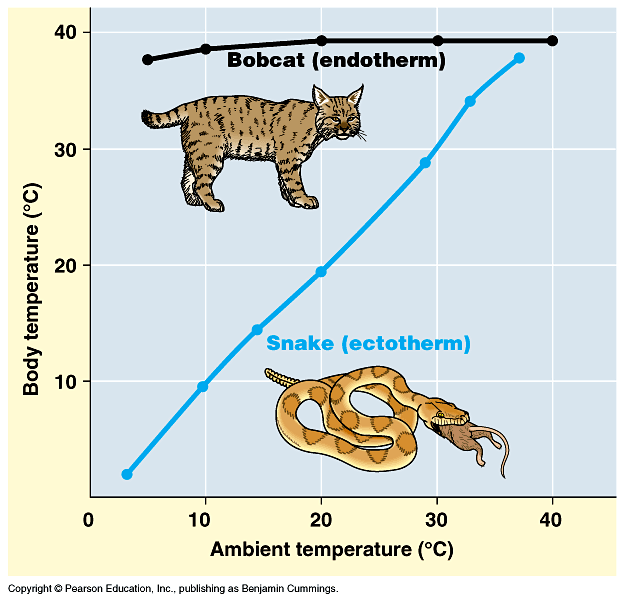
Most sharks (and rays) are ectothermic, meaning they're cold blooded and rely on external sources to regulate their body temperature, some of the most famous being reptiles(like the snake here on the right). The only shark species that are endothermic is the family Lamnidae, also referred to as the mackerel sharks (because that's their preferred food). Some sharks migrate depending on the temperatures, some stay in their "home range", but overall will respond to temperature through movement.
This led me to my favorite new phrase, behavioral thermoregulation, meaning movement to locate a spatially variable preferred temperature range. This way of living might contribute to their way of using energy in more efficient ways, like reproduction. There are many other theories, some tested and some not, but I have a greater understanding of shark movement from this research.
Now as for my own research, figuring out the set up for logging has been a fun ride. There are a lot of factors to consider, but I also have to remember to keep it simple. Understanding more about sharks thermoregulation, I'm excited to see which species that I've chosen have any sort of correlation and the differences between them.
Fins and grins,
Carly
Sources
 |
| Ambient versus body temperature of endo- and ectotherms |
This led me to my favorite new phrase, behavioral thermoregulation, meaning movement to locate a spatially variable preferred temperature range. This way of living might contribute to their way of using energy in more efficient ways, like reproduction. There are many other theories, some tested and some not, but I have a greater understanding of shark movement from this research.
Now as for my own research, figuring out the set up for logging has been a fun ride. There are a lot of factors to consider, but I also have to remember to keep it simple. Understanding more about sharks thermoregulation, I'm excited to see which species that I've chosen have any sort of correlation and the differences between them.
Fins and grins,
Carly
Sources
- Schlaff, A.M., Heupel, M.R. & Simpfendorfer, C.A. Rev Fish Biol Fisheries (2014) 24: 1089. doi:10.1007/s11160-014-9364-8
- https://www.britannica.com/science/ectotherm
- http://faculty.uca.edu/johnc/EndoEctothermTemp.gif
Casie UR-Watch out for Gators
 |
| Lake Monroe, FL |
Now to back track for a second, my scientific question is "Is there a correlation between copper in the water and the amount of Water Hyacinths in the area?"
She found zero copper in the water samples. I was floored by this discovery! I suppose the question is now answered, though not at all what I was expecting. There seems to be no correlation. Now I must reassess my scientific question and come up with a new question for my IRP.
Now I have the opportunity
 |
| Lake Ashby, FL |
Garth UR - Nothing but, gold...?
Nothing but, Gold...?

If wishes were dreams and dreams
were desires, then in fact I would find nothing but gold. Not as much as I
might like has come to pass this week for my project, although I have come to
specific intellectual milestones. I know what I am doing, where I am going and
what needs to be done. In fact, the hardest part is yet to come and much of the
leg work has already been finished. Now however it is time to crunch the
numbers compile the data and make a few phone calls. Overall, I feel good,
however the grindstone still sits wanting. So, it time to hit the old proverbial
keyboard and hack away. The other challenge I face is simple, I must convey
short sense to my audience of everything I have gleaned worthy of my interpretation
to share. So, keep all those positive vibes out there folks and we will see
what happens 😉

Dylan Radford UR, Shark Fishing!
Hello Class! Our session this week was a little disappointing I would say. I was really excited to do this lab but unfortunately we didn't catch any sharks. I was hoping to see how we would measure these sharks when we reeled them in. I do have to admit that it wasn't the worst class session ever. I mean we got to sit on the beach all day instead of go to class. I thought that all of the different hooks that we were using were cool!
While we were sitting on the beach chad told us to look at some birds that were flying by and he said that they were called skimmers. These are a really cool bird because of how they hunt for fish. chad said that they fly right above the water and run the lower beak under the water to scoop up any fish that they see. I thought it was awesome that chad was able to identify that species of bird from so far away.
This week, because we didn't collect any data, we didn't have a serious graph to do and were told to make up our data. My graphs question was, "which species made up the Greatest Percentage of all sharks caught". Of course we didn't catch any but I pretended that we caught a ton of tiger sharks and no bonnet head or black tip sharks. With my graph I was able to tell that there are more tiger sharks in the area than any other species that I had listed. although I had a great time sitting on the beach I really hope that the next lab we do is more of a success that the lab we just did.
 |
| Everyone having fun! |
This week, because we didn't collect any data, we didn't have a serious graph to do and were told to make up our data. My graphs question was, "which species made up the Greatest Percentage of all sharks caught". Of course we didn't catch any but I pretended that we caught a ton of tiger sharks and no bonnet head or black tip sharks. With my graph I was able to tell that there are more tiger sharks in the area than any other species that I had listed. although I had a great time sitting on the beach I really hope that the next lab we do is more of a success that the lab we just did.
Steve Cofone, UR - Maps, keeping guys from having to ask for directions for 100's of years!
Randomly chosen fishing spots 1-4 Right click, then open in new tab
This is a link to the fishing spots that I drew out of a hat. Its an interactive ARCGIS map.
You can click on the Pins and the info will come up in a pop-up window, so far its just spot 1 through spot 4.
But as I progress, I will be adding information such as the GPS coordinates, pictures of the spot, date and time I have fished those spots as well as any catch and pertinent information such as moon phase, tide, bait used and weather conditions.
The same link will take you there as I add the information, it will automatically update.
I can also add layers as they come available and I am able to find them, unfortunately Flagler County charges it's residents for GIS information and layers, The most recent aerial photography I found was from 2005, which is irrelevant as Flagler/Palm Coast has changed greatly since then.
I am doing an internship for Flagler County Land Manager for another class I am taking, part of this internship will be using ARCGIS for the county, so maybe I will be able to pull some good layers when I start that work, you will have to "Stay-tuned" to see what I can dig up.
I have also made this into a "collector" app in GIS, this enables me to instantly gather information directly on my phone, whether I have service or not (It will update automatically as I enter back into a service area) and continue my research past this school project and in the future if I desire too.
The random selection worked out well, I got a pretty decent mix of spots, there are 2 intercoastal spots, 1 intracoastal spot, and 1 freshwater lake with surrounding wetlands and water inlets from run-off.
The most exciting thing for myself was the fact that I went into ARCGIS and was able to design and manipulate a map in a relative short amount of time! I took ARCGIS 2040 with Al Hill 2 years ago now, and its good to know that what I learned in that class has stayed with me and is not something I forgot. I wonder sometimes as I have went through school how much of this massive amount of information I will retain when I finally enter the job force?
Doing this part reinforced that I am not only learning the information I am retaining it.
Subscribe to:
Posts (Atom)