IMES

IMES

Thursday, February 6, 2020

Lily Lehr (UR): See the line where the sky meets the sea? It calls me.


     Ok, no that line does not call me, at least physically. When I am with my family at the beach I much rather go back to the pool. My dad always says the ocean is cleaner than the pool. When I was younger we went to the ocean in Hawaii, and I got stuck on a sandbar, it was in the middle of a stingray migration (probably not so close to shore, but there were about five of them) and multiple swam right by me. I was about four, but I remember them being close so I froze in fear. My dad ran to me and carried me back to shore, as exciting as the experience would be now at the time it was petrifying, and mentally scarred me.
     My connection to the environment is strong. I treat it as something that is its own very powerful force that needs my effort and attention, but not something I need to spend every second in it for me to be connected. I tell my cousins when they come down to Florida that, "Some people are worth dying for," in the ocean. Yes, Olaf said that too, but we learn from these new movies important lessons.
    I know how to and participate in many ocean and water activities. My favorite books are underwater science fiction and movies deal with creatures under the sea. It's a weird love, but if the hearts are connected no distance will stop it. I chose Environmental Sciences, might change to Oceanography, but I'm still figuring that out because how indirectly it does the ocean calls me. The ocean inspires me because its depths are uncharted, but it shows welcoming features. It shows you its dangers as you walk into it, yet it holds the hearts and homes of an extensive variety of species.
    My IRP was always going to be about protecting the Earth based on either plastics or a new way of getting paper and benefits from other plants versus trees. I am seriously debating micro-plastics. Micro-Plastics are in the water we drink, the animals we eat, the dirt and ocean we play in. The creatures of the ocean do not deserve the effects humans have thrown at them. Recently, I watched this video about whales, in this video they did a project on deceased beach whales. Obviously the ones they could save they did, but some of these whales had thousands of plastic bags in their stomachs. I remember them saying about fifty pounds!!! Pounds, with a plastic bag being a couple ounces this is an intense discovery. I understand that the plastic bags are macro-plastics, but if we have a numerous amount of whales, turtles, birds, dolphins dying because of the larger versions how drastic will the measures be when we truly understand what the micro plastics are doing to us.

1) why did you choose your
field? What about it motivates or inspires you?
What do you care about? What do you think
your IRP might be abo

Alex Mercer (UR): Hands On

The first time I went to the beach I was 16 days old. Unknowingly then, it would become the place I fell in love with. On that 4th of July when I was only two weeks old, I saw my first shark (no I don't remember), but it was the start of a passion that I would carry with me for the rest of my life. For as long as I can remember the ocean has called to me and I knew that it would be a forever passion of mine. I knew that I not only had to live around it but I needed to work around it.

For over half my life I have worked with my hands, every job I've ever had, they were my tools. I was good at it, I had a natural ability to build and fix things. Growing up it was my dream job to build boats, I was obsessed with it. So after I got out of the military I decided to pursue that dream job and I landed it. I started building sport fishing yachts for Jarrett Bay Boatworks. I loved every second of it but it just wasn't enough. Thats when I decided I needed to take it a step further. I had built the boats, but now I wanted to design them. So I started to seek out degrees that would allow me to do that and I came across Ocean Engineering. I realized the vast number of opportunities that this degree path could open up for me. It will fulfill my dream to design boat hulls like I had originally planned or open up other opportunities such as working along sing scientists to design equipment they could use for shark research.

For my research project I would like to investigate the shark population and species of the shark bite capital of the world, which happens to be right in our back yard at Ponce Inlet. I want to know the "whys" of this location, what is drawing them here? What makes this tiny segment of the ocean so much more dangerous than anywhere in the world? With an ocean engineering degree I'll be able to combine my passions of the ocean, and working with my hands together. They say if you love what you do you'll never work a day in your life and thats what I'm after.

A rendering of a flats skiff I designed on the computer. 
Planking on the side of Jarrett Bay Hull #64.
This was the boat I helped build and is still under construction.


Monday, February 3, 2020

Jenna Fairchild (UR) - From Midwest Girl to Surfer Girl

Going right at Ponce Inlet
Here it comes. The peak of the wave is heading in my direction. I paddle in and I paddle right at the same time to line up with the part of the wave that has the most energy. I paddle once, paddle twice, then I push up on the rails of my hand shaped board to stand as the wave pushes me forward. I lean back to keep my balance and glide down the face of the glassy blue wave. I use my back foot to snake my board back and forth with the energy of the whitewash. There is nothing like dancing with a wave right before it crashes and ceases to exist. It is an intimate experience to be part of the last moment of that wave's life.

I grew up surrounded by corn fields and woods, persevering through long, dark, and cold winters. When I moved to Florida at 15 years old, I was fascinated by anything to do with the ocean. I picked up hobbies that immediately helped me understand the nature of its character even more. Surfing taught me that the ocean can be peaceful and calm, inviting and therapeutic. On other days, surfing forced me to recognize the oceans strength, unpredictability, unforgiving nature and more than anything - its mystery. I am intrigued by the contradiction of the ocean, the mystery behind its character, and also its ability to humbly control everything on land. With humility, and hidden beneath the salty water, the ocean controls climate, plant life on land, and also temperature and storms. Fascinating! And everything in life depends on this reservoir of mystery. I chose Oceanography/marine science as my field because there is a lifetime of research, learning, and protecting to do with the ocean. I am eager to learn for the rest of life and use that knowledge to protect the ocean, which gives me life - literally.
Welcoming the ocean's strength and mystery on the Ponce Jetty

More specifically, I am inspired by the perfect activities that innately happen under water for life to happen on Earth. For example, the balance of the chemistry in the water, the photosynthetic organisms zooxanthellae in coral, and the symbiotic relationship between coral and that algal component zooxanthellae. The ocean is 71% of our Earth! Don't you want to know what is going on down there? I do. With this being said, I think my research topic will be the local coral, Oculina varicosa. This coral is special because it can live with or without zooxanthellae. I want to focus my research on that interesting characteristic of this coral, and possibly use in vitro fertilization to experiment with the genes of less resistant coral from climate change. Ultimately, I would be helping the coral to adapt at a faster rate by forcing it to.

Sincerely,
Jenna Fairchild

Friday, January 31, 2020

Ivey (UR)--Just a little get to know me!


Hello Everyone!

I would love to start out by introducing myself my name is Ivy Gentry and I am 19 years old. I am currently going for a major in Marine Science or Marine Biology. I love the ocean more than most things in the world. My favorite animal are sea turtles, I even have a watercolored sea turtle tattoo. I care greatly about the environment. I have done many volunteer hours at the Marine Science Center in Ponce Inlet. I have worked with sea turtles, string rays, many invertebrates, sharks and even with two different types of snakes one pine snake and a corn snake. My favorite animal to work with would have to be the stingrays. I got to help the guest feed and pet the sting rays correctly. As a volunteer, I have also been able to help with some of the turtle releases over the years.

In high school, I was also part of the AEMS academy which stands for Agriculture, Environmental, and Marine Science. With being a part of this academy, I was able to be in a marine science class where I got to take care of a shark, an eel, and a blue triggerfish. I was also able to participate in an aquaculture class during my senior year, in this class, I had to pick a species of fish to try and breed by the end of the year; however, with getting out of school earlier I was not able to see if they did breed. I also got to participate in many different field trips, like the ShORE event, Marine Science Center, etc. Ever since I was roughly seven-year-old I have wanted to be a marine biologist but just recently I have decided to move over into Marine Science to be able to do more with the environment and be able to work more in the ocean not just the biology of the sea animals.

Other than just school and science I really enjoy spending time with my family and friends. There many different things I enjoy doing with family and the main one would have to be going to Disney World. I am a huge Disney fan and have been to Disney World many times. I love taking pictures of different things from plants to pictures of my friends and family. I also enjoy going to the beach with friends, while on the beach I tend to walk and pick up any trash that I see.

This was my first tattoo! 

This is a picture that I took on my phone during the firework show.

Meeting Stitch at Magic Kingdom!


Whitney M. (UR) : This is just the beginning!

Hey! My name is Whitney. I am currently enrolled in the Marine Science Track. With a split goal of majoring in Oceanography (Biological) and Ocean Engineering. Originally from Ohio, raised barefoot, climbing trees and exploring forests in different states across the U.S.. From influences working on farms, in Veterinary offices and Automotive Shops I chose a path working as a Diesel Mechanic for a construction company. Throughout my time I spent most of my days in my bay working on loaders, semis and dump trucks. Being around this environment conflicted with my values as I have always had a passion for the nourishment and love of nature. I wanted to change the way I impacted the world an steer others in the right direction as well. Exploring my options in finding a balance I found inspiration in books, podcasts and educational talks. This decision did not come easy as I have only just met the ocean a few years ago and my understanding of its ways is still unfamiliar. I think in finding a path we love and can thrive in we need to find something that challenges us and combining my love for organisms and my fear of anything unpredictable. I look forward to the journey this semester, and the challenges I will face. This is only the beginning!
Bike Week Daytona Beach, FL

Shelling in Marineland, FL

Studying local birds in Ponce Inlet, FL


Thursday, January 30, 2020

Alex Mercer (UR): Getting My Feet Wet

Hey everyone! 


My name is Alex Mercer. I’m a new member of the Oceanography Lab at Daytona State College. Originally from North Carolina and now here in Florida, I have always been around the water. I’m a Navy veteran who is now pursuing my degree in Ocean Engineering. Since I was a child, I've been fascinated by the ocean and all it has to offer and explore. I got certified as a rescue diver in Guantanamo Bay, Cuba. However, I prefer to free dive and spearfish. On the weekends you can always find me at the beach surfing, fishing, or painting marine life with acrylicsSharks have always been a huge interest of mine and I love diving with them and spending time in their environment, so shark conservation and tracking is something I’m very passionate about. I look forward to all the research and information I will be learning throughout this semester and I know I have a great team behind me to help me out and get my feet wet!


Free diving through a cave in Cuba.
Catching a wave at Ponce Inlet.


Swimming with sharks in Belize.


One of my favorite pieces I did in acrylic.


Holly-Noel (UR)- Just Testing the Water

I have always enjoyed going fishing with my family when I was younger, especially if it was salt water fishing. There would be some nights we would catch a variety of marine life, while others we would be lucky if we got a single bite. Now that I am older, I have begun to wonder why this maybe. For the research project I have brainstormed various ideas on how to incorporate this question.

Hammer Head Shark
Dunlawton Ave
Stingray
Dunlawton Ave
2016 Fishing Trip
Dunlawton Ave
 A question I have formed while brainstorming is, does the salinity, temperature, and dissolved oxygen levels of the water effect the abundance of marine life or their sizing?
In order to gather more information I could go to two locations; the Daytona Beach pier and of a bridge on 93 Dunlawton Ave, Port Orange. I would travel to these locations for the same amount of time during various mornings, nights, and afternoons to test the water salinity, temperature, and dissolved oxygen levels. I would like to also go out right after it rains for further testing. With this information I would begin to fish for a set amount of time while noting the various marine life I catch as well as there sizes. 
View of Dunlawton Ave Bridge
Underside of the Daytona Beach Pier
I hypothesis that the pier will have a higher salinity concentration and possibly cooler temperature due to being off the coast versus the more inland and possibly less salinity based and warmer location of the Dunlawton bridge. Also I will be able to collect data from the same types of marine life at both locations. At the Daytona Beach Pier I do have to take in account for noise as well as the guest possibly dropping food from the restaurants near by. At the Dunlawton bridge I will also have to keep in mind noise/ road vibrations from traffic as well as guest possible dropping food from the near by restaurants.

Ame Teaderman (UR) - A New Player has Entered the Match!

Greetings!

My name is Ame Teaderman, and I am a trans guy who is eagerly working towards finishing my Associative Science degree for Environmental Science and Technology in Daytona State College. Coming from a background immersed in science and the arts, I'm always interested in seeing the two connect in my everyday life, especially now that I have a growing fondness for the environment. When I'm not out and about observing nature, studying, or socializing on the rare occasion, I'm playing video games, hence the title. But more importantly, I'm also taking part in recreational writing and art, while using research to fuel my interests further and add weight to my words.
Enjoying the attractions at Disney's Animal Kingdom Theme Park.
Originating in Ohio, I moved down to Florida just before high school, and have travelled to various locations near and far, from the various state parks right here in Florida, to other places like Pennsylvania, Virginia, New York, Washington DC, and Niagra Falls. I've even travelled out of the country a handful of times to visit family for a month out in Ukraine, and the rural, quiet scenery there really seeded my love and curiosity for the life around me. Since then, all of my experiences thus far have only served to fuel my love and various interests in nature, which currently include seabirds and various flora, but also encompass a wide variety of other wildlife, and the conditions they need to survive. It is my hope that this blog, and all of the opportunities I've had here in Daytona State College, will give me the start I need to find my place in the scientific community, and make a difference in whatever way I can. Until then, see you next week!

Saturday, January 25, 2020

Jenna Fairchild (UR) - Translating My Love for the Ocean

Hello everyone!

My name is Jenna Jay Fairchild and I would like to introduce myself as a new member of the Oceanography lab at Daytona State College. After completing a year long conservation marketing internship with Costa Del Mar in the last year of my undergraduate degree, I fell in love with conservation and wanted to pursue a marine science graduate degree. In order to apply to a graduate program, I am gaining course credentials and research experience at DSC. 2020 will be a BIG year for me!

Most everything I love to do is centered around the ocean. I am an open-water diver who loves to adventure around Florida springs and caverns (see image below). I am a local surfer at Ponce Inlet who sees surfing as a way to be one with the ocean while riding along with the energy of a wave. I enjoy learning classic rock songs on my guitar and harmonica. And lastly, I find solitude by translating my love for the ocean through artwork of all sorts (see below).

As of right now, I am leaning in the direction of studying artificial reefs alongside Volusia County's Reef Research Dive Team for the Oceanography Lab. I can't wait to learn alongside everyone!

Groovy surfer piece I wood burned and enhanced with acrylics

Diving in The Ballroom at Ginnie Springs
Sincerely,
Jenna Fairchild
Jenna_fairchild@daytonastate.edu

Thursday, January 23, 2020

Holly-Noel (UR)--the Beginning of a Tree Huggers Dream!

Hello reader, my name is Holly-Noel Monroe and I am currently enrolled in the Daytona State College Environmental Science and Technology program, while also working towards my Associates and Arts degree in Wild Life and Ecology Conservation. I have always lived in Florida, but I have traveled and experienced many wonderful environmental sites. Like these top two photos for example were taken in New York state parks. As you can see I also really love photographing trees and also taking photos hugging them as an ongoing family joke.
Hugging a tree in New York State Park


Do you remember being a graduating high school student and being asked "What do you want to do career wise?" countless times? You may have had an answer or maybe you did not, like me. I honestly was unsure of what path would suit me, but then one day I realized. Luckily, through volunteer service on a local horse farm I was given the inspiration to persue a higher education in environmental sciences. It has always been a childhood dream of mine to make a difference in the science community and work for a zoo. This research blog here will be that stepping stone to an excellent future career. I look forward to blogging my research further soon!

Thursday, October 31, 2019

Andrew Hardwick- (CUR)


Alrighty then, boys and girls. buckle up cause I have two more devises that we can observe for Blue Energy:

First up is the Rotating Mass WEC (Wave Energy Converter): the basic principle is fairly simple. you have a hollow mass with a rounded bottom that has a heavier mass inside it that is attached to a vertical axle. The device is tipped over to and fro by the waves that causes the mass inside to rotate the axle, this rotation is then converted into usable energy. easy peasy. The difficult part is trying to find any amount of useful information about it other than basic concepts. Luckily the Finnish have me somewhat covered on this. Back in 2013, the Finnish company Wello Ltd. deployed such a device in Orkney, Scotland. This device had a maximum output of  300-700Kw and was able to take on waves up to 12 meters (when converted from the European's strange metric ways, that would work out to 39 feet, 4 inches). In the test, it was able to operate in waters as deep as 60 meters. keep in mind that the average water depth around the Florida Peninsula is around 50 meters. As seen on the map below.
With this being a primary model, there is much room for improvement in the second model, which is currently rated for a full Megawatt!

Image result for topographic map of florida peninsula


Now the second one is a bit trickier to wrap your head around: the Submerged Pressure Differential WEC. The concept behind this device is that as waves pass by, there is a change in pressure under the water's surface. this change in pressure can be used to drive a submerged mass or two up and down. This mechanical energy can then be converted to usable energy. think of it as a submerged point absorber. But the leading model for this method would be the mWave device developed by Bombora, a company founded in Australia. With this design (which resemble more of an attenuater design), it has the potential to be the most powerful WEC in the world at 1.5Mw. It is also the most well-funded, and the most well developed. Bombora is supposed to deploy their first full-scale model sometime early next year in 2020. It consists of a frame-like structure that is sealed with industrial rubber membranes around an air pocket. As waves pass over it, the pressure from those waves compress the rubber membranes which forces air through a unidirectional  pipe. this air turns a turbine which is directly converted to energy.

---------------------------------------------------------------------------------------------------------------------

Why did the Witch's baseball team lose?

their bats flew away.

Thursday, September 26, 2019

Andrew (UR)--My thoughts on Improving my Project


My thoughts on improving my project would be to "narrow the search" so to speak. There are several ways of harnessing wave energy, the two that I mentioned just so happened to be the the two I could find the most information about at the time. Just as a general introduction to the idea of wave energy. There are different devices for on shore, near shore, and off shore. And there are different devices for each section.

I could focus on one section (on, near, or off shore) and try to find information on two devises in that section. As i am finding information on those devices, I can acquire wave data in those sections.

As I've stated before, we simply can't populate the World's Most Famous Beach with on shore wave technology. So we will have to resort to off or near shore devices. The definition for offshore that I was able to gather was anything more than 9 miles from the shore. This being Florida, the water can be relatively shallow quite a ways out, so we can mostly look at devices for near shore devices.

However, I have already covered two devices that can operate in near shore locales. So I will have to find two more.

For reference, here is my original project in PDF:


--------------------------------------------------------------------------------------------------------------------------
Why do graveyards have fences?
Because people are always dying to get in.

Monday, September 23, 2019

Katie CUR: Welcome back the wonderful Chondrichthyes Class

Hey Guys!
Let me reintroduce myself to all the new people joining us! My name is Katelyn DiGirolomo and I am currently double majoring in Marine Biology and Secondary Biology Education. I am apart of the Fischler Academy and the Dual Admission Program at Nova Southeastern. I am currently doing research at Daytona State College on hopefully devolving some type of antibiotic that will help prevent bacterial infections from happening in shark bite victims. In this post I  am going to present some of the information that I have found from the research I have come across and also the research phases I have to go to through to be able to get to the end goal.

------------------------------------------------------------------------------------------------------------

In early 2017 I came across some research that was done by a Nova Southeastern University Professor. He wanted to do  studies on Blacktip sharks, Carcharhinus limbatus,  on what bacteria was in their mouths and to see which of those possessed  multi-drug resistance. What he found was that 4% of the 19 samples he took where multi-drug resistant to the antibiotics. Nathan R Unger was able to run microbiological tests on the samples that were taken and was able to identify the bacteria that was collected. 
Blacktip Shark
Later on in 2017 I took an Oceanography class where we were told to think of some research to do  for the class. I thought back to the publication from Unger and wanted to build off of that. I wanted to start small and be able to build the project from start to finish with multiply species of sharks.

Here is how the phases of my research are going to work.

Phase 1
Collect usable  samples from various  East Coast sharks.

Phase 2
Run Microbiological tests to determine if the bacteria is Gram Positive or Gram negative

Phase 3
Do API tests to classify the bacteria.

Phase 4 
Find or Develop an antibiotic that works with the multi-resistant bacteria that is produced in sharks mouths

Right now I am in Phase 2 of my research. Isabella Storozkova,lab manager at Daytona State college, has been helping me in running the microbiological tests this week and we are waiting for the final tests to be done to be able to identify f the bacteria is Gram Positive or Gram Negative. Next week I will let you guys know the findings that we got from the plates so far.

Below I am attaching my abstract for this research that I am presenting at AGU this year. If you guys have any questions or are interested in learning more about my project don't hesitate to leave a comment or ask.

Also here is a link with an article on my research for In Motion.

-------------------------------------------------------------------------------------------------------------
Introduction
There is a preconceived idea that sharks attack in order to feed. This could be no further from the truth. Over 400 species of sharks inhabit our waters, ranging from the 8-inch dwarf Lantershark to the 40-foot-long Whale Shark (WWF,2018). Out of that 400 species of sharks, 35 Species are known to have attacked humans at least once, and a dozen of them habitually do so. Sharks are carnivorous and eat fish and other larger animals including humans. Between 2001 and 2011 an average of 59% of shark attacks took place in U.S Waters, Florida being one of the top spots for them To happen in (Elert, 2012). The teeth on a shark are not its only weapons they possess. Sharks harbor deadly and even drug-resistant bacteria that can cause extreme damage to the person who was bitten by them. Gram Staining has been a known test that can differentiate two large groups of bacteria based on their different cell wall constituents (Bruckner,2016). This test has been used in previous studies following the bacteria that reside in a sharks mouth.

What is Known
Nathan R. Unger and Colleagues did a study on Isolated Bacteria found in Blacktips (Carcharhinus limbatus)
Majority of shark attacks on Florida beaches occur over on the Atlantic Ocean side in Volusia County (FloridaLife 2009)
Vibrio alginolyticus, Vibrio fluvialis, and Vibrio parahaemolyticus have been found in Great White Sharks that and common to infections in humans     (Burk,1996)

What is Unknown

What bacteria inhabits other shark species mouths
Which of these bacteria are harmful to humans

Scientific Question
Are there variations in the types of bacteria found in the mouth of sharks? What is the classification of  these bacteria?


Work Cited
6.Unger, Nathan R., et al. “Antibiotic Susceptibilities of Bacteria Isolated within the Oral Flora of Florida Blacktip Sharks: Guidance for Empiric Antibiotic Therapy.” PLOS ONE, Public Library of Science, Aug. 2014, journals.plos.org/plosone/article?id=10.1371/journal.pone.0104577.

Friday, September 20, 2019

Allie (CUR): Home is where the magnetic field is

Loggerhead Turtle
Loggerhead Turtle 
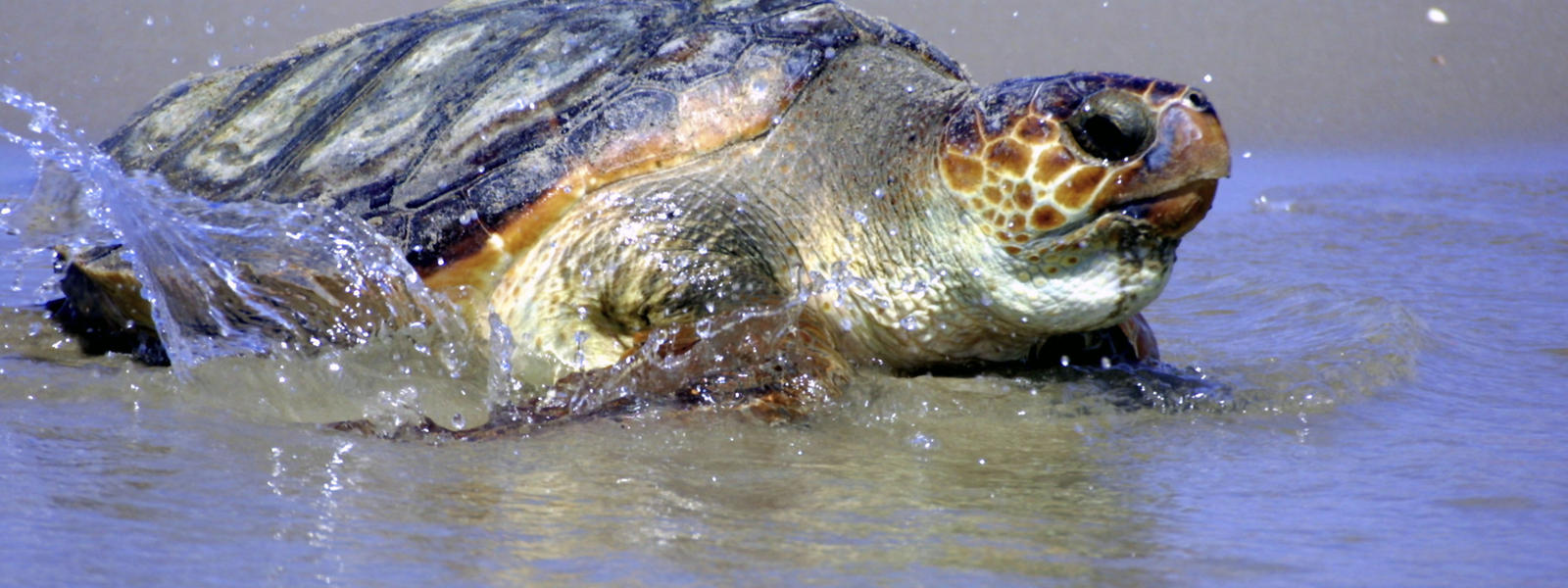
     Volusia County along with many counties in Florida, host the thousands of sea turtles during nesting season. In particular, the Northwest Atlantic Loggerhead (Caretta caretta) is the most common sea turtle found. According to Florida Fish and Wildlife Conservation Commission, Loggerhead turtles usually nest along the coast of Florida from May to October. Every two or more years, female turtles come back to their nesting beach to lay an average of 4.1 clutches (approximately 110 eggs) every 14 days. 

     The gender of many species is established by fertilization. However, reptiles such as turtles’ gender is established after fertilization due to temperature-dependent sex determination. This means the temperature of the eggs during embryonic development factors whether the offspring will be male or female. Loggerheads dig a nest with an average depth of 46 cm, when burying their eggs. The temperature and environmental conditions surrounding the nest during this thermosensitive period (TSP) are relevant after the egg is laid, these aspects influence egg clutches in nests and gender of sex. 


Development period of Loggerhead turtle eggs
     It is known that if the developing eggs are incubated at a temperature of less than 28°C the turtle hatchlings will be male. Warmer temperature above 31°C will result in female offspring. Nests of temperatures in between will produce hatchings of both sexes.

     The day the egg is laid to date of hatching is typically 75-80 days. This process involves a thermosensitive period (Day 28-52) occurring within the middle third of incubation, during this period the embryos gender is determined through temperature pulses.


The objective of research started May 2019 by classmate Jessica Jacono and Dr. Woodall is to determine variations in sand texture between New Smyrna Beach and Daytona Beach. This could be used to answer many questions about the impact sand variation has on the incoming Loggerhead turtle population. Six temperature probes were buried approximately the same depth as turtles dig their nests (46cm). Three sites contained sand from New Smyrna Beach and the other three included sand from Canaveral areas. They were left to record temperatures during the time of nesting season. Recently as of Sept 9th, 2019, they were removed from the sand and we await the results for further observations. Samples of sand from both sites are going to be collected and compared for results of variations. This information could answer the question of how sand variations and the condition of the sand impacts turtles during hurricane season.

***The results of sand sediment will be compared and shared next blog post. 

Turtles return to the same place every year to lay their eggs by sensing the individual magnetic field of the beach where they were born. Each beach has a distinct magnetic pattern which becomes imprinted on a turtle's brain to help them find their way back (stock)
Turtles return to the same beach to lay their eggs by sensing the individual magnetic field of the beach where they were born.

     The article, “How Do Sea Turtles Find the Exact Beach Where They Were Born?” by Carrie Arnold explains how marine reptiles use Earth’s magnetic field to navigate. Scientists have proven many animals travel the sea by detecting the ‘invisible lines of the magnetic field.’ Author Carrie Arnold compares this ability to how sailors use latitude and longitude when sailing the seas. It is truly fascinating that Loggerhead turtles return to the location they were born to mate and lay eggs of their own.

Learning this information, got me wondering.
How is sand sediment impacted by storms and how does that influence nesting season?


     Loggerhead turtles nesting season heavily depends on environmental conditions such as temperature of the sand/ developing eggs. The coastline of Florida is home to thousands of turtles during nesting season each year. This time aligns with hurricane season, occurring June 1st to November 30th. September is the peek of storms, which is also around the end of the nesting season of turtles. It is common that tropical storms such as hurricanes can impact the sand composition along the beach. Therefore, the condition of the sand after powerful storms can greatly affect the outcome of successful hatchings. 


Works Cited:
Arnold, Carrie. “How Do Sea Turtles Find the Exact Beach Where They Were Born?” National Geographic, 16 Jan. 2015, www.nationalgeographic.com/news/2015/1/150115-loggerheads-sea-turtles-navigation-magnetic-field-science/.
Fernandez, Colin. “Sea Turtles Use Earth's Magnetic Field to Navigate Back to Beach.” Daily Mail Online, Associated Newspapers, 12 Apr. 2018, www.dailymail.co.uk/sciencetech/article-5608545/Sea-turtles-use-Earths-magnetic-field-navigate-beach-hatched.html.
“Loggerhead Nesting in Florida.” Florida Fish And Wildlife Conservation Commission, myfwc.com/research/wildlife/sea-turtles/nesting/loggerhead/.
“Loggerhead Turtle.” WWF, World Wildlife Fund, www.worldwildlife.org/species/loggerhead-turtle.


Tuesday, September 10, 2019

Here is my project from last semester. If you see anything that can be improved, please feel free to comment.