
While I was not able to meet with the Environmental Specialist at the Marine Science Center and get fully briefed on the specific experiments being conducted at the MSC, I did continue researching Gorgonian care, feeding and flow rates. While researching a question of how to tell how much a coral is feeding, I was able to find one study conducted by the University of Miami in a Marine Ecology Progress Series that discussed in materials and methods, their way of determining this. After allowing these corals to feed on particulate matter, feeding was detected by determining numbers of prey in the guts of 20 randomly selected polyps through dissection under microscope at 40X.
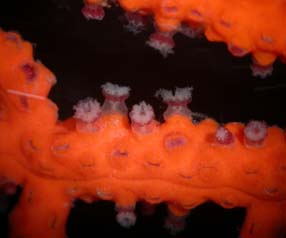 |
| Leptogorgia virgulata with extended polyps |
I read the article Invertebrate Non-Column: Gorgonians discussing the best way to ensure a proper set up and factor in all the requirements to sustain health and encourage growth. While the species discussed in this article are not the specific species I will be studying at the MSC, the same problems must be addressed. Variables such as flow rates, food size, coral position, polyp size all factor in to finding the best possible setup. There are some generalizations that can be made when discussing flow rates and polyp size and that is, generally, the smaller the polyp, the higher the flow rate at which they are able to feed. However, one of the study discussed in this article points out that of the species being studied all fed best at a flow rate of 8 cm/s while another study determined between 10-15 cm/s. Either way, this gives a rough estimate of flow rates at which to start. Also discussed in this article is prey size. As I discussed in my last post, there is a wide variety microscopic prey. While Gorgonians filter feed water, there is a limit to the size of prey items they are able to catch, subdue and devour. Primarily, zooplankton from 100-200 micrometer size range accounts for over 75% of the Gorgonian coral discussed which also has small polyps. The species I will be working with are described as unable to capture zooplankton but feed on particulate matter Artemia cysts.

Paul, this is fascinating. I'm looking forward to more posts from you as you dig deeper.
ReplyDeleteSo--I guess you will be studying polyp gut? If so, how do you do this? How is it removed/stored for study? How many would need to be studied to provide good information?
ReplyDelete