
"Those of us who love the sea wish everyone would be aware of the need to protect the sea."- Eugenie Clark #InternationalWomensDayHey all!
These past couple of weeks have been researching and testing my methods for research. The first time researching myself I wasn't very successful in finding a lot of information. Reaching out and asking those who are more familiar or experienced in the subject tends to pay off, so that's what I did.
I talked with Dr. Osmon, who graced us with her presence the past couple of labs for our shark catching attempts, about my independent research. She lit up, saying she could send me some documents, which led me to some great research that has been done on the environmental factor correlations with shark and ray movements.
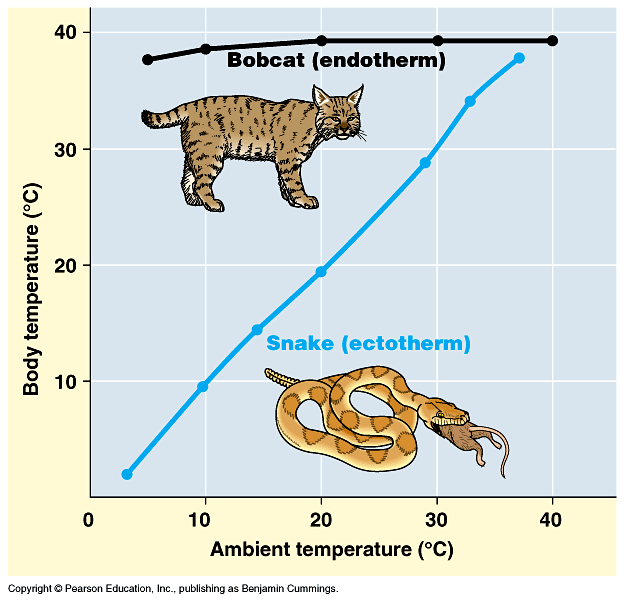
Most sharks (and rays) are ectothermic, meaning they're cold blooded and rely on external sources to regulate their body temperature, some of the most famous being reptiles(like the snake here on the right). The only shark species that are endothermic is the family Lamnidae, also referred to as the mackerel sharks (because that's their preferred food). Some sharks migrate depending on the temperatures, some stay in their "home range", but overall will respond to temperature through movement.
This led me to my favorite new phrase, behavioral thermoregulation, meaning movement to locate a spatially variable preferred temperature range. This way of living might contribute to their way of using energy in more efficient ways, like reproduction. There are many other theories, some tested and some not, but I have a greater understanding of shark movement from this research.
Now as for my own research, figuring out the set up for logging has been a fun ride. There are a lot of factors to consider, but I also have to remember to keep it simple. Understanding more about sharks thermoregulation, I'm excited to see which species that I've chosen have any sort of correlation and the differences between them.
Fins and grins,
Carly
Sources
 |
| Ambient versus body temperature of endo- and ectotherms |
This led me to my favorite new phrase, behavioral thermoregulation, meaning movement to locate a spatially variable preferred temperature range. This way of living might contribute to their way of using energy in more efficient ways, like reproduction. There are many other theories, some tested and some not, but I have a greater understanding of shark movement from this research.
Now as for my own research, figuring out the set up for logging has been a fun ride. There are a lot of factors to consider, but I also have to remember to keep it simple. Understanding more about sharks thermoregulation, I'm excited to see which species that I've chosen have any sort of correlation and the differences between them.
Fins and grins,
Carly
Sources
- Schlaff, A.M., Heupel, M.R. & Simpfendorfer, C.A. Rev Fish Biol Fisheries (2014) 24: 1089. doi:10.1007/s11160-014-9364-8
- https://www.britannica.com/science/ectotherm
- http://faculty.uca.edu/johnc/EndoEctothermTemp.gif

Excellent! I love to see your enthusiasm and all that you are learning. However, please learn how to properly cite your online information.
ReplyDelete