IMES

IMES

Tuesday, March 27, 2018

Karen (UR) Got Weed ?

Have I got your attention now?  Thought so.....  :-)

My Research Project is on Duckweed, Lemna minor, and it's ability to filter excess nutrients (Nitrate and Phosphate) from fresh water. This tiny and I mean tiny plant can do big things.
 

This is what is known: For centuries, in Asia, small scale farmers have used this plant to filter out excess nutrients from their "sludge" ponds.  A sludge pond is where waste is kept, it can be animal or plant waste, and turned into fertilizer. Duckweed also purifies the water so that it can be reclaimed for watering crops and livestock. Because Duckweed can double it's mass in 48 hours it is also used as a high protein food source for humans, animals and fish, it has become a multi purpose plant.  Yes, the plant is rinsed and dried before being used.  Recently the University of North Carolina has been conducting research on this subject.  Many other countries have been using this plant for the above purpose as well.  It has been particularly useful in  the Middle East and Africa.

What is not known:  Is Lemna minor a possible answer for the bioremediation of excess nutrients from fresh water?

My scientific question:  Is there a concentration level that is lethal to the Duckweed?


I will be using these materials:

Distilled Water,  LaMotte Nitrate/Phosphate test kit #3119, 4 1/2 inch Culture Dishes, Miracle Gro 8-7-6 Liquid Fertilizer, Biotronette Mark III Environmental Chamber

Methods:

Using the above materials, 4 culture dishes will be prepared with 150 ml of

DI water and liquid fertilizer, 1 as a control, 3 with duckweed.  
Culture dishes will be placed under plant light in the chamber with 12 hours

of daylight.
Every 48 hours the liquid will be checked for evaporation/transpiration loss

and adjusted accordingly using the fertilizer/ DI water mixture. 
The DI water/fertilizer mixture in the dishes will be tested for Nitrate levels.


References:  
Ansari, A. A., & Khan, F. A. (2008). Remediation of eutrophic water using Lemna minor in a controlled environment. African Journal Of Aquatic Science, 33(3), 275-278. doi:10.2989/AJAS.2008.33.3.11.623
Burkholder, J., Libra, B., Weyer, P., Heathcote, S., Kolpin, D., Thorne, P. S., & Wichman, M. (2007). Impacts of Waste from Concentrated Animal Feeding Operations on Water Quality. Environmental Health Perspectives, 115(2), 308–312. http://doi.org/10.1289/ehp.8839
“Wildflower Preserve Water Quality Initiatives.” Lemon Bay Conservancy, lemonbayconservancy.org/wildflower-preserve/wildflower-preserve-water-quality-initiatives/.


Augustus (UR) - Arguing with Thermometers


While continuing my research on water level variation in Florida, I've stumbled across some very interesting articles. Now the common belief, by who you ask, is that the growing change in sea level is due to growing global temperatures that are increasing water temperatures and melting the polar ice caps, which in my opinion I agree with, but through my research I've learned that there is so much more. I was always so confused when Dr. Woodall wouldn't say this is a "Climate Change” project and now I see why, it's one of the reasons why I couldn't complete my midterm proposal because I wasn't quite sure what my project was looking for.

In a study produced in Geophysical Research Letters, undertaken by the university of Florida the sea levels in the south eastern United States have risen almost 6x faster than the national average through the years 2011 - 2015 and it has less to do with Climate Change than we thought. 
This Graph shows an average sea level increase of 3.2 mm/year

17 of the 18 warmest years in history have occurred since 2001

What is the cause? Well there are a few basic causes one being the melting of land-based ice and two the expansion of water. Now, in water like in most molecules as the temperature increases so does the space between the atoms as they gain more kinetic energy, thus causing an expansion in water, this according to NASA sea level division can cause an increase in sea levels from 0.4 to 0.8 mm. Those two can be attributed to Climate Change but the extreme increase in water level can also be attributed to natural occurring events exacerbated by increased Global Temperatures. These are El Niño which brings warmer air and increased rainfall over the oceans causing localized sea level increases to the south eastern United States and the North Atlantic Oscillation (NAO) which concentrates that warmer air and water by causing a reduction in the atmospheric pressure which can greatly affect water levels. The NAO is a weather phenomenon of atmospheric pressures at sea level between Iceland and The Azores.
Water Level increases during El Nino

 With all this put together sea level rise could increase in Florida faster than anticipated. 

Valle‐Levinson, Arnoldo, et al. “Spatial and Temporal Variability of Sea Level Rise Hot Spots over the Eastern United States.” Geophysical Research Levels, vol. 44, no. 15, 16 Aug. 2017, pp. 7876–7882.

NASA. “Global Climate Change.” NASA, NASA, 3 June 2014, climate.nasa.gov/.

NASA. “Sea Level Change.” NASA, NASA, 3 June 2014, sealevel.nasa.gov/.


“Sea-Level Rise in Florida.” Florida Sea Grant, www.flseagrant.org/climate-change/sea-level-rise/.

Monday, March 26, 2018

"Plastic Problems: Polluting our Seas" UR- Allie Femiano


   The time of industrialization brought a new way of life for humans, many believed plastics to have positively impacted human life. In a way- plastics had freed us from the restrictions of limited resources and adversity the previous generations had faced. The availability and ease of man-made constructed materials authorizes humans to have ideal control over their daily lives. Although, the environment would argue that we are not in control of the impacts of our own influences. 
   By producing plastic in mass quantities, the world had now found a more productive and efficient way to function. However, the use and abuse of these forever materials are discarded improperly at an alarming rate into the natural world. Specifically our seas- by infecting and polluting the waters with toxicity, our marine life is suffering indisputably. By establishing and polluting such material, we endanger and kill many species. 


Related image
Photo by a water filtration company 

IRP Proposal: Microplastics in local fish species

  As most of you are aware, my independent research project is based on data from microplastics discovered in local fish remains. My goal is to collect information from locally caught/ recently dead fish's stomach contents. The accumulation of data from each catch/ collection will reveal a lot of answers to the questions I have about local fish microplastic consumption and answer my scientific question. 

What we know about Microplastic studies in local fish species 

   It's a fairly new study that people have began to pay attention to. Not much data has been documented on this, especially not locally. In the 1970's scientists began to produce records of plastics discovered in the stomachs of sea creatures. Since then, 92 species of fish have been affected and growing. This collected data proves this to be an important research project. We know the seas are filled with tiny pieces of microplastics that once consumed by marine life animals cause mutations and death. In an ecosystem all animals rely on other species for food- one consumption of plastics can spread to more and more animals. Causing the plastic to never break down and to continue polluting and infecting. Not only dangering one species but in turn dangering many more and possibly you (the consumer). 
  
What dont we know?

   Through my research, it has been determined there have not been clear differences in plastic consumption between the pelagic and benthic fishes. It's also prevalent that the plastic micro-pollution and relation to toxicity and impact on the oceanic food chain have also yet to be further studied. All information is also left unanswered on a local scale of which I plan on collecting data from.

My Scientific Question

   Are local fish species suffering from the impacts of microplastic consumption?
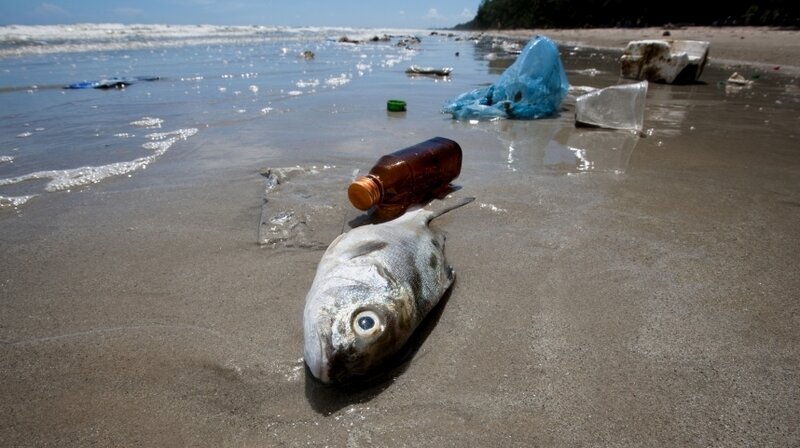
Dead fish captured amongst plastic pollution

My Methods 

   From numerous location, I will collect previously dead/ recently caught fish from fishermen and other local beach goers. Also- reaching out to anyone reading my independent research project proposal, contact me if you have any fish available for me to study. I just request a few environmental notes (long. lat), Fish ID, and initial fish mass.

   As I reach the scene, I will record lat/long, fish ID, mass of fish. Then I will remove the fish's stomach contents, weigh and remove the plastics discovered. After examining the remains I will then weigh the microplastics in proportion to the size of the fish (g of plastic per kg of fish) this will become a median between the data. I will record the data for each individual fish species and create an accurate representation of the data interpreted. For example, are local fish affected by microplastic consumption? Is there an underlying relation to fish species habitat and amount of plastics consumed? 

My Materials 

Gloves, Fish scale, GPS, camera, measuring tape, Fish ID guide, knife 

My Data represented 
These interpretations are still a work in process! I know that I will be including information on type of fish species and amount of plastics found in a bar graph. I also hope to create a graph tying the local data of plastics and relation to fish species habitat (pelagic, bottom dwellers).


Works Cited-
oAmaral, Kimberly. “Plastics in Our Oceans.” Plastics in Our Oceans, www.whoi.edu/science/B/people/kamaral/plasticsarticle.html.

oLonne, Torben. “How Ocean Pollution Impacts Marine Life-and All of Us.” MarineSafe, AlterNet, 3 May 2016, www.marinesafe.org/blog/2016/04/18/how-ocean-pollution-impacts-marine-life-and-all-of-us/.


Michelle (UR) - From Fake Smiles to Bloody Scars: Current and Future Uses of Alginate

I am using my IRP to investigate alginate, and its possible use as a filter for microplastics. My scientific question is can water pass through alginate, and if so, is it a viable filter material?


Makeup mold
Dental mold
What is Known:
Alginate is a seaweed-derived substance that is used in biomedical applications, dental molds, and even as a food thickener. There are both paste and powder versions of alginate, and it can be mixed with different substances based on the desired consistency and properties. Makeup artists use alginate molds for special effects, while dentists use them for prosthetic teeth. In biomedical applications, it is used for a range of applications, from wound dressing to drug delivery.
Microplastics are tiny plastic fibers that are less than 5mm, or 1/5 of an inch. These are too small to be removed at wastewater treatment plants, and end up in the environment. Microplastics are a result of larger pieces of plastic that have degraded, or fibers that are manufactured that small. Manufactured microplastics include the fibers of synthetic clothing, which release over a thousand microfibers per wash.


Carolina Biological's Alginate Powder
Materials and Methods:
The materials that I will be using are alginate powder from Carolina Biological, distilled water to mix with the powder, lab dishes and beakers, and screens.
Example of filter backing
The first step will be to test the alginate for different consistencies and thicknesses. Each thickness will be tested for water permeability. This will be done by testing how much water passes through the filter in a predetermined length of time. The three thicknesses that allow the most water through in the fastest amount of time will be chosen for use as filters. These filters will be made using two screens each. The screens will be utilized to limit the amount of large particles from potentially contacting the alginate, as well as to help lower the amount of water pressure on the alginate. The screen will be backed in a crisscross shape, similar to an air filter. This shape will be used for additional strength and stability. Each filter will be tested for the amount of fibers that are collected, as well as the sizes of the particles. I intended to represent the results using two graphs.
This graph does not represent real data; only an example of anticipated results

This graph does not represent real data; only an example of anticipated results
The scatterplot will represent any possible correlation between the thickness of the alginate and the amount of water filtered. The water will be measured in mL per minute. The column graph will represent the amount of each size particle the filters collect.

What if it fails?
If water cannot pass through alginate, that would still be a good result. Instead of making a filter, I would concentrate on attempting to make environmentally friendly, truly disposable cups, plates, and utensils.


References:
Browne, M.A., Galloway, T.S., & Thompson, R.C. (2010). Spatial Patterns of Plastic Debris along Estuarine Shorelines. Environmental Science & Technology, 44, 3404-3409. http://pubs.acs.org/doi/abs/10.1021/es903784e
Carolina Biological (n.d.) Sodium Alginate. https://www.carolina.com/catalog/detail.jsp?prodId=888171&s_cid=ppc_gl_products&utm_source=google&utm_medium=cpc&scid=scplp888171&sc_intid=888171&gclid=Cj0KCQiA2Y_UBRCGARIsALglqQ2Bu4Bw1zd8nrqxnT5xou9IrHOx9ih5FaQZzmbajqxVMToyvWVA31EaAosqEALw_wcB
EnvironMolds, LLC. (n.d) The Many Uses of Alginates. https://www.artmolds.com/alginate-uses
Instructables. Alginate mold photo. https://cdn.instructables.com/FLA/03U5/H0OIZSUN/FLA03U5H0OIZSUN.LARGE.jpg
Lee, K.Y., & Mooney, D.J. (2012). Alginate: properties and biomedical applications. Progress in Polymer Science, 37(1), 106-126. http://doi.org/10.1016/j.progpolymsci.2011.06.003
Nandini, V.V., Venkatesh, K.V., & Nair, K.C. (2008). Alginate impressions: A practical perspective. Journal of Conservative Dentistry: JCD, 11(1), 37-41. http://doi.org/10.4103/0972-0707.43416
Stan Winston School. Alginate dental mold photo. https://www.stanwinstonschool.com/ckeditor_assets/pictures/1103/content_mark-viniello-cynthia-garza-molding-casting-prosthetic-fake-teeth-tutorial-mini-lesson-009.jpg?1357935904
Yang, Y., Rodriguez-Jorquera, I.A., McGuire, M., & Toor, G.S. (2015). Contaminants in the Urban Environment: Microplastics. EDIS Publications. http://edis.ifas.ufl.edu/ss649

Jenna Westfall(UR)- Plastics Vs. Birds

Hi everyone! I know it’s been confusing because I’ve been back and forth with different topics but finally, Renee and I have decided to do a project together. We will be researching the different kinds of birds around the area and see what type of species usually hangs out around the beach more. We will research what they eat and how often they are there also how long they stay near the beach or if they stay there all year long. We still have to figure out who will be researching what exactly. We will be splitting it in half so she will research some and i will research some but I’m super excited. We will be researching micro plastics in the birds. Can’t wait!