IMES

IMES

Tuesday, February 13, 2018

Karen (UR) Ducktales

Wow !!  A tiny little "nuisance" plant has the potential to do big things !

I have found so much research on Lemna minor that I don't even know where to start.  Suffice it to say, there are endless possibilities here so I am keeping my IRP to measuring the Nitrate levels in the water.  There is research being conducted, at Wildflower Preserve in Florida, on removing excess nutrients introduced by treated wastewater effluence when the land was being used as a golf course.  Their research has shown high levels of nitrogen, phosphorus and chlorophyll in their test ponds.  Additionally, I have found some interesting articles from the African Journal of Aquatic Science on the remediation of eutropic water using Lemna minor and one on the NIH (National Institute of Health) website on bioremdiation for CAFO's (concentrated animal feeding operations). 


For my IRP, I will be using the Biotronette Mark III Environmental Chamber in the lab on the South campus in New Smyrna Beach.  This will allow me to monitor the plants on a daily basis.  I will be purchasing the Lemna minor in order to have a clean specimen.  Originally, I had planned to "fish" it out of a local pond, but after careful consideration, I was concerned about bringing unknowns into the lab area.  I plan on using 3 culture dishes, 1 will be a control, 1 will be a steady state and 1 will have 1/2 the plant matter removed weekly.  The culture dishes I will be using are 4 1/2 inch diameter with a 250ml capacity.  I will be using DI water (distilled water) and adjust the liquid volume to 150ml to account for the plant matter. The levels of nitrate will be monitored every 48 hours as well as the evaporation and transpiration rates.  Water levels will be adjusted accordingly. I will be adding a nitrogen fertilizer to the water every 48 hours also.  Due to the time constraints, because of spring break, I will not begin the experiment until March 19.
Environmental Chamber

 
Culture Dish


Ansari, A. A., & Khan, F. A. (2008). Remediation of eutrophic water using Lemna minor in a controlled environment. African Journal Of Aquatic Science, 33(3), 275-278. doi:10.2989/AJAS.2008.33.3.11.623
Burkholder, J., Libra, B., Weyer, P., Heathcote, S., Kolpin, D., Thorne, P. S., & Wichman, M. (2007). Impacts of Waste from Concentrated Animal Feeding Operations on Water Quality. Environmental Health Perspectives, 115(2), 308–312. http://doi.org/10.1289/ehp.8839
“Wildflower Preserve Water Quality Initiatives.” Lemon Bay Conservancy, lemonbayconservancy.org/wildflower-preserve/wildflower-preserve-water-quality-initiatives/.


Monday, February 12, 2018

Jordan (UR) The Feeble Oyster vs the Mighty Microplastic

        One of my favorite foods of all time, is steamed oysters with crackers, so when I was told about microplastics found in oysters, I was understandably concerned. Am I eating oysters full of plastic? I needed answers, which is one of the places my idea for the IRP, along with Dr. Woodalls guidance, came from. For my IRP I will be surveying the number of micro plastics found in maricultured clams or oysters from the Mantanzas inlet against oysters that have been growing naturally in the Halifax river or Indian River.
Dinner 
    We already know that micro plastics in the ocean are a huge problem, however it seems to be based upon location, and season, according to one study done on filter feeding sharks and rays in the Philippines. So my scientific questions is will oysters that are harvested during winter, spring and the beginning of summer have different concentrations of microplastics. I may also include a separate group from each that are harvest before a storm, and harvested a few days after it has stormed. I do think that there is a correlation between runoff and the amount of plastics found in oysters and other filter feeding organisms around the Florida Coast. Please let me know what you think of these ideas. 


Saturday, February 10, 2018

Hannah Vu-Bennett (UR): Toxic water


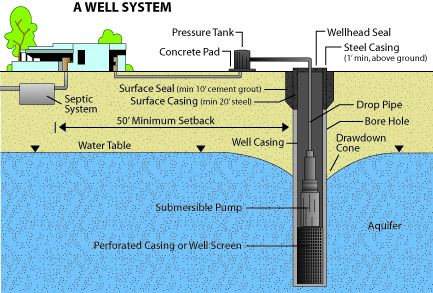
For my IRP, I want to test well water throughout Volusia County for possible contaminate.  The majority of the water we use for daily living is pumped from aquifers beneath us. Due to the porosity and permeability of Florida’s surface, it makes it easier for chemicals and toxic waste to leach into our aquifers. Our groundwater is not only vulnerable to toxic runoff, but the impacts of over pumping and development could lead to saltwater intrusion. It’s a difficult and costly process to reverse the effects of saltwater intrusion. Although our drinking water is filtered through water treatment plants and filtration systems, it’s not uncommon for aquifers to be contaminated.
Image result for aquifer pumping system florida
This is a representation of a Well system pumping water from an Aquifer.

Every year during hurricane season, toxins are more likely to enter aquifers through storm surges and flooding. Floodwater is contaminated with toxic bacteria and chemicals which is then absorbed into our groundwater, affecting public, as well as private water supply.  The effects Hurricane Irma had on our environment lead me to wonder on the safety our water and what possible impacts the hurricane had on our aquifers.
Image result for aquifer contamination
This image shows the process of contaminated groundwater can go.

Friday, February 9, 2018

Cynthia UR Nature Bound

I am disappointed, some things just require time you won’t have in a semester. Pushing on, because there is always more.
I’m not one to write what isn't pertinent to say, but perhaps a few lines that encourage others not to give up maybe in order.
Sometimes, we accept a plan we know nothing about in hopes we will learn what will make it a desirable concept. When we leave ourselves open to possibilities anything can happen, and I think maybe it will.
My IRP will examine to what extent seawater maybe anthropologically effected by a heavily suburban populated area. Raising microorganisms in samples taken from four sites along the east coast of Florida and the use of information by those scientists whom conducted experiments already and shared the results. They will be identified and differences recorded. 
I will share if what you can’t see may harm you.
It will be a surprise like the sudden appearance of a Ghost Crab. 

Where does your garbage end up? UR-Allie

My idea for my IRP involves the relationship between deaths of oceanic wildlife and human impact on the environment. Ever since the beginning of time, human beings have created and produced a life to tailor our wants and needs. People idolize a world of simplicity and ease. However often when thinking this way, people seem to only focus on the right now and not what the impact these things will have on the future. Unfortunately artificial objects that we love so much such as plastic, rubber and other various synthetics are being left discarded into our seas. Human influence impacts the environment and habitat for the oceanic wildlife greatly and ultimately, our fish are paying the price.


My scientific question is, what happens once plastic goes into the ocean and what can we as the species that introduced this to the natural environment, do now? To know more about this topic I had to research a little about plastic. I wanted to know how much of it is involved in our lives and also how much of it we dispose into our oceans.


Plastic is everywhere and anywhere you look in the modern world. I'm not just referring to the 5 water bottles most people consume a day or the container your lunch came in. This also includes TVs, keyboards, computers, screens, glasses, contact lenses, phones, cars, ect. Its overmanufactored and become a natural go to for people to consume. For all of its benefits, the good outweighs the bad. The environmental issues plastic will leave on this world will be forever.


http://www.abc.net.au/news/science/2017-02-27/plastic-and-plastic-waste-explained/8301316


Niki UR Live every week like it's Shark Week

When I moved to South Carolina in 2013, I had no idea that I would be spending a lot of my free time fishing for sharks. I caught mainly black tip pups, but the entire experience has left me wanting so much more! My obsession has only grown in the last few years, and i've become a little disappointed in the amount of research done on sharks in general. There's so much we don't know!
For my IRP, I want to be able to discover more about the sharks that are living in my own backyard. I have done some research and found that apparently the Indian River Lagoon serves as a bull shark nursery!
newly tagged bull shark pup ready to be released

Female bull sharks usually give birth in the north of the lagoon every spring, leaving the pups on their own until they are ready to become offshore adults in October and November.
This seems like the perfect opportunity to gather as much data as I can about the bull shark pups that live in the Mosquito Lagoon and the Indian River. I would prefer to do a study of the growth of these pups over time, however I am concerned with the amount of data I will actually be able to collect out in the field.
Any suggestions are welcome, please! I do not currently have the equipment to be able to capture these sharks or accurately collect any data. (such as shark weight, water measurements, etc)


https://jacquithurlowlippisch.com/2014/07/18/the-indian-river-lagoonthe-most-significant-bull-shark-nursury-on-the-u-s-atlantic-coast/

https://www.researchgate.net/publication/233147673_Seasonal_Distribution_and_Habitat_Associations_of_Bull_Sharks_in_the_Indian_River_Lagoon_Florida_A_30-Year_Synthesis

Augustus UR What Could've Been and What Might Possibly Be

As with everything I choose to not make things very easy for myself and this IRP is no different. My interests are so far between that it makes it hard to choose then when I do make a decision its a little bit out of my pay-grade. So I will share to you what could've been my IRP and baring a miracle might still be...

     My project was going to be on the DDT levels in the waters of the Indian River Lagoon. Some of you might know Volusia/ Brevard county is "renovating", for lack of a better term, the Indian River area. By renovating they are destroying mangrove trees and either burying them in the river or just cutting them down. These trees are very old which means when the United States used to use DDT back in the '40s, '50s and '60s, before being banned in the '70s, these trees absorbed the chemicals through the water and other ways and since DDT has a half life of 150 years it stayed in the trees until now, since they're being cut down that DDT is leaking back into the water and possibly affecting the marine life of that area. Now to explain what DDT is, it is a very powerful pesticide used primarily in Florida to control the Mosquito population back then but the EPA later banned it from use in 1972 because of the affects on Marine life.
An Dichlorodiphenyltrichloroethane molecule or DDT for short


So with all that said the question I wanted to answer was: Are the DDT levels rising again in the Indian River Lagoon and could the mangrove trees be the cause of this? Doing a quick search on the Daytona State Library I found the last paper written about this was in 1980 which even include a method they used to test the sample which is much safer than the other method of digesting the sediment with extremely harsh acids. While searching I also found a DDT fact sheet both of which I will include the links to here:
DDT fact sheet

1980 DDT research

*I'd include the sources they cited but its about two pages long

If I can't do this research I will need to come up with a new research idea and I am totally open to listening to any of my classmates!

Thursday, February 8, 2018

Ray, UR, I'm Not a Flamingo!


  If you are in Florida and see a pink bird flying over-head, you are most likely seeing the Roseate Spoonbill, which is commonly confused with the Flamingo. The Roseate Spoonbill is not a Flamingo, they are not even related. Although, like the Flamingo, they are thought to have the same process of developing their pink feathers by eating a diet of carotenoid-rich organisms like shrimp. The Roseate Spoonbill has not been well researched like the Flamingo. I think this is one of the reasons why they are being mis-identified and shoved to the side. I mean really, have you ever seen a Spoonbill lawn ornament? Does nobody care about this incredible, cutlery-shaped, pink and red bird?!
NOT A FLAMINGO
My scientific question is: Are Roseate Spoonbill populations decreasing?

 Yes, this seems like a relatively easy question to gather information on, but when I started to indulge myself I could not find any solid answers. In fact I found three articles that seem to have different opinions of this species status. From what I gathered, it seems that this species is not threatened on a global scale, but state-wide they are imperiled. Also, they are not listed Federally. I am inclined to believe that their populations are on the decline due to major habitat loss and disturbance here in Florida, but I could be wrong. The Roseate Spoonbill is known to make a come-back. About one hundred years ago they were hunted to near extinction in the famous plume trade of the late 1800’s, with a record of only 15 breeding pairs left by the early 1940’s. However, in the late 70’s the breeding pairs peaked to around 1,300, then apparently started to decline in the 80’s, and went back up in the 90’s (FWC 2003). So, how are their populations doing today? I have not been able to find an internet resource for this question. There really has been very little research on this magnificent bird. My goal is to speak up for our pink, native bird and get some more published research out there!
My educational tool. 


http://www.fnai.org/FieldGuide/pdf/Ajaia_ajaja.PDF
http://www.eol.org/pages/1064972/overview
Cited works:
Florida Fish and Wildlife Conservation Commission. 2003, January 6. Florida's breeding bird atlas: A collaborative study of Florida's birdlife. http://www.myfwc.com/bba/ (Date accessed 02/08/2018).

Michelle (UR) - Microplastics, Oysters, and Filters, Oh My!

I am going to attempt to create a filter to capture microplastics before they enter the environment. The filter is going to be based on the way oysters filter water, since they are known to contain plastics. Oysters are pretty hardworking, with the capability for a single oyster to filter more than 50 gallons of water in a day. The water enters the oyster, and the pumping of the gills forces the water and nutrients through the stomach, excreting the waste (or, in the case of microplastics, not...).
Photo courtesy of Adrian B. Jones and Nigel P. Preston
I believe this pumping action is one of the keys to creating a viable filtration system. The filter must act more as a muscle than a traditional filter. I have been doing research into the use of static electricity to capture the microplastics. My research is still early, but an electrostatic charge could possibly attract the microplastic particles, preventing escape from the filter. I have also considered whether using a membrane-type design would be more beneficial than a traditional filter design.

Sources:
Chesapeake Bay Program. (n.d.) Oysters. Retrieved from  https://www.chesapeakebay.net/issues/oysters
Jones, Adrian B. and Nigel P. Preston. Biofiltration of Shrimp Pond Effluent by Oysters in a Raceway System." [PowerPoint Slides]. Retrieved from http://slideplayer.com/slide/8732045/
Williams, Lyle. (2017, March 2). We struck plastic...Again. [Blog Post]. Retrieved from https://oce1001lab.blogspot.com/2017/03/lyle-ur-we-struck-plasticagain.html