IMES

IMES

Thursday, February 25, 2016

Rachel UR-- Skates vs Rays, The Identity Crisis of the Sea

           Hello fellow bloggers! In this weeks blog I bring to you one of the biggest mysteries of the sea, what's the difference between a skate and a ray? First, let's take a look at one of the most common ray seen off the coast of Florida, Dasyatis Sabrina, more commonly known as the Atlantic Stingray.
Dasyatis Sabrina, commonly known as the Atlantic Stingray


   The Atlantic Stingray is normally found in coastal waters including but not limited to estuaries, lagoons, and sometimes rivers. They feed off of benthic (occurring at the bottom of a body of water) organisms such as small crustaceans and shrimp. Occasionally they will feed on small fish that swim near the bottom. Rays generally are a non-aggressive, but they do have a barb near the base of the tall that they use for self-defense. Rays also give birth to live young. The Atlantic Stingray normally has about one to for pups per pregnancy. The Atlantic Stingray is shaped like a pancake. They have a slightly pointed nose with the fronts of the wings rounded, which can reach up to 2 feet in diameter.                                                                                                        


Raja Eglanteria, commonly known as the Clearnose Skate
   The Clearnose Skate on the other hand is shaped like a spade.  The front part of the wings come in at an angle and can reach a diameter of 2.5 feet. They are most commonly found in coastal waters but can live at depths of up to 1,000 feet. These skates also feed on benthic creatures including small squids and fishes. Clearnose skates do come into estuaries and bays to reproduce. Unlike the Atlantic Stingray, skates use small leathery like egg sacks to protect their young. These egg sacks can wash up on the beaches and are often called mermaid purses. These purses can reach lengths of 9 cm and widths of 5.7 cm. A single female clearnose skate can lay as many as 66 eggs sacks in a single reproductive season. They also lack the barb that stingrays have. In the barbs place is a row of spiny scales along the back of the ray.

Clearnose Skate egg case often called a mermaid purse
     My plan for my IRP is to find these eggs cases as they wash up on the beaches and take measurements from year to year. By doing this I can monitor the eggs for any changes or any egg cases that might indicate an invasive species.


Citations:
1)Skates: Clearnose Skate. (n.d) Retrieved February 20, 2016, from http://myfwc.com/research/saltwater/sharks-rays/ray-species/clearnose-skate/

2) Stingrays: Atlantic Stingray. (n.d) Retrieved Febuary 19,2016, from http://myfwc.com/research/saltwater/sharks-rays/ray-species/atlantic-stingray/

3) Raja Eglanteria (Clearnose Skate). (n.d.). Retrived February 23,2016, from http://www.iucnredlist.org/details/161658/0


Wednesday, February 24, 2016

Renee; UR: Welcome to the 21st century kids!!

I may not be able to get my mitts on a flying car yet (darn you Back to the Future for lying to me!) but there are a lot of awesome bits of tech to make life as an undergraduate researcher easier! For examples lets consult some highlights from my materials list thus far:

BLU is headquartered in sunny Miami FL
and has proven to be a leader in affordable
no contract smartphones.
1) My shiny new Studio X cell phone from BLU (Bold Like Us) 
 This baby has some impressive specs (the details of which you nerds out there can check out at your leisure via the website linked above) considering it isn't carrier specific and cost me less than a smooth Benjamin ($100). 
For my IRP I will be using the GPS locator services to tag my sample locations for mapping purposes and future reference, taking picture with the 8 megapixel camera (a megapixel refers to the image size when a digital picture is taken) for documentation purposes and most fun of all the latest Collector App from ESRI will help me with data collection in the field and make future GIS analysis easier.
You may remember I mentioned this app previously in my introductory post and I am looking forward to becoming more familiar with it and all of its functions during this study.
Ohaus- starter water
analysis pen meter


2) Precision Beyond Balance ST Series Pen Meter by Ohaus which I will be using to measure redox reaction(an oxidation-reduction (redoxreaction is a type of chemical reaction that involves a transfer of electrons between two species) these reactions involve gaining or loosing electrons and it is this electron change which the device measures from my understanding. I'm still figuring this fancy redox thing out so if anyone has some helpful links please leave a comment and share the wealth of knowledge.


The rest of my materials list is less exciting but no less important as you can see below.
Materials
  • Measuring tape
  • 10, approximately 1-cup containers
  • clean trowel
  • plastic flags
  • cloth for cleaning trowel between samples
  • 2mm mesh slieve (per Ag Extension processing requirements)
  • 10, wax free, 2.5x3 inch bottomed paper bags (per Ag Extension processing requirements)
  • Sharpee Marker
  • Soil Test UF Ag Extension paperwork
My process still has a few kinks to work out...
My biggest problem right now is going to be finding a place to air dry my soil samples as is required for the Ag Extension to test the samples and sifting the soil to meet the Ag Extensions testing requirements. I'm sure once I give Dr. Emmett and Dr. Woodall a poke we will be able to work it out. The sifting I'm not so confident about...
Next I need to fill out the first wave of Ag Extension paperwork and find out when they will accept my samples.
The next part is fairly easy: go into the field and take the samples!

Procedure: Root Zone Samples
  1. determine reference pitcher plant specimen
  2. document GPS location of sample and corresponding reference specimen with Collector App*
  3. measure distance of no more than 6in from base of pitcher plant specimen's vegetation and mark with flag.
  4. document the aforementioned distance
  5. use trowel to collect approximately 1-cup of dirt making sure to stay within the top 5in of soil.
  6. close sample container tightly and label container with specimen number and date. This data will also be added to Collector App*
  7. thoroughly clean trowel
  8. take redox measurement and enter in Collector App*
Procedure: Distance Samples (I'm still working on this title)
  1. determine a reference pitcher plant specimen
  2. measure a distance of at least 3 feet along ecotone (an ecotone is the transitional area between two major ecosystems, see the picture below for a good illustration of an ecotone; for my study the ecotone's exact location is not yet defined) from the reference specimen
    Here is a nice diagram I found on the Google to help explain
    where the ecotone  is.
  3. document GPS location of sample, corresponding reference specimen and distance from reference specimen with Collector App*
  4. use trowel to collect approximately 1-cup of soil, being sure to stay within the top 5in of soil
  5. close sample container tightly and label container with specimen number and date. This data will also be added to Collector App*
  6. thoroughly clean trowel
  7. take redox measurement and enter in Collector App*
* Note: as this is a 'field test' of the Collector and relying purely on tech can end in disaster even in the 21st century any data recorded during my study will also be taken in good ole hard copy format in the lovely field journal we all have come to know and love. :)

Procedure: Post Sample Collection (a work in progress)
  1. spread out samples in individual, contained and labeled areas to air dry
  2. for each sample label a wax free, 2.5x3 inch bottomed paper bag (per Ag Extension processing requirements)
  3. prepare any necessary shipping paperwork and container to ship samples in
  4. once the samples are dry sift each sample individually using a 2mm mesh sieve
  5. (I need to consult Dr. Emmett on what we should do if none of the samples will filter through such a small gauge sieve... o.0... Any process we may have to add would go here)
  6. place samples in their corresponding, pre-labeled paper bags
  7. pack bagged sample in order for shipping to UF Ag Extension
  8. (I need to consult Dr. Woodall on if my samples will be shipped from Daytona State College or if I will be making a trip to the post office. My money (and hope) is that shipping will be from the college)
Just for fun: Dr. Woodall trying to explain to me how to
use the Hach DR/890 Colorimeter which measures turbidity
while I took 'photo-documentation' of our field
excursion last Friday.

Q&A
Q: Deb n' Paul (Dr. Woodall)
Ok so here is your correction. When citing an e.g., article within your 'article' it should be e.g., Wheeler, E., et al., 2010. the et al lets the reader know there are other authors and you should always include the date since Mr. Wheeler likely had publications from other dates. Also--thanks for giving those great definitions of terms I'm unfamiliar with! It really helps!

A: Yay!!! You do love me after all! lol
but seriously, thank you for the et al and date tip. I went and made a big note on my apa citation guide about it. Citation is my Achilles heel here and I need all of the help I can get.
I'm glad you appreciate the definitions. I get so used to using big technical words that I don't realize I've lost people most of the time. The exception being my mother cause she interrupts me mid-sentence to inform me she left her dictionary at home. She isn't very happy when I remind her Google is just a few taps away on her fancy shmancy Iphone. ;)

Samantha, CUR- $3.6 million Park.

          First of all I would like to say kudos to the St. Johns River Water Management, Department of Environmental Protection Department of Transportation as well as Brevard County for funding and managing this project. As we all know the Indian River lagoon is a imperative and biodiverse estuary in Florida associating specifically with my hometown, New Smyrna Beach.  Although expansive in range(156 miles) and covering about 40% of the Atlantic Coast of Florida, the estuary has not fared well in the midst of the ever-increasing human population and associated activities that have been detrimentally effecting the environment.  As of 2015 citrus fields gave way to a park of ponds to capture fertilizer-laden runoff from Barefoot Bay and surrounding areas that one ended up in the Indian River Lagoon.
A map highlighting the features of the Wheeler Stormwater Project in Southern
Brevard County 
 The new Wheeler Stormwater will catch pollutants from a 21,000-acre watershed before they can reach the North prong of the St. Sebastian River which feeds into the IRL.  The project was completed in May 2015 and other opportunities such as walking trails and kiosks will be completed by the end of 2016 and open to the public in approximately one year.  The series of ponds will keep a yearly average of 16,753 pounds of Phosphorus and 27,223 pound of Nitrogen from entering the lagoon, according to the district. Each pound of those nutrients have a potential to grow 500 pounds of algae!
Work continues on the Wheeler Stormwater Park Project, a 300-acre facility designed to capture pollutants in stormwater such as nitrogen and phosphorus. Collected stormwater will be filtered through a series of interconnected ponds that will capture the majority of pollutants before the water is returned through the Sottile Canal to the St. Sebastian River. The four-year project is scheduled to be completed by the end of the year. (ERIC HASERT/TREASURE COAST NEWSPAPERS)
"The more of these we do the more of Phosphorus and Nitrogen we take out of the system, but don't expect the lagoon to bounce back overnight," said Duanna Defresse, director of the Indian River Lagoon National Estuary Program.


Garland, Ed.(2015 November 17).$3.6 Million Micco Project to cut pollution to Sr. Sebastian River, Indian River Lagoon nears completion. Retrieved from http://www.tcpalm.com/news/indian-river-lagoon/health/36-million-micco-project-to-cut-pollution-to-st-sebastian-river-indian-river-lagoon-nears-comple-230-351015481.html. 

HWRA.( 2016 February 18). SJRWMD, partners celebrate project aimed at cleaner Indian River Lagoon. Retrieved from http://www.tampabay.wateratlas.usf.edu/hrwa/newsletters/HRWA%20Newsletter%202-18-2016.pdf

Sunday, February 21, 2016

Dave, UR - Understanding sound propagation

People are critical of sound effects in sci-fi films, because sound isn't propagated through a vacuum. After all, there is no atmosphere to conduct sound waves forward from their source. Many people take the transference of sound waves through our own atmosphere for granted, and even more people assume that sound travels through water the same way it travels through air. This is not only false, but sound actually gets conducted through water better than it does through air--farther and faster.

In the same way we breathe air and not water, this begins by understanding that water is more dense than air.  As the image on the right reflects, water density helps capture energy and transmit it much better than air, because the molecules are more tightly packed.

This is the point at which we believe that we should be able to capture much more specific signals from underwater organisms, than we could above the surface.

To that end, and in order to refrain from wasting time and materials, I am currently researching much more specific information on both the transmission of sound energy through water, as well as what attempts have been made to do so, from an engineering perspective. If you would like to follow along, I have cited the sources I am presently reading in order to refine our design idea. I have been reading largely about how sound moves through water, and what approaches have been taken towards acoustic collection, but the bottom resource also discusses how dolphins collect, and since they are our target organism, I'd prefer not to ignore nature's approach either.

Bibliography:
Vigoureux, P. (1960). Underwater Sound. Proceedings of the Royal Society of London. Series B, Biological Sciences, Vol. 152, No. 946, A Discussion on the 'Ear' Under Water (Apr. 26, 1960), pp. 49-51.  Feb 2016.

Martinez, J., et al (2011). Design and Implementation of an Underwater Sound Recording Device. Multidisciplinary Digital Publishing Institute-Sensors. 2011,11,8519-8535; doi:10.3390/s110908519

Branstetter, B. K., Mevissen, S. J., Pack, A. A., Herman, L. M., Roberts, S. R., & Carsrud, L. K. (2007). Dolphin (Tursiops truncatus) echoic angular discrimination: Effects of object separation and complexity. Journal Of The Acoustical Society Of America, 121(1), 626-635. doi:10.1121/1.2400664

Friday, February 19, 2016

Emily UR - Stormwater Runoff and Atmospheric Deposition Studies

Quick review: My IRP is focusing on the nutrient pollution originating from stormwater runoff of two different stormwater management ponds (SMPs), one located in a very urban setting & the other located in a county park. During my library research, I found my topic of interest to be a rather uncommon study but was determined enough to find two well-executed studies addressing a similar issue. The first study, titled "Storm Water Quality of First Flush Urban Runoff in relation to different Traffic Characteristics" was definitely the most helpful because it studies various sorts of stormwater runoff pollution in varying traffic conditions which allowed the Swedish researchers to make a positive correlation between high traffic volume and excess pollutants found in stormwater runoff samples.1 This study, along with the information learned these past two weeks about rainwater (via the Chapter 3 slides in Aquatic Environmental Science) have given me a wonderful foundation on which to begin my research.
First, the conditions of the two sites being studied need to be examined for their exposure to nutrients from fertilizers, information which can gathered from the home-owners association for the Halifax Plantation location and the Volusia County Parks & Recreation department for the Tuscawilla Park location. Next I'll have to take to the internet to find what other sources of nitrogen and/or phosphorus my SMPs are exposed to which can help to differentiate between actual stormwater runoff and pollution originating from atmospheric deposition. The latter source research was addressed in a different article titled "Source Identification of Florida Bay's Methylmercury Problem: Mainland Runoff Versus Atmospheric Deposition and In situ Production" which found that more pollution was originating from atmospheric precipitation than from stormwater runoff.2
In preparation for next week's blog and actual water sample collecting, I plan to conduct further research into the appropriate amount of samples to collect before, during and after a rain event as well as  how much of said water sample will be needed to obtain an accurate measurement of nutrients.
Halifax Retention Pond Location (one or the other, not both)
Note it's location, behind housing, surrounded by golf courses &
adjacent to I-95.

Tuscawilla Retention Pond Location.
Note it's location as well, exposed to more nature than roadways.
Citations:
1. Czemiel Berndtsson, J.. (2014). Storm Water Quality of First Flush Urban Runoff in relation to different Traffic Characteristics. Urban Water Journal, Vol.11 (Issue 4), p284-296. 13p. Retrieved from http://eds.a.ebscohost.com.db06.linccweb.org/ehost
2. Rumbold, D. G., Evans, D. W., Niemczyk, S., Fink, L. E., Laine, K. A., Howard, N., Krabbenhoft, D. P., Zucker, M.. (2011). Source Identification of Florida Bay's Methylmercury Problem: Mainland Runoff Versus Atmospheric Deposition and In situ Production. Estuaries and Coasts, Vol. 34 (Issue 3), p494-513. Retrieved from http://link.springer.com.db06.linccweb.org/article/10.1007/s12237-010-9290-5
Pedro UR; Canal Curiosity
Charles Faulkner has concerns of quality in the water around his neighborhood. My IRP will be to conduct a series of test in the canals and try to pinpoint a particular source which may be causing poor water quality. Mr. Faulkner has concerns that the city of Flagler Beach Water treatment facility may be a threat to the water quality due to previous assessment preformed by the Department of Environmental Protection.

https://www.google.com/maps/search/palm+coast+treatment+plant+site3/@29.4805632,-81.1315601,102m/data=!3m1!1e3   (Google,Map data 2016)

 I used google maps to measure the distance from the facility to the mouth of the canals and it is just over 1Km away.
there see to be only one way for water in or out of these canals I'm looking forward to find out more

Lilli UR -- Microplastics, What Are They and Why Should You Care?

Hello all and welcome to my weekly science-fest. This has been a busy, long, productive yet sad week. Other than receiving some disheartening news, I have continued working on my IRP which concerns micro-plastics in the ocean environment. After speaking with both Dr. Woodall as well as Angela I have come to understand that there are different types of oceanic plastic material. Which include what is referred to as micro plastics and are tiny fibers, and microscopic pieces of plastics that have degraded from larger pieces of plastics that have found their way into the ocean. But also includes micro-bead "plastics" which from my research I have come to understand are sometimes made of a wax material as opposed to plastics but these micro beads can also be made of plastics as well depending on the source of the beads. You can learn a little more here Oceanic Micro-Plastics, this an article I pulled from the DSC library database. I did not find much about general plastics in the ocean on my initial search, however there was some localized pieces about S. Korea, as well as Cambodia and the polar waters of the Arctic. There was also an article on the DSC library data base that spoke of how these micro-plastics specifically affect wildlife and the marine environment which you can check out here Micro-Plastics and the Marine Environment. 
Microplastics under a microscope
I also spent some time at the Marine Science Center this week with Mallory who taught me how to filter sea water and how to identify micro-plastics that may be present. Above is a nice example of what they actually look like under a microscope.Mallory informed that although they have yet to find micro beads they continue to look but they find an abundance of the fiber plastics (which are the hair like objects in the above picture). This was an amazing experience and one I am very thankful for. Not only did I get to see some micro-plastics and learn about the processes and materials used in not only finding but identifying them, I also got some great pictures of wildlife at their facility. Not to mention I almost got to see some whales off New Smyrna Beach but got lost on my way to where they were, next time gadget, next time.
A very cute little seahorse at the MSC

One of my favorites...a horseshoe crab

The downright biggest hermit crab I've ever seen!

I also learned about some pretty disturbing things when I was with Mallory, she spoke of how these micro-plastics end up in the ocean by trash dumping and then due to the UV rays of the sun as well as activity from wildlife such as nipping and attempting to ingest the larger pieces, become degraded to the point where they are so small the fish and other marine wildlife mistake them for food and ingest them, which as you might suspect is toxic to them. This information is also mentioned in both the first and second article I linked to so it was no surprise to hear Mallory mention it as well.  So in light of that particular piece of information I have included the photo below to perhaps encourage you to pack out what you bring onto our beaches and leave only footprints behind you in respect for our fellow creatures.
If this doesn't break your heart we cannot be friends :(
So my fellow bloggers, classmates and friends I leave you with one final thought and image. There is a giant patch of garbage that just floats around in the Pacific Ocean adding to the growing problem of these micro-plastics in our marine environments and it is called the Great Pacific Garbage Patch (no, really, it is). I was totally clueless about the existence of this "island" of trash that we, unfortunately, created until first taking Oceanography 101 with Dr. Woodall.  It just sits out there polluting our oceans, destroying our wildlife and yes, in case you were wondering, in some cases finding its way microscopically into your food.Which, in my opinion is not only a pretty big reason to care but (for me at least ) yet another reason to be a vegan!
Just a small portion of the Great Pacific Garbage Patch
So before you bring your groceries home in those plastic bags or purchase that "pretty" new fleece jacket consider the ocean and its inhabitants and remember -- Reduce, Reuse, Recycle, Refuse. There is also a website run by Dr. Maia McGuire from the University of Florida, where you can learn all about how you can get involved and make a positive impact on this growing problem which you can find here Florida Microplastics. There is wonderful information, educational materials for yourself as well as the public such as brochures and other pamphlets you can print if you are so inclined and a great pledge you can take to reduce your plastic footprint (not sure if this is a term but it should be ) which I have taken myself and would encourage all of you to consider as well. Dr. McGuire also provides information about the methods and materials she uses as well as a handy guide to identifying micro-plastics with some great pictures. She also details how one can become a volunteer and get involved in her efforts and provides some excellent resources as well as instructing you on how to log what you find and the hours you spend collecting, filtering and analyzing for those of you who may be interested. 
Until next week my friends, be happy, be safe and remember our friend Mrs. or Mr. sea turtle.


P.S. I have tested all of these links during the creation of this blog post but if anyone finds they are not working or you are unable to access the information please let me know so I can fix it as soon as possible. 


RESOURCES

Katsnelson, A. (2015). News Feature: Microplastics present pollution puzzle. Proceedings of the National Academy of Sciences of the United States of America, 112(18), 5547–5549. http://doi.org/10.1073/pnas.1504135112

M. M. (n.d.). Be Plastic Aware! Retrieved February 18, 2016, from http://stjohns.ifas.ufl.edu     /sea/microplastics/index.html 

Shim, W. J., & Thomposon, R. C. (2015). Microplastics in the Ocean [Abstract]. Archives of                Environmental Contamination and Toxicology, 69(3), 265-268. Retrieved February 18, 2016, from http://link.springer.com.db06.linccweb.org/article/10.1007/s00244-015-0216-x


Victoria UR- "They caught A Shark, Not THE Shark"

Found in an article titled Satellite Tagging: Expanded Niche for White Sharks a study using pre-dated satellite tags set on six different white sharks. It revealed the travel paths of each shark, as well as "pressure, temperature, and light-level data taken at 2-minute intervals" giving insight into where white sharks go, what temperature ranges they can survive in, and how often they visit the shorelines, near human activity.

Boustany, A. M., Davis, S. F., Pyle, P., Anderson, S. D., Le Boeuf, B. J., & Block, B. A. (2002). Satellite   tagging: Expanded niche for white sharks. Nature, 415(6867), 35+. Retrieved from   http://go.galegroup.com.db06.linccweb.org/ps/i.doid=GALE%7CA187492037&v=2.1&u=lincclin_ccla&it=r&p
=AONE&sw=w&asid=8693647c898749299e71a216bb0e9c3a

Tagged white shark
(Great White Sharks are only called white sharks in the science community because there are not another white shark by name, so the "great" is not needed)
In another article called Vulnerability of the Oceanic Whitetip Shark to Pelagic Longline Fisheries, 11whitetips were tagged and tracked with pop-up satellelite archival tags (PAT)


Table 1.  Meta data of the oceanic whitetip sharks tagged in the western Atlantic Ocean.
Information from 8 of the 11 tagged sharks and when the tags popped up


     Tolotti MT, Bach P, Hazin F, Travassos P, Dagorn L (2015) Vulnerability of the Oceanic Whitetip Shark to          Pelagic Longline Fisheries. PLoS ONE 10(10):e0141396. doi: 10.1371/journal.pone.0141396


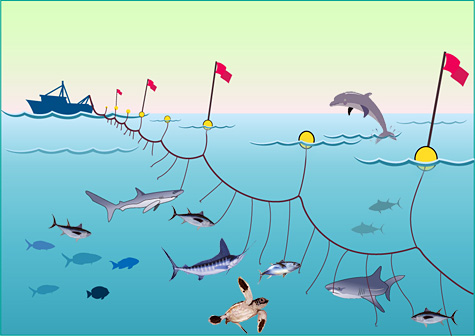
For many catches, the method of actually catching the specimen can vary greatly depending on the target species. For the most part, a long line is used for a great range, with many hooks, giving a greater chance of catching multiple sharks, and a variety of species. A drumline can also be used, which consists of an anchor and a buoy with a long hook centered in between the anchor and buoy, which can only catch one specimen and limits total catch. Also, a drumline is usually used in deeper waters where a longline can be short or long depending on which line length is used in the water.


Drawn longline, shows how many possiblilities as well as the chance of bycatch.

Drumline

Thursday, February 18, 2016

Deanna, UR- Red Drum Studies

Since Red Drum is an extremely popular sport fish species here in Florida, and also known to be a decent meal, their populations are of interest for conservation reasons. Thusly, resulting in regular stock assessments and enhancement studies. One study I found focused on the movement patterns of adult red drum here in Florida lagoons. In fact this study was done in a northern part of the Indian River Lagoon and Mosquito Lagoon.

IRL and Mosquito Lagoon - location for movement
pattern study
For this study forty-four red drum were caught, tagged and released from May of 2006 through June 2007. Fish in this study were caught by various methods, either different types of nets (some targeting red drum schools), some were donated by local fisherman and others were caught on hook-and-line (which will also be my method when it comes to my IRP). And of these forty-four fish, "All fish exceeded the 457–685 mm (18–27″) total length slot size in Florida and were not legally harvestable" (Reyier, E.). These fish were sedated, had a few scales removed, coded acoustic transmitter was inserted in each fish, and they were weighed and measured. After the sedation wore off the fish were safely released. This study tracked the forty-four fish over the time period of May 2006 until September 2008, and most of these fish had returned to or remained in this estuary for this time period. Eleven of these fish had left the area and never returned and, ten had been tracked for several months than disappeared (suggesting death or removal of the tracking device). This study proves what I had previous learned (from the FWC website) that red drum remain in estuaries and other inland water bodies until they get larger and then move into the ocean (which seven of the eleven fish in this study were tracked actually did this) some returning multiple times before spawning and after spawning season.
Example of a tagged red drum.

Another study was done in Tamps Bay, and focused on stock enhancement focusing on recreational fisheries. This study took different information from stock assessments (age, mortality, population, catchability, voluntary release rate, etc.), and all things considered, this study determined that stock enhancement may increase the socioeconomic objectives associated with recreational fishing but do come at a cost. This was shown by the increase in the total fishing effort and the satisfaction (of the fisher) in certain stock enhancement scenarios is directly related to an increase in the amount of vulnerable fish Camp, V., 2014).
 
FWC's stock enhancement hatchery - this is actually for
 several different important marine fish
species and bivalves.
This study brought to my attention that stock enhancement for red drum is not a popular thing. In fact, the only study I have come across about it discusses how Florida only does small-scale stock enhancements for red drum, and most of which are research based (Camp, V., 2013). While Texas is known for large-scale red drum stock assessment (they release millions of red drum a year). This study states that stock enhancement in Florida is not large-scale due to fairly low survival rate of the released red drum. However, like this study states, could be due to "lack of stakeholder motivation to advance production level enhancement" (Camp, 2013). Which could simply mean the stakeholders are satisfied with the increased numbers of wild red drum over the last twenty years.
 
 
Citations:
Reyier, E., Lowers, R., Scheidt, D., Adams, D. (2011). Movement patterns of adult red drum, Sciaenops ocellatus, in shallow Florida lagoons as inferred through autonomous acoustic telemetry. Environmental Biology of Fishes, 90(4), 343-360. Retrieved from http://link.springer.com.db06.linccweb.org/article/10.1007/s10641-010-9745-3

Camp, E. V., Lorenzen, K., Ahrens, R. M., & Allen, M. S. (2014). Stock enhancement to address multiple recreational fisheries objectives: an integrated model applied to red drum Sciaenops ocellatus in Florida. Journal Of Fish Biology, 85(6), 1868-1889. doi:10.1111/jfb.12548
Chicago/Turabian: Author-Date
 
Camp, E. V., Lorenzen, K., Ahrens, R. M., Barbieri, L., & Leber, K. M. (2013). Potentials and Limitations of Stock Enhancement in Marine Recreational Fisheries Systems: An Integrative Review of Florida's Red Drum Enhancement. Reviews In Fisheries Science, 21(3/4), 388-402. doi:10.1080/10641262.2013.838075

Chris Browne, UR - Smyrna Bacteria

E. coli
     Bacteria can be beneficial or harmful, and sometimes the amounts of bacteria present can be a normal setting for any marine coastline environment. Dr. Woodall has instructed me that the primary purposes of my IRP will include the datum results of bacteria in the Canal Street inlet, as well as researching the impact that bacteria has had on similar environments (Muirhead, 2006). Local, International, rural, and urban areas have had many studies done, as the where our waste ends up, is where our society would be wise to manage effectively.
Canal Street Inlet
     Bacteria can have detrimental consequences to our human health, as we live and work in the coastlines. Most coastlines are fished and harvested regularly (Cooke, 1976). The health of the organisms in these environments are important in many ways. Specifically the shellfish and benthic organisms that clean our waterways are in jeopardy. As stewards of our environment, keeping a keen eye on our micro biotic ecosystems (Drexler, 2014) will prove significant as they set the stage in the macro environment.
     Ranges of attempts have been made to address bacteria in our environment. Taking studies from the effects of disinfection of our own waste water could be considered (Blatchley, 2007). E. coli and other food borne bacteria is a common problem for urban environments (Ibekwe, 2011). Too much anaerobic bacteria can cause massive area deaths of beneficial plants and animals. Those areas, in turn can then become toxic other areas as tides move in and out. My IRP will focus on all these areas, and shed some light onto downtown New Smyrna.  
E. coli petri dish test

~CMB

Blatchley, E. (2007). Effects of Wastewater Disinfection on Waterborne Bacteria and Viruses. Retrieved from Water Environment Research Vol. 79, No. 1, January 2007: Stable URL: http://www.jstor.org.db06.linccweb.org/stable/23805205
Cooke, M. (1976). Antibiotic Resistance Among Coliform and Fecal Coliform Bacteria Isolated from Sewage, Seawater, and Marine Shellfish. Retrieved from Antimicrob Agents Chemother. 1976 Jun; 9(6): 879–884.: PMCID: PMC429643
Drexler, J. (2014). Marsh soils as potential sinks for Bacteroides fecal indicator bacteria, Waccamaw National Wildlife Refuge, Georgetown, SC, USA. Retrieved from Water, Air, & Soil Pollution. 225.2 (Feb. 2014):: DOI: http://dx.doi.org.db06.linccweb.org/10.1007/s11270-013-1861-1
Ibekwe, M. (2011). Microbiological Evaluation of Water Quality from Urban Watersheds for Domestic Water Supply Improvement. Retrieved from Int J Environ Res Public Health. 2011 Dec; 8(12): 4460–4476.: doi: 10.3390/ijerph8124460

Muirhead, R. (2006). Interaction of Escherichia coli and Soil Particles in Runoff. Retrieved from Appl Environ Microbiol. 2006 May; 72(5): 3406–3411.: doi: 10.1128/AEM.72.5.3406-3411.2006


Samantha, CUR- NO SWIMMING


A green harmful algae bloom in Florida's IRL.             
               Imagine walking from your car to the beach on a hot sunny day in Southeast Florida.  The smile on your face begins to fade when you see an unusually green water and a sign that reads, "No swimming allowed; harmful algae bloom present." 
Map of the Indian River Lagoon showing the
five main segments, 20 sample sites and
four reference sites.

The IRL watershed is massive and populated by nearly 1.7 million people.  Rainfall events cause episodic discharges of groundwater contaminated with septic tank effluent into nearshore waters, enhancing eutrophication.   Nutrient Pollution is a primary driver of eutrophication and harmful algae blooms in estuaries and coastal waters worldwide. In 2011-2012, sites evenly distributed throughout the 251-km long Indian River Lagoon (IRL) were assessed during three sampling events of dissolved for dissolved nutrients(DIN,SRP,TDN,TDP) and chlorophyll a.  Sea water samples were collected at 20 fixed sites in the IRL.  Each site sampled three different times within a two year period.  Nitrogen was found in high concentration through the IRL especially in northern parts(Volusia County's IRL). Associated with high Nitrogen concentrations a were harmful algae blooms.  As discussed in Nutrients and the Indian River Lagoon, more action needs to be taken in monitoring a specific point source, discharging into the IRL.  This being said  leads to my Independent Research Project (IRP), Monitoring water quality within the Canal Street Canal.  For information on what is already known about this canal area as well as the water quality within read Measuring Water Quality Parameters.   My site was chosen beginning with the founding of hypoxic water conditions monitored in this canal by colleagues, Dr. Woodall as well as myself (noting this area is associated with a storm drain system).   The discharge basin (5x8 box culvert) runs South starting at the northern part of Canal street collecting approximately 170.6 acres of runoff. In order to set up experiments to measure the water quality within the canal there are commonly used tools and methods such as; YSI85(measuring dissolved Oxygen, Conductivity and Salinity), Van Dorn(to take surface and depth samples within the Canal), HACH DR/980 colorimeter(for nutrients and copper concentrations).

Measuring chlorophyll in the lab using 90% Acetone,47mm filters and of course the
Fisher Scientific Filtration Device.

Citations:
(1) (K Fegley, City Engineer of New Smyrna Beach, September 2015)

(2) Anderson, Sean. Sewage Pollution running amuck in Florida's Indian River Lagoon. Retrieved from http://oceanbites.org/sewage-pollution-running-amuck-in-floridas-indian-river-lagoon/

Renee; UR: Trichomes, ants and public service announcements, OH MY!

I would like to start off with some kudos to Kristen our favorite librarian for her Botany Research Guide! It was full of all sorts of articles about pitcher plants including one which detailed some of the unique features of the Okefenokee subspecies of S. minor (Sarracenia minor). One particular detail concerning trichomes (Trichomes are hair-like growths that form on the epidermis or outer "skin" of plants) caught my eye. It struck me as very odd that the pitchers of S. minor okefenokeensis would be taller than my S. minors but then exhibit fewer trichomes when it is generally hypothesized that these trichomes help the plants prey of mostly crawling insects reach the opening of the pitchers. (Stephens, J. D)
This fancy fellow is Dorsera tokaiensis,
a hybrid created in Japan and a favorite for terrariums!

Trichomes are important for other plants including my second favorite category of carnivorous plant the sundew. These often little guys have impressive trichomes that secrete a sticky fluid which helps them catch, hold and digest prey. The fluid contains digestive enzymes but they aren't potent enough to hurt the curious passerby if you should be so inclined as to poke one. Sundews come in many shapes, sizes and colors as you can see to the left and below. (Per Dr. Ray Emmett's Native Plants class)
As the weather warms up sundews like this Drosera capillaris
will be popping up to keep my pitcher plants company at Longleaf
Pine Preserve!


I also found a fascinating study concerning the protective advantages of the ants that S. minor specializes in. It was observed that the presence of ants deterred female Exyra  semicrocea, better known as the pitcher plant mining moth, from laying her eggs on the pitchers effectually saving the plants from being devoured by the moth's caterpillars; however, other sites dominated by the fiercer fire ants we as Floridians should be familiar with would likely ...


This scary dude is a grown by Sunbelle Exotics
in south Florida. Guess who my newest pitcher
will be once I get some extra cash?

...experience benefits against larger herbivorous because of these ant's naturally higher levels of aggression. This scenario was not obsurved during the study however and remains an intuitive hypothesis. (Wheeler, E.)

To the left is another species of pitcher mentioned in the previously mentioned study as an example of pitcher plants that without question use ants as a defense mechanism. It is a Nepenthes bicalcerata which is endemic (a fancy word for a plant or animal that is native to or restricted to a certain area or country) to Borneo but is sold commercially. In the wild this plant actually houses the ants in the hollow tendrils that the pitchers hang from and the ants in turn defend the pitcher from weevils!

This pitcher was so wonderfully unique I couldn't help but include it! Nepenthes bicalcerata's common name is the fanged pitcher plant. (I wonder why, any guesses?) It's from the same family as I suspect my plant babies are!!(remember them from my previous posts?)


Citations:
Stephens, J. D., Godwin, R. L., & Folkerts, D. R. (2015). Distinctions in Pitcher Morphology and Prey Capture of the Okefenokee Variety within the Carnivorous Plant Species Sarracenia minor. Southeastern Naturalist14(2), 254-266.

Wheeler, E., Rossi, A. M., Moon, J., Moon, D., Mckelvey, L., Elias, S., Depaz, J. (2010). Ants provide nutritional and defensive benefits to the carnivorous plant Sarracenia minor. Ocelogia, 164(1), 185-192  

A Brief Public Service Anouncement:
For anyone in Volusia county or who plans to move to Volusia county in the future there is a new Wetland Review Ordinance being proposed by the county. 
From what I understood of the public presentation slide show given on February 8th that is posted at the Volusia County Wetlands Ordinance Discussion webpage on the county website the only major change to what is currently held as a standard by the St. Johns Water Management District is that areas marked as Priority Review Wetlands would require a 50ft buffer rather than a 25ft buffer between the wetland and any development. 
I encourage everyone to check out the webpage and bring any questions or concerns to the county's attention now. Those in Ormond may want to talk to the city as I was told they have already been rather vocal in their concerns about how businesses and homes along the Halifax River will be effected but the proposed regulations.

Friday, February 12, 2016

Emily UR - Flooding in the Florida Flatlands

Tuscawilla Parks soft-shelled turtle.
She lives in the main retention pond.
Living, working and going to school in Florida, we all know two things that are very characteristic of our beloved sunshine state. The first being that this state is disturbingly flat and the second being that it rains a lot. Humans are intelligent and adaptive creatures though, so over the years we've been able to control flooding through the implementation of storm drains and Stormwater Management Ponds (SMP), also referred to as retention ponds, which are constructed basins designed to hold stormwater and its associated runoff from higher elevations. Stormwater runoff can be defined as the "water flowing over the land during and immediately following a rainstorm.1
A great blue heron feasting on a water snake
in the Halifax retention pond. (This took place
in my backyard, cool to wake up to see)


SMPs serve two main purposes: to limit flooding and to catch (urban) runoff pollutants. During a rain event, stormwater will be essentially guided into an SMP, picking up everything from fertilizers and sediment to decaying animal feces along the way, which can dramatically affect the overall quality of these ponds. In fact, "statewide, stormwater (as compared to regulated discharges such as sewage and industrial treatment facilities) is the source of (1) 80 to 95 percent of heavy metals; (2) 99 percent of all sediment; (3) 90 percent of oxygen demanding substances (i.e., decaying plant or animal material); and (4) 50 percent of the nutrients".2 High enough concentrations of nutrients from fertilizers, such as nitrogen and phosphorus, with the appropriate meteorological conditions can cause massive algal blooms in these ponds, effecting the various creatures that reply on these ponds for food and as a habitat. In fact, the St. John's River Water Management District (SJRWMD) suggests that SMPs have a higher potential for a bloom due to their concentration of stormwater runoff in combination with "lots of sunlight, warm temperatures and shallow, slow-flowing water."3
For my research, I have selected two particular retention ponds to study and compare. The first pond is located in the heart of the Halifax Plantation in Ormond Beach, a very urban setting, where it is exposed to a great deal of fertilizers from surrounding golf courses and newly constructed homes. The second pond is located in Tuscawilla Park in Daytona Beach, a more natural setting, where it is also exposed to fertilizers as well as pesticides.
So finally, my scientific question is, "After a rain event, which retention pond is more heavily polluted by nutrients?". My follow-up question, if you could call it that, is, "Are the sources of the pollution found, if any, from urban runoff or atmospheric composition at the time of a rain event?". Other factors to consider would be the amount of total suspended solids (TSS), pH, salinity and dissolved oxygen content of the water.


And for the sake of Valentine's day being around the corner,
this birdy was making the moves in front of Tuscawilla's other
retention pond.
Citations:
(1) Wetherell, V. B., & Chiles, L. (n.d.). Stormwater: A Guide for Floridans. Retrieved from www.dep.state.fl.us/water/nonpoint/docs/.../Stormwater_Guide.pdf
(2) U.S. Environmental Protection Agency (EPA). (2016) Facts about Stormwater Management Programs in the State of Florida. Retrieved from http://nepis.epa.gov/
(3) St. John's River Water Management District (SJRWMD) (2014, June 03). Understanding Algal Blooms. Retrieved from http://floridaswater.com/algae/