IMES

IMES

Sunday, February 22, 2015

Robin, UR..... "How Oyster Mats are Made"

 Until further notice my project is to create  oyster mats without plastic, So I needed to see how the plastic mats were made with the plastic mats in order to get an idea.
 Google provided me with some great images and after talking with Annie Morgan last Friday, it all starts with donations of recycled oyster shells, which are then washed and set to air dry for one to several months, purchasing of plastic matting and zip-ties.
 After the drying process it is now time to drill holes and with large plastic zip-ties they are fasten to the plastic mats as shown below.


 Once the mats are assembled they are transported to destination and with cement sprinkler holes they are again zipped-tied together to hold  them in place.


I hope to continue with this project and if I do my next blog will be on the natural oyster beds and a little comparison in order to get some ideas.


Saturday, February 21, 2015

Jody, UR.... Guess what I found out during my chlorophyll sampling!!!


Graph from Chlorophyll Class


First of all my chlorophyll readings were the highest (surprise!!) of all the samples submitted for lab class with Pond#1 at 35.76 µg/L, and Pond#2 at 34.891µg/L with an average of the two samples at 35.326 µg/L. Here is my graph from class as a comparison. This sample was taken from a pond that is surrounded by golf course on all sides and cannot get it's water from any other source than surface runoff from our property.


 I chose this site having a suspicion that it would have higher numbers because it is surrounded buy golf course on all sides and only has one point of overflow, also it does not get treated (more on that to come). Also we have very recently put down granular fertilizer on the tee's and have had two rain events since, so I am sure the runoff from those rain events has had an opportunity to get in the pond and begin to exacerbate the organic growth.
My future water samples will, I'm sure be more specific for phosphates and nitrates and possibly copper among others, to get a better understanding as to what is going on in these lakes water chemistry with input from these anthropogenic impurities.


In my attempt to not be totally negative on golf course impacts on the environment I have to try and balance my blogs so here is an article I found in my research regarding water birds and golf courses. Even if it is a study sponsored by the US Golf Association I know it has some value because we have a lot of aquatic birds constantly feeding in our lakes. MORE TO COME>>>     


Friday, February 20, 2015

Todd UR, updates

From advice on a prior blog and personal advice given from Dr. Woodall it was suggested that I narrow my ideas.  In doing so my main focus will be:  Does the Tomoka landfill affect the water quality of the Tomoka River?  Important chemicals I want to test for are staying the same:   They are according to Cornell University they do define known contaminants as having "a high biochemical oxygen demand (BOD) and high concentrations of organic carbon, nitrogen, chloride, iron, manganese, and phenols. Many other chemicals may be present, including pesticides, solvents, and heavy metals" (Cornell Waste Management Institute).       
Further advice from the professor suggested that I concentrate more on sampling methods.  some suggestions were : Transect.. dilution, tracer  ….    I am kind of unclear about the tracer method.  I would like further advice on the tracer method aspect because from class I see it used in a reference to determine if air quality is from natural or man made aspects and.  The articles I have read concerning anything tracer, their method uses a dye or something they added to the water to determine flow.  Since the river starts at the area I want to test the direction of the flow is obvious.
Tomoka River 

Amanda, UR, Wading anyone?

This is a sample site for me.
When I pulled up this picture in my phone the lat/long coordinates were actually off a bit, as I note below the following image.

I don't know if you can actually see the little green "x"s that I drew on the map around the water body to the far left; however, if you can, the "x" in the circle is where my phone pinpointed my location and the free standing "x" is where I actually took the photo above. You can actually access all of these lakes by trails or by kayak.
My phone put my lat/long at 29◦16’29.6”N 81◦04’15.0”W, which is actually still in my neighborhood and not at the site where I actually took the picture.

Thursday, February 19th I did go get my very cold water samples from Central Park closest to my house. I now have the lat/long coordinates that I was able to pull up from the computer as 29.273023 lat/ -81.072640 long.
My anticipation is mounting as I await our lab today to see what lurks beneath the surface of these waters.

Thursday, February 19, 2015

Paul Ferguson, UR - Troubles in keeping Gorgonians


While I was not able to meet with the Environmental Specialist at the Marine Science Center and get fully briefed on the specific experiments being conducted at the MSC, I did continue researching Gorgonian care, feeding and flow rates. While researching a question of how to tell how much a coral is feeding, I was able to find one study conducted by the University of Miami in a Marine Ecology Progress Series that discussed in materials and methods, their way of determining this. After allowing these corals to feed on particulate matter, feeding was detected by determining numbers of prey in the guts of 20 randomly selected polyps through dissection under microscope at 40X.
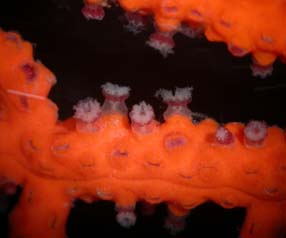
Leptogorgia virgulata with extended polyps
 I read the article Invertebrate Non-Column: Gorgonians discussing the best way to ensure a proper set up and factor in all the requirements to sustain health and encourage growth. While the species discussed in this article are not the specific species I will be studying at the MSC, the same problems must be addressed. Variables such as flow rates, food size, coral position, polyp size all factor in to finding the best possible setup. There are some generalizations that can be made when discussing flow rates and polyp size and that is, generally, the smaller the polyp, the higher the flow rate at which they are able to feed. However, one of the study discussed in this article points out that of the species being studied all fed best at a flow rate of 8 cm/s while another study determined between 10-15 cm/s. Either way, this gives a rough estimate of flow rates at which to start. Also discussed in this article is prey size. As I discussed in my last post, there is a wide variety microscopic prey. While Gorgonians filter feed water, there is a limit to the size of prey items they are able to catch, subdue and devour. Primarily, zooplankton from 100-200 micrometer size range accounts for over 75% of the Gorgonian coral discussed which also has small polyps. The species I will be working with are described as unable to capture zooplankton but feed on particulate matter Artemia cysts. 

Crystal UR - Make way for Wawa!

Adjacent to my work, there is a construction project to build a much anticipated Wawa. What interesting to note about this project is that prior to construction there was nothing there. When I say "nothing," I don't mean a vacant wooded lot. I mean there was nothing but a hole connected to a small sink hole lake. Meaning construction could not commence until the hole was partially filled. I plan to sample the water of this small lake and another pond nearby as a control so see what, if any, havoc construction has caused.


Wednesday, February 18, 2015

Courtney, UR- Biomedical Bleeding of Horseshoe Crabs

Blood harvesting of live horseshoe crabs
Limulus amebocyte lysate (LAL) is a pharmaceutical product that can only be obtained from the blue blood of horseshoe crab, It is used to ensure that vaccines and medical equipment are bacterial free which makes it lifesaving to humans. Each year almost half a million live horseshoe crabs are harvested for their blood and they are heavily bled, taking 20-30% of their blood. Unfortunately about 20-30% also die due the blood harvesting. 

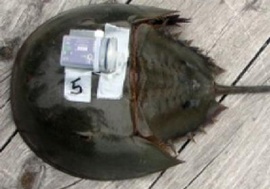
This device is the accelerometer used to track the movements before blood harvesting. 

Researchers in this article, "Biomedical Bleeding Affects Horseshoe Crab Behavior", were curious as to exactly how many of the released horseshoe crabs are falling into the same fate and to help answer this question researchers monitored the movements of captured crabs for a week  before taking blood from them. "Electronic data recorders called accelerometers that measure the crabs’ speed and direction were strapped to their backs and the crabs were placed in running wheels in tanks filled with seawater." It was noticed that the horseshoe crabs moved less and seemed almost disorientated for up to two weeks after the procedure.
spawning horseshoe crabs
Horseshoe crabs are harvested in the middle of their spawning season because they are easily captured by the thousands but if taking their blood alters their behavior in negative ways then could this make them less likely to breed? If so then this could be a huge factor in the declining populations of horseshoe crabs along the east coast of the United States.


Researchers in the recent article believe that with improved capture and transport methods as well as wait until the end of the breeding cycle could drastically improve the declining population numbers of these unique and crucial creatures!


Taylor - UR - An Experiment on Octopus Enrichment

Today I went to the Marine Science Center to speak with Chad Macfie who is the Environmental Specialist and Live Collection manager there along with Dr. Amy Osmon from DSC about an experiment we could work on with the octopus located at the MSC. I was able to see the octopus and get some information on it's personality. Just like most animals, each one has its own personality and ways of going about its instinctive nature. As for the octopus at the Marine Science Center, since they brought him in on January 29th, they have found him to be reclusive and prefer to stay in his lair most of the time. He will come out during feeding times and enrichment sessions with toys and puzzles. Fortunately, I was able to see an enrichment display done by Chad to see how the octopus reacts with toys and give it some "play time." The octopus almost came fully out of his lair during this play time, but it didn't last long until he decided to hide away again.

But what exactly is enrichment? In the article "Enrichment for Giant Pacific Octopuses: Happy as a Clam?" it is explained that animals kept in captivity need environmental enrichment for their well-being. Environmental enrichment is, "an animal husbandry principle that seeks to enhance the quality of captive animal care by identifying and providing the environmental stimuli necessary for optimal psychological and physiological well-being." So in a less confusing definition: environmental enrichment is a principle that stimulates an animals senses to keep it physically and mentally healthy. As an example, the octopus at the MSC will play with toys or try to get food out of a jar or snorkel tube. This gives this invertebrate physical and mental stimulus that keeps them "happy" and healthy. In some ways, its just how humans react to stimuli. When we get bored, we find something to entertain us, if we don't find anything that keeps us entertained then we tend to get tired and unhappy. This goes just for any animal, especially animals with a higher "intelligence" or more adaptive brain. Enrichment also helps with stress and negative behavior. If an octopus is having a hard time adapting to it's environment and is unhappy, it will instigate negative behaviors such as swimming sporadically around the aquarium, hitting their heads against the side of the tank and in some extreme cases, begin to eat themselves (this is a disease that is common in all octopi, but is only exposed when an animal is stressed and their immune system decreases. Such is the same with a human, if you have a virus inside your body and your immune system is weakened by outside sources, the virus will then attack your body.) So, enrichment is an extremely important factor when taking care of captive animals.

So from talking over some of the wonderful articles Chad gave me, working with Dr. Osmon and debating on what kind of experiment we could actually take data on with enrichment, we all finally came up with a plan. The octopus in the aquarium is again, very reclusive; he hinds under a rock with a barrier of smaller rocks and barnacles and doesn't seem very social. Since the octopus is new at MSC, he hasn't been worked with as much except for the feeding times and enrichment periods throughout the day. He is fed raw food, but Chad has introduced a concept that I will be able to play a role in; which will be to introduce live food to the octopus. Over the period of a few weeks, we will be documenting and taking data on the level of activity that is induced from different enrichment and feeding periods, along with timing how long it takes for the octopus to come out of it's lair to interact with us. I will be creating a data sheet that will then be filled out as we watch the octopus interact with it's new surroundings.
There is a lot going into this Independent Research Project and I could not be more excited to see if we can make this reclusive octopus a more social one!

Monday, February 16, 2015

Jody, UR....More Being Reveiled About Golf Course Ponds!

HOLE #16
A few more questions that were asked regarding my IRP on Golf Courses impacts on the Aquatic Environment are as follows. Can you tell us more about the ponds and lakes created for golf courses? e.g., are there size and depths requirements? When they are created, are there steps taken to prevent groundwater seepage? Are they monitored for water quality? If so, for which parameters and how often? 
 I will answer these the best I can from my 20+ years of golf course construction experience and then with a little research.
BIRDSEYE VIEW
There are three main reasons reasons for ponds on golf courses. First as I stated in an earlier post they are in place to capture water (precipitation) to be used as irrigation, because purchasing water from a municipality for said would be cost prohibitive. Second the material (dirt) excavated from them is used throughout the rest of the course to give it it's topography, raised Tee's and Green's complexes and other undulations. These are set forth by the designer on a set of plans and followed by the contractor. And third as you can see by this picture (above left) of  hole #16 a par 3 at my course, they give the course character by adding visual aesthetics and also making play a little more challenging. The size, depth, and amount of ponds/lakes are usually set forth by the designer but site characteristics will usually nudge these specifications a bit.Take for example the the long pencil lake at the bottom center of the picture at left. That is our main lake and it is 11 acres. That is where our pump stations are that deliver the irrigation water to the other 120 grassed acres. I have no idea how deep it is to the bottom but at full pond we have five+ feet of water over our intake for the pumps. Lets see.... that's 17,921,640 gallons if it is five foot deep.  To be continued!


Saturday, February 14, 2015

Robin, UR... Frequently Asked Questions


Hello Everyone it has been a few weeks, but I am here to share a few obscure research hang ups I have.
When I am researching I always find my-self in the "Frequently Asked Question" section and it never seems to disappoint me.


I was searching articles for information on Oyster Bed Restoration when I found myself in the FAQ section and this one question caught my attention: #10 "What are the environmental benefits of the oyster restoration project?" the answers, which I am going to share with you because I believe it sums up the reason, the whole ideal interests me for my IRP.

  •   The reefs will provide an increase in essential habitat available for many species of invertebrates besides oysters, such as shrimp, clams, snails, crabs, as well as may species of fish.
  • A large oyster population will effectively filter more water in the estuaries. When fully populated with oysters, the reefs will be able to filter the total volume of the St. Lucie Estuary in about one month.
  • The improvements in water quality will lead to expanded seagrass growth, which creates important fish nursery habitat.
  • Oyster reefs along with mangrove and other plantings will serve as effective shoreline stabilizers, helping to combat erosion.     


This one FAQ is one of the reasons I wanted to be in the Environmental Science Technology field. The Idea of a little physical outside work, proper education and some guidance, in being good stewards in helping planet earth for future generation is a job I am willing/wanting to take.

Friday, February 13, 2015

Rob - UR - Indian River Lagoon Recovering

Well, after last week's blog post, I wanted to continue on with some more information regarding water quality issues in our immediate area. I came across this article from September 2014 which addresses some of the local happenings. Apparently, some good news is on the horizon as the Indian River Lagoon seems to be making a turnaround after 3 years of being plagued by Brown Tide, waterway clogging algal blooms, fish die-offs and a still unidentified die-off of dolphins and manatees. 


So moving past 2012-2013 and into 2014 and beyond things are definitely looking up. New water quality monitors have been providing a continuous stream of data to be analyzed. The Indian River Lagoon is showing vast improvement in the expanse and density in sea grass beds, and along with this recovery, many other species are returning to repopulate the area including seahorses and crustaceans.

Another area showing signs of improvement are the oyster beds, with a marked improvement in growth over the preceding 2 years. Finally, although the algae which are responsible for the algal blooms of the recent past are still present in the water, they are present in much lower concentrations than before. This also includes the brown tide which is also still present in the water, but has not shown up in any blooms.


Well, this is definitely going to be something to watch. Maybe we will be able to pinpoint some trends in the water quality which might be either a cause or an aftereffect of this improvement in the quality of our local waters.

Thursday, February 12, 2015

Amanda, UR, Illusive information


I've been digging for answers to Dr. Woodall's questions about our fun lake in Central Park (how big it is, how deep, is it man-made?) I do know they are man-made and it's 'rumored' that they are old shale pits that were originally dug for the shale to distribute on dirt roads in the 1960's. All the links I went to just describe the parks and not really the depth of the waters. An interesting side note: they are thinking of setting up an environmental learning area at lake 2.

This picture is a great shot from someone's kayak in the Central Park waterways

This is one of the groovy tunnels they dug to connect the lakes; all 4 lakes are connected now and you can kayak/canoe back and forth between them without land interruption.

Luckily this is ongoing research so hopefully I'll be able to unearth some history on these fun water ways.
I was able to read more on sampling methods: there are sampling methods literally called clean hands (ch)/dirty hands(dh) and grab sampling. The sampling methods are very precise and ch/dh takes 2 people whereas the grab method requires that you're not afraid of alligators because you will be wading!!

Courtney, UR- Frisky Horseshoe Crabs...

So I have decided on doing my IRP on horseshoe crab populations since I have an awesome opportunity with an internship to do a little more research on this unique yet very important marine species. This article, "Beachgoers asked to watch for frisky horseshoe crabs", basically gives a little more of an idea of why horseshoe crabs are important and what needs to be done to help them.


This is an Adult Horseshoe Crab
Horseshoe crabs may look intimidating but they are actually completely harmless and are not related to crabs at all but more to scorpions and spiders! They are vital to coastal ecosystems because many coastal animals rely on the 100,000 eggs that horseshoe crabs lay in a single mating season and if there aren't any eggs then many animals don't eat. Horseshoe crabs are also important to us humans because we rely on the harvesting of their blue blood, which actually does NOT harm the horseshoe crab, for an important chemical, Limulus Amoebocyte Lysate, used to test the sterility of medical equipment and other medical related testing/research.
Populations are declining due to habitat destruction and beach development and there is little documentation on Florida's horseshoe crab population and Florida Fish and Wildlife Commission can use all the help it can get on getting more information. As a child I pretty much grew up on Florida's coast and I used to see horseshoe crabs all the time and was always fascinated with them so I am really excited to be able to help with the research and documentation of these unique and vital marine creatures.
This is a picture of a baby horseshoe crab


Paul Ferguson, UR - Azooxanthellate Coral... Hard to Pronounce, Even harder to Keep Alive


       I recently made contact with Chad Macfie, who is an Environmental Specialist II over at the Marine Science Center. He is the manager of Live Collection and Life Support there and referred me to an article in order to get me on board with what we plan to research. This article, Non Photosynthetic Corals,  discussed the difficulties in keeping this variety of soft corals alive in a closed system. Azooxanthellate corals differ from zooxanthellate corals in that they do not share the symbiotic relationship with the photosynthetic dinoflagellates. Azooxanthellates must therefore derive their energy to grow and recolonize from filter feeding tiny microscopic zooplankton.
Leptogorgia virgulata

Leptogorgia virgulata
      Part of the difficulty in keeping these corals alive in a closed system is determining what kind of food each coral will survive and thrive on. Some zooplankton are just too large for the coral to be able to capture, hold, and deliver to its mouth. Another major concern is current strength. All of these species have a threshold for optimization of feeding. In a slow current, their tentacles within a polyp orientate upstream in order to capture prey, while in a fast current, they face downstream to create an eddy. As the flow rate increases, their ability to feed increases, peaks and then decreases as the rate of flow continues to increase.
       The species I will be conducting my research on is the Leptogorgia virgulata. This species is located right in our backyard in the Indian River Lagoon and there are many questions to be answered with this species of azooxanthellate coral. This species occurs on ledges, inlets and the intracostal waterway. I haven't narrowed down exactly what my research will include or what specific question I hope to have answered, though I am thrilled at the opportunity to research something I have always thoroughly enjoyed learning about.

Wednesday, February 11, 2015

Todd, UR; Are we swimming in garbage?


Landfills take great measures to protect groundwater but do they do enough to stop surface run off, especially when they are built approximately 2,000 ft from a river and it’s headwater?  
The West Volusia Beacon Online tells its readers that The Tomoka Landfill has "good surfaces to drain rainwater.  And, the rainwater becomes leachate as it filters through the trash, and it must be collected and processed before it is allowed back into the environment." 

What types of chemicals are associated with surface water runoff? What types of chemicals are associated with leachate holding ponds and contaminated groundwater near landfills?
     According to Cornell University they do define known contaminants as having "a high biochemical oxygen demand (BOD) and high concentrations of organic carbon, nitrogen, chloride, iron, manganese, and phenols. Many other chemicals may be present, including pesticides, solvents, and heavy metals" (Cornell Waste Management Institute).     Using well known groundwater contaminants as a example is not a good idea because Cornell explains that there are other local variables to be taken into consideration therefor the local landfill can not be held at fault.
     
Does the Tomoka Landfill lie within a Flood Plain or Watershed?
From Google maps one can tell that this landfill is within approximately 2000 ft.  from what is the starting point of the Tomoka River, does something like this matter?  
    According to the EPA  "Headwater streams are the smallest parts of river and stream networks, but make up the majority of river miles in the United States. They are the part of rivers furthest from the river's endpoint or confluence with another stream. Many headwater streams have been lost or altered due to human activities such as urbanization and agriculture, and this can impact species and water quality downstream.
Watershed managers have had little guidance to help protect headwaters or assess their condition. Because there are so many headwater streams, monitoring all of them for health and permanence is impractical. Therefore, other methods are needed".

How will I know if this landfill lies with in sensitive areas?
I will use GIS to show the "Natural Floodplain and Wetlands" from a existing shape file data.  


Taylor - UR - Octopus Behavior

As of this week, I finally decided that I will be studying my IRP on octopus behavior instead of studying sharks. They're my favorite animal so this is perfect! I have read articles and watched many videos on the intelligence of octopus and have always been fascinated by their capabilities that have been so underestimated until recent years. This article called, "How Smart is an Octopus?" really goes into detail about what the intelligence of an octopus really is and some of the amazing skills it's learned. Octopi have been known to mimic other animals, disguise themselves as coral by changing colors and even being enclosed in a jar and freeing itself (watch it here). When they talk about the "intelligence" of an octopus, they're not talking about the IQ score of and octopus but the adaptations and skills they're brains have evolved to be able to accomplish. I also found it quite amazing learning that they have about half a billion neurons in their lobed "diffuse net" which is much like human brains; AND they also have the biggest brains of all invertebrates.
I think all of this is so fascinating that I am planning on working with an octopus at the Marine Science Center in Ponce Inlet to possibly do some behavior tests on it. There are many possibilities for what I could research, but finding one to really put to the test is hard to find. I would love to try and "teach" the octopus how to do something such as open a jar to get food out or even try and reinact the same octopus in the YouTube video freeing itself from a jar. I will be talking with Chad Macfie in charge of the Marine Science Center Aquariums about some other ideas I could possibly do with the octopus.

On a side note, this is going to be one of the most exciting things I have ever done and possibly one of the happiest days of my life. I have always wanted to work with an octopus one on one and I now will have my chance! I don't think anyone understands just how excited I am!

Monday, February 9, 2015

Jody, UR... Answers to some Questions

MOSQUITO LAGOON  
North America's most diverse estuary.
One of the questions asked buy Dr. Woodall regarding my topic on Golf Courses and their impact on the environment was. How many golf courses are there within the Indian River Lagoon drainage basin and how much area (acres, square miles, percentage?) does this represent? Although this is a very dynamic question to answer specifically, I will try to throw some light on it. Look here for a  interactive map to most of Volusia County's Golf Golf Courses. Keep in mind some of the pointers are not 18 hole golf courses at all, some are putt-putt's, a couple are driving ranges, and some are just golf shops. But the nearest I can count is approximately 20 full sized courses along the I-95 corridor in Volusia County. As far as the Indian River Lagoon drainage basin part of the question I'll need to do some research regarding where that line is (more to come on that). As far as acreage the average 18 hole course requires about 120-150 acres. One other item that has to be considered is, Golf Courses are designed topographically to keep all the precipitation that falls on the property on site. Most all of the surface water drains to the ponds/lakes which are then connected and drain to a central lake on property. That water will then be used for irrigation when needed and a lot of irrigation is needed, in the summer we put down close to 180,000 gallons a night. A lot of time and expense is taken to rid the course of excess surface water quickly and store that water for future use. So only in extreme precipitation events will this water have a chance to leave the property. What I'm trying to get to is most of the chemicals we put down to keep the grass so green do not have much of an opportunity to leave the property. Just saying... not trying to defend!!!
INDIAN RIVER MARSH
 (More to come) Indian River Lagoon Watershed Stats - The following information is quoted from this same webpage>
"Size of Basin: 155 square miles
Major Cities and Towns: New Smyrna Beach, Titusville, Cocoa, Rockledge, Merritt Island, Melbourne, Palm Bay, Sebastian, Vero Beach, Cape Canaveral, Cocoa Beach, Satellite Beach, Indian Harbour Beach, Indialantic, and Melbourne Beach
Counties: Fifty percent of the watershed lies within Brevard County, and smaller areas lie within Volusia and Indian River Counties (I Did not count Golf Courses in Brevard County)
Major Water Features: Ponce de Leon Inlet, Jupiter Inlet, Mosquito Lagoon, Indian River Lagoon, Banana River, and St. Lucie River and Estuary".


Friday, February 6, 2015

Rob Sierzega - UR - Water Resources Partnership

The article I chose for this week's blog post can be found online HERE at the Daytona Beach News Journal.

As you may remember me mentioning on the first day of class, I took part in the water sampling and analysis which Dr. Woodall and her OCE2013 students performed on the Tomoka River back in October. After taking part in the lab, I was lucky enough to be put in touch with Ms. Annie Morgan from the Marine Discovery Center in New Smyrna Beach. Ms. Morgan was able to provide me with water sampling data from all over Volusia County dating back approximately two years. It is this data which I am hoping to incorporate into my IRP this semester.


Focusing on the article, one of the main reasons I was put in touch with Ms. Morgan is due to the unveiling of Project H2O, a new partnership between the Marine Discovery Center, several local colleges and universities, and several community organizations with a focus on Education, Collaboration, and Science. The partnership has also reached out to State and Federal agencies for their cooperation as well.

This partnership is going to focus on Water Quality improvement all over Volusia County. This will include Stormwater Management, Wastewater Treatment improvements, and replacement of aging septic systems all in an effort to improve the overall water quality level of Volusia County's waters.

Amanda, UR, To sample or not to sample


I did find what appears to be an informative site on water sampling that lists equipment needed along with methodology.

I will be able to elaborate on the topic after I've had more time to research it.


As some of you know, my intent is to sample the water in the little lake near my house because I've been quite curious as to what chemical run off is spilling, seeping, and leaping into the waters there. I'm thankful for the opportunity to work on this project. It should be interesting what I find and hopefully I will be able to inform the neighbors in a "nice" way as to what the impact is on our natural water ways.

Education can mean preservation.


Thursday, February 5, 2015

Paul Ferguson, UR- Hope for Dying Reefs

Paul Ferguson, UR -

    The topic I chose to cover was a segment from PBS Newshour discussing a new and faster way to try and replenish coral reefs off of the Florida Keys. The dying off of coral reefs is a problem that only seems to be advancing at alarming rates. Pollution, overfishing and climate change have pushed our oceans health to the brink. Transplanting new fragments of corals to dead reefs is something has been tried before. However, biologists out of Mote Tropical research lab in Summerland Key, Florida are trying a promising technique to hasten the process of reestablishing coral reefs. It is seen as groundbreaking because of the rate at which they are able to grow hard coral species.
    David Vaughan, head researcher, describes how in order for some of the hard coral species they are working with, it would take 500 to 1,000 years to grow to the size of a large boulder or small car. With estimates of coral loss to from 25 to 40% of the world’s corals, we simply don’t have the time to wait centuries for the coral reefs to reestablish themselves. The biologists discovered that when the corals are cut into small strips, they quickly try to heal themselves. This is essentially getting the coral to have forced growth spurts and likened it to human skin that quickly tries to heal when injured.
 
    One example showed a piece of brain coral that would have taken about 10 to 15 years to grow in the wild. They were able to reach that size in one year in the lab. What they then do is put multiple fragments in a circle about the size of a dinner plate, which eventually grows together creating a coral that would have taken 25 to 50 years grown in only one year. This can be likened to have multiple grass plugs in a yard that grow together to form one large yard. Once the microfragmentaion process begins, they are placed in the ocean in a cage for 30 days to keep fish like parrot fish from eating them until they have lost their bright color, and then transplanting them onto dead corals of the same species.
    With the rates at which they are able to regrow corals and the possibility of being able to have entire reefs regrown, this seems very promising. Corals have always been an interest of mine, whether it was diving in the keys or watching them grow (slowly) in my tank. Hopefully this process of microframentation yields some real results and hope for the world’s coral reefs.

Wednesday, February 4, 2015

Courtney, UR: Climate change threatens sea turtle conservation.

As you all know I am really interested in doing my IRP on sea turtles even though I have a broad interest in Florida's marine wildlife so I am by no means limiting myself to just sea turtles. I did come across this interesting article that shows how climate change is potentially threatening 30 years of sea turtle conservation particularly in Florida. The change in climate is causing a rise in sea level which as a result is effecting the beaches in which sea turtles nest as well as the environment that other coastal wildlife depend on. The major concern in this article is that the rising sea level will negatively impact the Archie Carr Refuge, a 13 mile long stretch of uninhabited beach, by eroding and narrowing the beach in which sea turtles nest. What the coastal community does as a result of rising sea levels will drastically effect the sea turtles and other wildlife. There is a need for a logical and strategic plan that will solve the problem of the naturally eroding beaches.

 
I found this article interesting because not only is it effecting Florida's sea turtle populations but an array of coastal wildlife as well. I feel this could be a good start to a possible IRP, I am just not exactly sure where to begin!

Taylor - UR - Sharks, Sharks and More Sharks. IRP Ideas?!


I am a big shark advocate and am very fascinated by their species and behavior.  Below are a few article links on some ideas of what I would like to do for my Independent Research Project. My absolute favorite idea to do for the IRP would be a topic on shark tagging, its benefits and what scientists have learned from tagging. I am always watching shows on it and would love to have hands on experience researching and hopefully tagging sharks. Although I wish we didn't have to tag sharks to learn about them, I know a lot has been revealed by doing so. The articles below are about shark tagging and following particular sharks on their migrating and feeding paths.
As for some other ideas, the two articles below relate to each other because they have to do with the water quality and how it affects sharks, their behavior and swimming patterns. This interests me because I have always been concerned about the negative effects of water pollution on sea life and behavioral effects it would have on them. I believe that I would be able to find a way to research this further, but I am not sure exactly what yet.
The other articles I found were very interesting as they talk about whether or not fish and sharks feel pain. I'm not sure how I would research this but I have always been very curious about it and think others would find it interesting as well.
So, these are my ideas for the Independent Research Project! Sorry there are so many but I love them all! Any ideas, questions or comments? Anything will help! 

~Taylor


Tuesday, February 3, 2015

Robin, UR ...Putting a Voice with a Face

Hello everyone, my name is Robin and I am a EST student at Daytona State College, currently I'm a hairstylist, have been for 20 + years. I had own and operated "Snapperhead lawn and landscaping" business for 10 years which is were I discovered that the out doors and nature is where I need to be. As a young girl I was always playing in the woods and where there was water, I was there too. I like to build, fix, and create/design things. My decision to go to college was one of the best things I've done and the Environmental Science Technology course is awesome, a lot of work, but worth every minute.  This course, for me, it is like "putting a voice with a face".

"Oh by the way, I will be marring my best friend, April 20th, this year."